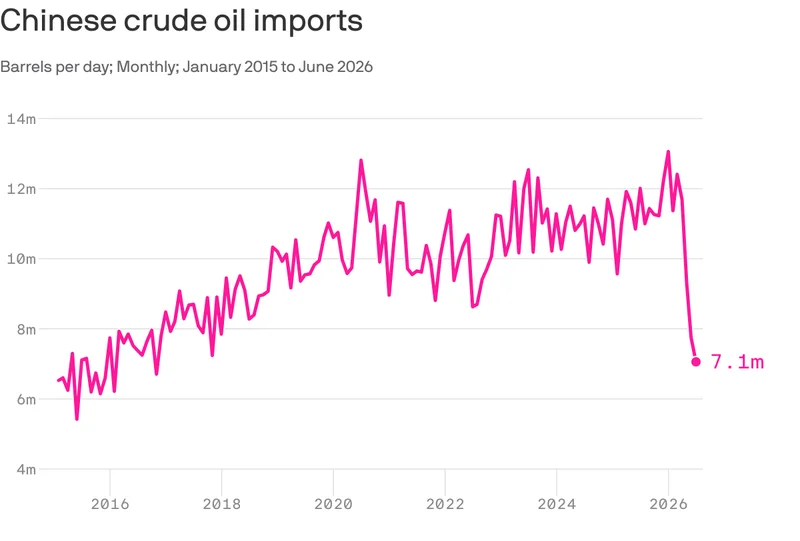
Data: China's General Administration of Customs; Chart: Matt Phillips/AxiosThe Iran war has revealed China's enormous power over global oil prices, thanks to its position as the world's largest buyer. Why it matters: China's reaction to the oil shock — by substantially withdrawing from buying on world markets — helped prevent the worst of the price spikes that experts thought would follow from the effective closure of the Strait of Hormuz.Catch up quick: After the U.S. and Israel launched the war on Feb. 28, Chinese crude oil imports dove as prices spiked. At first, the decline in imports didn't surprise analysts. (China has long been known as a price-sensitive buyer.) Yes, but: Few expected that China could maintain this low level of oil buying without deeply damaging its domestic economy. But as the war approaches its sixth month, China has done just that.By the numbers: Through June, Chinese oil imports remain down over 40% from the previous year. "I guess the surprise has been just how low Chinese demand can go," said Michal Meidan, head of China energy research at the Oxford Institute for Energy Studies. "But it's been low without impairing the well-functioning of the economy." How it works: Chinese policymakers have pulled several levers to mitigate the impact of the decline in oil imports, Goldman Sachs analysts say. Chinese officials tapped into domestic reserves of coal, oil and natural gas for supplies. They boosted usage of coal and renewables, where it is less reliant on imports. And China took advantage of its giant fleet of electric vehicles, reflected by the fact that "despite much lower gasoline consumption, traffic congestion remained relatively stable," Goldman analysts say.Big picture: Broadly speaking, analysts say that China has taken such steps almost exclusively for the benefit of its domestic economy. But the benefits of those decisions — basically lower global oil prices — have been broadly shared. What they're saying: "China has been a key player in helping the global economy navigate this crisis," Reid I'Anson, a Houston-based economist at global commodities and shipping consulting firm Kpler, tells Axios."They are the major swing demand setter in the global oil market, for sure," says Jane Nakano, senior fellow in the Energy Security and Climate Change Program at the Center for Strategic and International Studies."China has drastically reduced its net imports of fossil fuels, effectively acting as a shock absorber for global energy prices through reduced demand," Goldman Sachs analysts wrote in a report last week. Caveat: China isn't the only reason that the world economy was able to deal with the energy supply disruptions of the war.Rich nations released large amounts of oil from their own strategic reserves.And U.S. energy companies drastically boosted exports to meet global demand.Connect the dots: Still, China's energy policy — and its ability to keep global prices in check — could be a valuable asset, as it positions itself as a source of stability, often in contrast to current U.S. leadership."China is doing this for China, fundamentally," said Ruby Osman, a senior policy advisor on China at the Tony Blair Institute for Global Change. "But obviously it's not unhelpful for China that it has become a global public good."What we're watching: Any hints that Chinese buyers are flocking back to global markets. Early indications suggest a bit of a bounce in July purchases.
Iran war shows China role in setting the price of oil