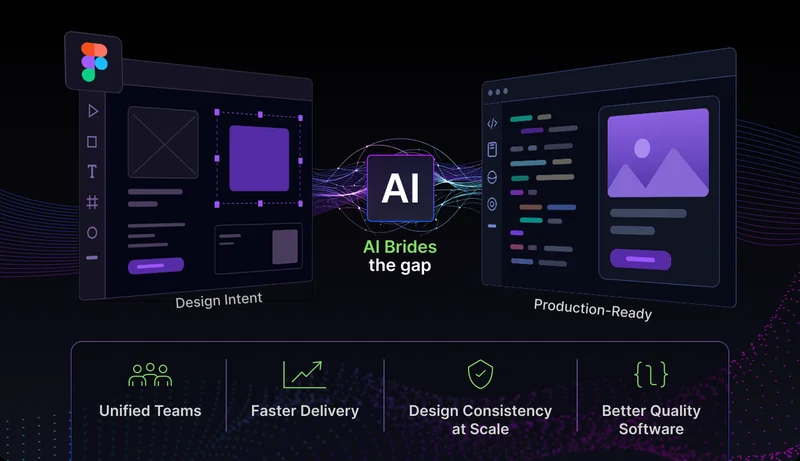
The wall between design and development is well-known, well-documented, but where is this going?
For decades, enterprise software teams have treated design and development as separate phases connected by a design-to-development handoff. AI is beginning to collapse that distinction.
Most designers face this on a daily basis. You open the production build, pull up the Figma file next to it, and start comparing. An interaction that took two weeks to get right in the prototype got quietly swapped for something simpler somewhere between the handoff and the sprint review. The developer would tell you the build matches the ticket, and they'd be right. The designer would tell you it doesn't match the design, and they'd also be right.
Design-to-development handoff is the process of translating interface designs into production software. Traditionally this involves designers creating interfaces in tools like Figma before engineers implement them in code. Differences between design intent and shipped software have made handoff one of the longest-standing sources of friction in enterprise software development.
Why Design and Development Became Organizational Silos
As products grew, companies hired designers who focused on how something felt and developers who focused on how it worked. Over time, the two groups didn't just develop different skills. They developed different ideas about what success looked like.
UX designers are trained, at something close to a professional ethic, to put the user first. "Advocate for the user" is more than just a job description. Developers are trained to care about the system: what it can carry, how it holds up under load, what happens six months from now when someone else has to maintain it. Both are legitimate. Both also pull in different directions.
The org structure reinforces this. Design reports to a product or marketing leader; development reports to a technology leader. They operate on different planning cycles and get evaluated by people who care about their own team's output but rarely about both simultaneously.
Designers get recognized for the quality of the work they produce on the canvas. Developers get recognized for shipping on time and keeping things stable. When these conflict, and they do, each side rationally protects its own measure of success. The gap between what was designed and what shipped isn't anyone's personal failure.It's the predictable output of a system that never assigned anyone the job of holding both sides accountable for the same thing.
Why Design Teams Own UX While Engineering Owns Delivery.
Erica Rider, a UX leader who spent years working on PayPal's internal developer tools, made a popular observation: designers carry full accountability for the user experience while holding almost no control over what ships, and engineers hold full control while carrying almost no accountability for whether what ships matches the intent.
This is a classic accountability-versus-control problem in product development.
The less comfortable reading is that accountability without constraint breeds its own problem. If you're fully responsible for the user experience but nobody requires you to understand what it costs to build, you can spend that accountability on work that was never going to ship as drawn. Figma has no sprint velocity. The canvas doesn't tell you when an animation requires rebuilding a component from scratch. A three-week development task looks identical to a two-day one when it's a box on a screen.
Designers who haven't been close to production code develop a specific blind spot here, and large organizations make it worse. The layers of process between the two teams mean that the moment where someone says "this would require us to scrap the entire table component" rarely happens in a room the designer is in.
The silo story stays popular because it casts development as the place where good ideas go to die. The less flattering version, where design contributes to its own irrelevance by staying insulated from consequence, doesn't get told as often.
How Design Systems, Dev Mode, and AI Reduce Design-to-Code Friction.
Whole product categories got built around the dysfunction. Zeplin, Abstract, InVision, Avocode: tools whose entire reason for existing was that two teams working on the same product couldn't coordinate properly. The market validated the problem by paying for the band-aid rather than fixing the wound.
Better tools helped at the edges. Figma's Dev Mode gave engineers direct access to specs without a separate handoff file. Design tokens are reusable variables that synchronize colors, typography, spacing, and component styling between design tools and production code, removing an entire category of discrepancy. IBM's Carbon design system, used across hundreds of internal products, showed the measurable result: fewer gaps between what was designed and what got built.
What these fixes have in common is worth noticing. Each one shortens the distance between the person making a design decision and the person paying the cost of it. Not better communication, not more documentation. Shorter distance between intent and consequence.
The specialized design developer role works for the same reason. Someone who holds a design critique in the morning and writes production code in the afternoon can't design fiction because they'll have to build it themselves. Linear gets cited constantly as the benchmark here, and rightly so. Their product doesn't look designed and then built. It doesn't look like two different teams were involved. Because fundamentally, they weren't.
How AI Is Changing Design-to-Development Workflows
Modern AI design-to-code tools can now convert natural-language prompts or Figma designs into functional user interfaces. Non-designers are building screens that work. The thing that used to require a designer to draw and a developer to build can now be approximated by someone who is neither.
What this actually does is sharpen a question the industry has avoided: what is design expertise for, exactly? The answer, following the logic above, is judgment about constraints. Understanding which user need is worth the implementation cost. Knowing when a simpler solution serves someone better than an elegant one. These are precisely the instincts the silo prevented designers from developing, because it kept them insulated from consequence.
Several AI app development platforms now embed design systems directly into the software delivery pipeline. Rather than treating design as a separate phase, these platforms integrate app design architecture, design tokens, and component libraries directly into application generation. One example is WaveMaker. WaveMaker's Studio environment lets developers move between generating, reviewing, and editing what gets built at each step using AI agents, with design tokens and component systems embedded as starting constraints rather than external references.
Design decisions don't have to survive a handoff if they're already built into how the product gets made.
The Future of Design and Development in the AI Era
None of this dissolves the org chart problem. Design and development will keep reporting to different leaders, measured on different things, for as long as companies find that easier than the alternative. But the AI pressure is making the cost of the silo more visible than a decade of better tooling ever managed to. When a product manager can get something functional on screen in twenty minutes, keeping design expertise insulated from consequence stops being a defensible position. It becomes a choice, with a price tag that's getting harder to ignore.
That's a harder change than deploying a better tool.
The teams that have done the work tend to build things that feel finished in a way most software doesn't. You notice it in the details nobody had to fight for: the interaction that behaves the way you expected, the error message that reads like a person wrote it, the edge case that was clearly thought about. That quality doesn't come from better tooling or a cleaner handoff process. It comes from designers and engineers who were close enough to each other's reality to be solving the same problem at the same time. Most teams aren't. The gap in the final product is usually just the gap between the teams made visible.
Frequently Asked Questions
1. How is AI used in app development?
AI is increasingly used throughout the application development lifecycle—not just for code generation. Modern AI app development platforms can help generate user interfaces, convert Figma designs into code, create application components, assist with testing, generate documentation, and automate repetitive development tasks. More advanced platforms also combine AI with design systems, component libraries, and architectural guardrails so that design intent is preserved throughout development instead of being lost during handoffs.
2. What features should I look for in an AI-powered app development platform?
The best AI app development platforms do more than generate code from prompts. Enterprise teams should look for capabilities such as:
- Design-to-code support from Figma or similar tools
- Built-in design systems and design tokens
- Reusable component libraries
- Human-in-the-loop review and editing
- Architecture guardrails
- Open standards and code ownership
- SDLC and CI/CD integration
- Collaboration features for designers and developers
These capabilities help reduce design-to-development friction while producing applications that teams can maintain over time.
3. How is app development conducted using AI and natural language?
Many modern AI development platforms allow teams to describe an application using natural language prompts or existing design files. AI interprets the intent, generates application structure, creates user interfaces, and assists developers with implementation. Rather than replacing developers, AI increasingly acts as a collaborative assistant that accelerates development while keeping humans responsible for design decisions, architecture, and production quality.