WASHINGTON — Northrop Grumman is taking another charge related to the solid rocket boosters it provides for the Vulcan Centaur rocket and suggested updated motors might not be ready until the end of the year.
The company said in the release of its second-quarter earnings July 21 that it took a $91 million unfavorable adjustment to its earnings at completion on its GEM 63XL motor program. Northrop announced a $71 million charge in the first quarter for the same program.
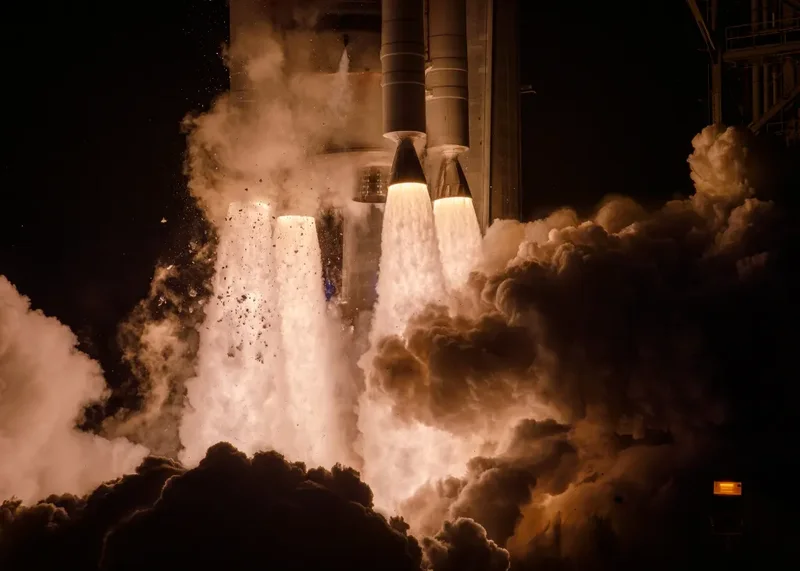
That motor is used in the solid rocket boosters on United Launch Alliance’s Vulcan Centaur rocket. On the most recent Vulcan launch in February, a booster suffered a “significant performance anomaly,” although the rocket was still able to place its payload into its planned orbit.
Neither Northrop nor ULA has disclosed details about the cause of the anomaly. In an earnings call, Kathy Warden, president and chief executive of Northrop Grumman, said the company had taken unspecified “corrective actions” that included new components for the motor.
“We progressed on the root cause investigation on the GEM 63XL program, and we are implementing corrective actions to address the anomaly we experienced on a launch in the first quarter,” she said. “These include a component redesign, which has now been proven in a successful static-fire test.”
However, she indicated that the redesigned motors may not be delivered for several months. “We expect to begin delivering the redesigned motors by the end of the year,” she said.
Vulcan has not launched since the anomaly on the February launch, and ULA has not disclosed when the vehicle will return to flight. U.S. Space Force officials said in April the service was considering resuming Vulcan launches in a configuration that did not use solid rocket boosters but have not announced specific plans to do so.
Despite the problems with the GEM 63XL, Northrop executives were optimistic that the program’s financial performance would improve. John Greene, the company’s chief financial officer, said the company expected sales to increase in its space division in the second half of the year. “This growth is primarily driven by higher volumes on national security space programs, new awards and improved performance on GEM 63XL,” he said.
HALO update
The company also reported lower performance in the second quarter on the Habitation and Logistics Outpost, or HALO, program. That is a module Northrop had been developing for the lunar Gateway.
Earlier this year, NASA announced it would not pursue the Gateway, focusing instead on a lunar base. That has put the future of HALO into question, even as Northrop deals with a corrosion issue with the module.
“HALO can still be repurposed for any mission, and it’s the most mature technology to support a deep space or lunar habitat,” Northrop said in April, but neither the company nor NASA has elaborated on those potential alternative uses.
“We are working with NASA to take the technology that we were developing under the HALO program and still have that contribute to their future Gateway plans,” Warden said during the earnings call.
“We are in the process of restructuring the contract to do that,” she continued. “It will reduce revenue this year as we outlined in our filings, but it will extend it over a longer period of time as we work deliverables into the new NASA plan.”