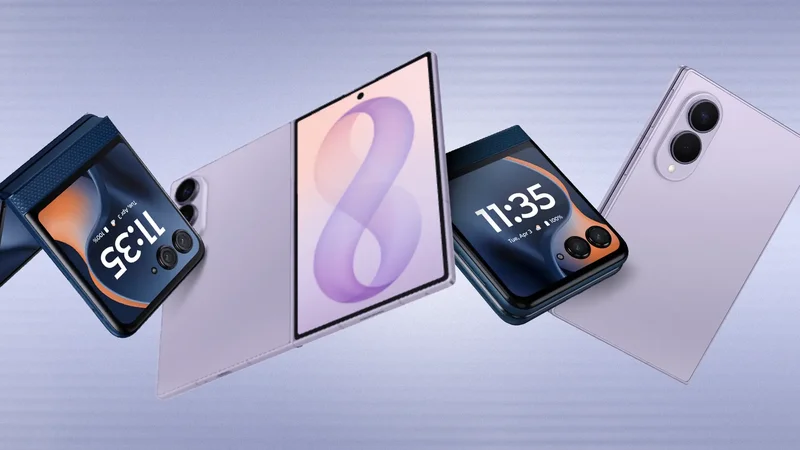
What started as a gimmicky nostalgia trip has turned into the most contentious style for modern smartphones. I'm talking about foldables.
Whether , foldable Android phones have dramatically increased in quality over the past few years.
2026 is the first year since Motorola relaunched its Razr brand in 2019 that I've seriously thought about buying a foldable phone.
But while 2026 is shaping up to be the best year for foldables, I still won't buy one.
Motorola and Samsung have mastered the flip-style and book-style foldable
After years of waiting, foldables are finally good
I've been a regular Google Pixel phone user since the Pixel 6, but the Motorola Razr 2025 is the one device I would trade in my Pixel 11 Pro for.
After Motorola's initial foldables offered more compromises than features, I dismissed the brand and watched Samsung's Z Flip series with an eagle eye.
However, over successive years, Samsung failed to turn the Z Flip into a must-buy flip phone. I began to think the technology was a dud, and then the Razr 2025 came along.
The . Motorola understood what flip-phone buyers wanted and built a phone that offered an exceptional experience.
Best of all, it was only $700 at launch. Over a year later, I can find it brand-new for under $500. A bargain.
But what about foldables? I'd dismissed them for years as luxuries that nobody actually needed. But apparently, this was because manufacturers had been building their book-style foldables wrong.
Samsung wasn't the first to adopt the wider aspect ratio for its foldables, but it's the most accessible device of this style in the US.
AP's Andy Boxall and marveled that by simply changing the aspect ratio of the display, Samsung produced a killer device.
Yes, it's still eye-wateringly expensive. $1,900 is an absurd amount of money for a smartphone.
But let's put aside the price for the moment and talk about why the Z Fold 8 and Razr 2025 have made 2026 the year of the foldable.
The foldable user experience has peaked
Where do we go from here?
In our Motorola Razr 2025 review, former AP writer Stephen Radochia stated that "Motorola understood the assignment, realizing that we don't buy flip phones for superior specs but for an exceptional experience — and a healthy dose of flair."
AP's Andy Boxall similarly said about the Z Fold 8: "It's hard to describe why the Galaxy Z Fold 8 has worked so well for me … But it does work, and to the point where I believe it will change people's minds about whether a larger foldable will work for them or not."
The theme across these two devices is that Motorola and Samsung have created devices that are not great because they have the best hardware, cameras, software, or displays.
The Z Fold 8 and Razr 2025 won our hearts because they provide the best experience.
Analyzing the performance, cameras, and software on Android phones is becoming increasingly irrelevant. For most people, everything is good enough. You're choosing the flavor of ice cream, but at the end of the day, you're still getting ice cream.
Still, there are phones that we don't recommend buying, but the Android landscape has stabilized into a lineup of decent phones.
Unfortunately, it's boring.
I consider my phone a tool. It helps me do things like call my parents and listen to Dune! The Musical ten times in a row without a break.
But when I'm using the same tool for hours a day, I want using it to be the best experience possible.
The Z Fold 8 and Razr 2025 are tools. They're also great to use. Motorola made the cover screen fun on a flip-style phone, while Samsung turned the book-style foldable into something easier and fun to hold open than closed.
Foldable phones rely on a gimmick. Nobody actually needs a folding phone. But these manufacturers have turned a silly trick into something that you'll enjoy using every day.
So why won't I buy one?
There's always a compromise to be made
The problem with the Z Fold 8 and Razr 2025 is price and software support, respectively.
I can make use of various discount codes to knock a few hundred pounds off the Z Fold 8's retail price, but it's still expensive. I refuse to spend quadruple digits on a phone out of principle, and I'm reluctant to spend over $800.
But I know the pattern, and next year (or perhaps even at the end of this one) I can trade in my Pixel 10 Pro and make use of post-release discounts for the Z Fold 8 to save even more.
The Razr 2025 is an affordable flip phone and therefore makes compromises. The biggest one right now is that it only has one year of software support left. Pitiful.
The , but I'll receive more OS and security updates. But it's just too expensive, at $800. I'll need to wait for sales.
The year after launch is always the best time to buy a phone
So for now, I'll be sticking with my trusty . But when the post-launch discounts kick in, I'll have to make a tough decision. Affordable fun, or expensive brilliance?