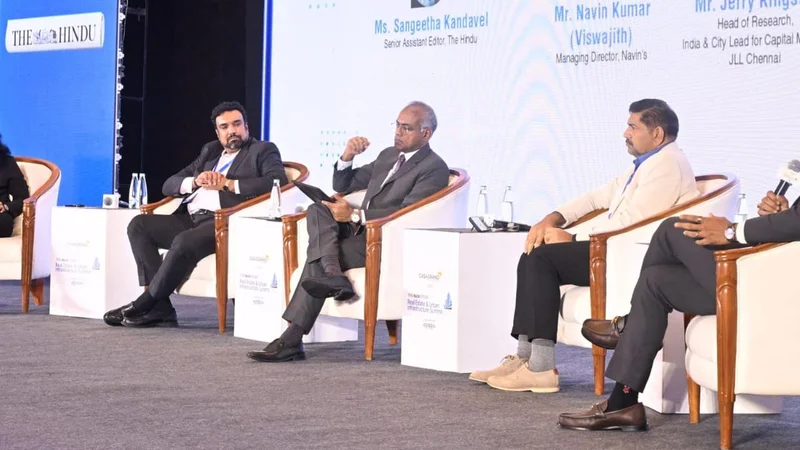
Infrastructure growth in an area usually follows real estate development, but it should be the other way around, with development following infrastructure, said Habib W.S., Managing Director of RWD, on Thursday (July 30, 2026) at a panel discussion titled ‘Beyond City Limits: Why Peripheral Chennai is Becoming the New Investment Destination’ at The Hindu Real Estate and Urban Infrastructure Summit 2026 in Chennai.
Speaking at the session, moderated by Sangeetha Kandavel, Senior Assistant Editor, The Hindu, Mr. Habib said that approach roads, water availability, drainage, and electricity remain key challenges in peripheral areas. “I see the future as integrated development,” he said.
Gautam Agarwal, Chief Operating Officer, Casagrand, said that cities and regions with greater employment opportunities tend to grow faster. In Hyderabad, infrastructure was planned and developed before the real estate sector expanded. He said integrated townships would be self-sustaining, adding that Chennai’s next phase of growth would be more seamless if it had more integrated townships.
In the last six to seven years, end-user purchases have been on the rise, and for most of them, it is their first home. Many of them are moving from the city to the peripheral areas because they want to live closer to their workplace. In the south of Chennai, the IT and ITES sectors are dominant; in the west, the automobile and manufacturing sectors dominate; and in the north, there are many warehouses, he said.
Head of Research, India, and City Lead for Capital Markets, JLL Chennai, Jerry Kingsley, said that 65% of all residential project launches in Chennai in the last quarter were in the outskirts of the city. The city is growing towards the periphery, and these areas will be the engines of growth. The southwest, south, west, and north are seeing growth because of the infrastructure activities taking place in these areas.
Cities such as Singapore have seen growth led by infrastructure and a master plan. Shanghai has seen the development of industrial cities. When infrastructure is retrofitted after an area has grown, the cost is higher. “Transit-oriented development is important as we prepare for the next master plan,” he said. The availability of quality education and healthcare providers along industrial corridors is important. When zones are developed, the focus should be on holistic growth with supporting infrastructure, as livability is important for all stakeholders, he added.
According to Navin Kumar, Managing Director of Navin’s, while the average age of property buyers in the peripheral areas of Chennai is 35, irrespective of the age group of the property buyer, lifestyle and amenities are among the factors that drive decisions to move to the peripheral areas of the city. Developers are experimenting with multiple designs and features to meet current lifestyle trends. The location of the workplace and the availability of educational infrastructure for children are reasons for people moving to the peripheries. The government should focus on development and infrastructure rather than policing. It should provide infrastructure well ahead of time, and Master Plans should be implemented properly. It should improve the quality of last-mile connectivity, he said.
The Real Estate and Infrastructure Summit 2026 is presented by Casagrand in association with Adissia Developers. The event is supported by – Associate Partners: Navin’s and Mindspace REIT; Banking Partner: State Bank of India; Insurance Partner: United India Insurance; Academic Partner: Saveetha College of Architecture & Design; Industry Partner: CREDAI Chennai; Television Partner: Puthiya Thalaimurai; and Digital News Partner: The Federal.
Published - July 30, 2026 06:52 pm IST