Israel’s Defense Ministry is reportedly exploring the acquisition of cheap, long-range cruise missiles in large quantities as part of the country’s bid to reduce its reliance on American armaments, particularly advanced combat aircraft. Such a move could realize a former Israeli defense minister’s proposal to develop a separate missile corps almost ten years ago to reduce Israel’s reliance on its powerful and technologically advanced air force and diversify its strike capabilities.
Israel’s Haaretz newspaper reported on July 23 that the ministry’s Directorate of Defense Research and Development is conducting a preliminary review “exploring the acquisition of long-range cruise missiles that would be cheaper than those offered by the major arms manufacturers and that could be produced quickly and in large quantities.”
“Such an investment could mark a shift in Israeli strategic thinking, to allow Israel to rely on cruise missiles rather than American-made fighter jets in a future war,” the report added.
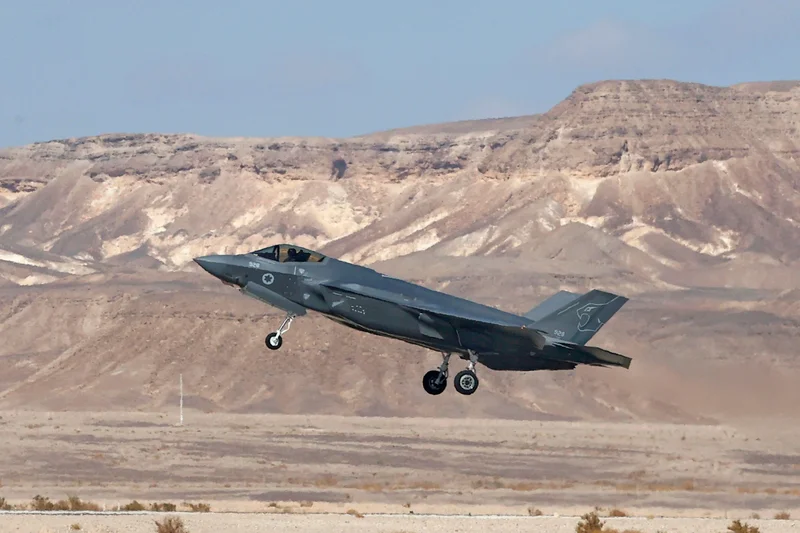
Israeli Prime Minister Benjamin Netanyahu has declared that Israel needs to prepare to become a “super Sparta” capable of independently developing all of the armaments it requires. He has also pledged to gradually bring a complete end to U.S. military aid within the next decade. Furthermore, Axios reported on Wednesday that Netanyahu has even instructed the Israeli defense sector to begin work on a modern homegrown fighter jet within the same time span. The move aims to guarantee that Israel maintains its advanced airpower in the event that the U.S. stops supplying it with modern fighters like the F-35 Lightning II stealth strike fighter.
Israel will likely field new cruise missiles in considerable quantities before any homegrown fighter jet rolls off the assembly line in even a prototype form. Israel already operates more than 40 F-35s with another 60 on order. It has opposed other regional states acquiring the fifth-generation fighter. In response to Netanyahu’s latest opposition to a potential Turkish F-35 sale, President Trump bluntly told reporters that, “Nobody tells me what we should be selling.”
Israel’s rival Turkey, which was banned from buying F-35s over its purchase of Russian S-400 missiles, is already developing a homegrown stealth jet, the TF Kaan, but remains dependent on U.S.-built General Electric F110 engines for the time being. Any Israeli project to build a modern fighter would mark the first attempt it’s made since the fourth-generation Lavi it was developing in the 1980s but ultimately canceled. Since then, it has remained reliant on the United States for fighter jets and operates an all-American fleet. Since 1980, it has acquired no fewer than 362 F-16s alone of varying models and still actively operates more than 200. At present, there are renewed calls in Israel to develop a Lavi 2.0 to reduce this decades-long dependency in case it becomes unreliable.
In the meantime, the preliminary review to acquire a new arsenal of long-range cruise missiles suggests Israel may be exploring a capability advocated by Avigdor Lieberman when he was Israel’s defense minister in 2016 to 2018. In August 2018, Lieberman proposed a missile corps for Israel separate from the air force to diversify its long-range strike capabilities. The surface-to-surface arsenal would enable Israel to deal with threats from Hezbollah in Lebanon, which had developed an enormous surface-to-surface arsenal at the time, and Assad’s Syria without relying entirely on the air force. He stressed that Israel needed to have the capability to strike enemy targets “with intensity and precision” and without fighter jets if necessary.
“We absolutely must have an alternative to the air force,” Lieberman told Al-Monitor at the time. “We can’t afford to put all our eggs into one basket, no matter how sophisticated that basket may be.”
In the eight years since, Israel did not develop an independent missile corps. It has introduced a series of new air-launched ballistic missiles, but these are exclusively launched from Israeli fighter jets. Israel used these ALBMs in Syria beginning in the late 2010s, and more recently against Iran. In one incident in September 2025, it even hit Qatar with ALBMs launched from jets flying over the Red Sea in a failed attempt to assassinate the Hamas political leadership there. While these ALBMs doubtlessly enhanced Israel’s capability to conduct deep strikes in even contested airspace, it was far from a realization of what Lieberman had in mind for his missile corps.
The Haaretz report points out that Israel has already developed and fielded a series of cruise missiles with both air- and ground-launched variants. Nevertheless, it noted that many of these have relatively short ranges of around 200 miles, wholly insufficient for deterring or striking distant adversaries like Iran or the Houthis in Yemen. By comparison, the well-known U.S. BGM-109 Tomahawk cruise missile can accurately strike a target 1,000 miles away with a 1,000-pound warhead. The U.S. fired a whopping 1,000 of these at Iran during Operation Epic Fury earlier this year. Israel requested a Tomahawk acquisition in 2000, but Washington declined. It unveiled a ground-launched version of the Delilah cruise missile shortly thereafter, but that had a comparably paltry 186-mile range.
Israel launched its first large-scale air campaign against Iran in June 2025, the 12-day war. At the time, it seized the opportunity presented by the collapse of the Assad regime in December 2024, which enabled it to destroy Syria’s remaining air defenses and military arsenal, completely clearing Syrian skies. Iraq also lacks strategic air defenses, although it is trying to redress that with an acquisition of medium-range South Korean systems. In other words, that window of opportunity Israel had in the 12-day war and in the joint campaign with the United States earlier this year is unlikely to remain open indefinitely.
Consequently, in certain circumstances, expending a few cost-effective long-range surface-to-surface cruise missiles in lieu of dispatching a fighter strike package to distant targets in either Iran or Yemen might make more sense in the future. After all, it would eliminate any risk of Israel losing an expensive combat aircraft and having the pilot fall into enemy captivity, as almost happened to that American F-15E Strike Eagle pilot and his weapons systems officer who ejected over Iran in April.
With the political and strategic climate radically different than it was less than 10 years ago, Lieberman may finally get something resembling his missile corps proposal somewhat late rather than never.