Everyone believes their generation is uniquely maligned; invariably, so do I. The formative years of my generation—I’m at the older end of the dreaded Gen Z—vanished within the global despair and uncertainty wrought by COVID-19. In lieu of the presence of other human beings, many of us retreated into our phone screens and never left. The pandemic irreparably altered our sense of the future. Many are concerned about the blankness in our eyes. We don't touch grass; instead, we bed rot. We have taken refuge in therapy speak, are increasingly skeptical of monogamy and our parents' relationships, and are incredibly, remarkably lonely. The New Yorker buzzily asked in 2025: “Are Young People Having Enough Sex?” From Vice, another headline: “Gen Z Isn't Having Sex. They're Doing This Instead.” The “this” we are doing is having “a solid night of sleep.” We may be sleeping—just not with each other.
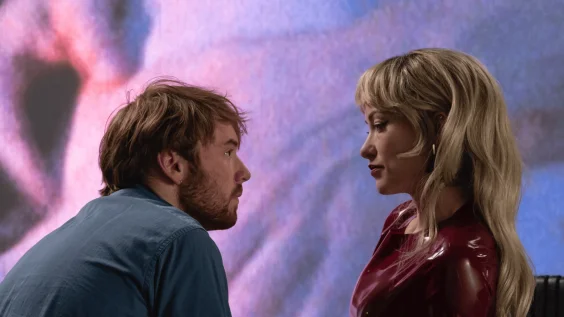
Enter the 62-year-old director Gregg Araki, who is back with a message for my generation after a 12-year absence from feature filmmaking. His latest movie I Want Your Sex is raucous, jubilant, and unafraid to name the very “chickenshit”—the film's words, not mine—quirks of today’s young people. Elliot (Cooper Hoffman) is 23 and clueless about his direction in life. On his hands read tattoos that say “Yes?” and “No?” Accordingly, everything the young Elliot does is punctuated with a question mark. Experiences in the world present themselves as either “cool” or “embarrassing” to him. He begins working for Erika Tracy (Olivia Wilde), an artist whose challenging work is drawn from her own sex life. Erika is indisputably “cool” in Elliot’s estimation—after all, didn’t she have sex with Vincent Gallo at the night of The Brown Bunny premiere? Most of all, we sense that Erika has everything Elliot lacks: drive, identity, a career, a healthy libido.
Araki's films are landscapes of sex and destruction scored to Slowdive, the Cocteau Twins, and other artists who embody the angst of his young characters. Passion, intensity, and alienation are the fundamental feelings of Araki's films, many of which—notably, his Teen Apocalypse trilogy—are about the frictions young people encounter against the injustices of their heteronormative, capitalist milieu. Sex, violence, fantasy, and lawlessness happen to be the few tools a young person has in their arsenal to feel seen in their Totally F*ed Up world. Still, Araki's work has a tender lining, even under all the bloodshed and existential melancholia. His characters, despairing and angry at the normalized cruelty of their world, search for others who feel as miserable and unseen as they do. Love happens in every way possible in his films: unrequited yearning, group sex, fantasies of alien abduction. The young people of his films just want to find someone to be with as the world ends.
As serious as that sounds, it’s also often very funny. Nowhere (1997) is a gay, bloody, and absolutely riotous version of a John Hughes movie featuring characters with names like “Egg” and “Handjob.” His 2007 film Smiley Face, which stars Anna Faris as a Communist Manifesto-toting pothead whose weed dealer may or may not steal her mattress, was a more forward attempt at comedy in earnest, with hardly any sex and more screwball comedy. Smiley Face is silly and funny with a punk heart, which is actually also how I might describe I Want Your Sex. Even with the BDSM, Araki's latest film is actually far more vanilla than his earlier works. (That's not saying much, though.) Araki, working with a script co-written by sex writer Karley Sciortino, is more didactic than ever before. He is speaking directly to young people. This film isn't a lecture, necessarily, but a gentle, compassionate, almost paternal urge to action. Yes, Gregg Araki wants us to laugh with I Want Your Sex. More importantly, he wants to encourage younger people to be vulnerable, to risk it all for the noble cause of connection.
For all his flaws and early ambivalence, Elliot is able to take up this challenge. In the absence of a sex life with his girlfriend, the studious and frigid med student Minerva (Charli XCX), Elliot develops a vivid one with his boss. His best friend and roommate, Apple (Chase Sui Wonders), a fellow Zoomer, is understandably envious of Elliot's newfound reason for existence. “My life is so beige,” she complains, as Elliot recounts his sex life to her. Apple and Elliot could not appear more dissimilar: There is Elliot, having a revelatory experience with Erika, and Apple, who expresses persistent unhappiness in her sex life and beyond. The film's running joke is that she might just not have considered lesbianism yet.
I found myself envious of Elliot, too, because Olivia Wilde is exhilarating in this role. This summer has been industrious for the actress and filmmaker: I Want Your Sex premieres the same month as The Invite, in which she directed and starred. Both films are concerned with what sex can tell us about ourselves. In The Invite, the sexless marriage of Wilde's character reflects deeper strife; in I Want Your Sex, Erika Tracy's overt, audacious sexuality obfuscates her own emotional invulnerability.
In recent interviews for The Invite, Wilde has been open about the double standards she has encountered as a mother, specifically the expectation that motherhood required her to renounce her own sexuality. I suspect that feeling fueled some of the effortless authority in her performance as Erika Tracy. Hoffman impressively holds his own against her, in a different way: all sincerity and naivety. I adored Hoffman in Licorice Pizza, and now believe what makes him special is that he is naturally endearing. The way Araki films his actors, often in close-ups and in dramatic full face shots that spotlight their expressions, requires an earnestness that Hoffman can muster so well. Araki's roster of loyal actors is on display here, too: Margaret Cho, who appeared in The Doom Generation, is here as a police officer trying to get the truth from Elliot; Roxane Mesquida from Kaboom and Now Apocalypse is a French friend of Erika who chides Elliot for his naive eroticism; James Duval, a beloved Araki regular, makes a surprise cameo.
I Want Your Sex is colorful and excessive. Wilde's outfits are stupidly tight and obnoxiously gaudy. Even the sound effects, which telegraph the various kinds of wetness in this film, are absurdly exaggerated. In typical Araki fashion, everything—energy, action, tone, affect, color—is heightened. The apartment Elliot and Apple share has the proportions and vibrancy of a children's television show. When Erika first invites Elliot over to her home—an elegant, sculptural, very grown-up mansion—we view Erika through young Elliot's eyes. Her chest is literally rendered as a cartoon. As Erika speaks, Elliot imagines her unclothed, her breasts—now animated—bobbing outrageously. Does this feel ridiculous? Yes. Do all the sex scenes of Elliot and Erika, engaged in absurd feats of physical acrobatics and costumery, feel ridiculous? Yes, but the film would neither succeed as a comedy nor an experiment in daring without a strong dose of ridiculousness. This is a film that truly believes in the ethical value of fun. Some scenes in the film peter out or don't seem to find momentum. The emphasis of the film, though, is not continuity or coherence—it's ecstasy. As I watched, I delighted in the fact that even these actors appeared to be having fun in their roles.
I Want Your Sex makes an optimistic case to its viewers, Gen Z and otherwise: Connection is real, so long as you feel it, and other people can change you, so long as you say yes. Over the course of the film, Elliot allows himself to be destroyed and transformed by his experience with Erika. His old life incinerated in the fire of their relationship, Elliot finally begins anew, having grown the integrity to not only confront Erika for her selfishness and hypocrisy, but to also finally create the life he truly wants for himself. The credits scene of I Want Your Sex plays a blooper reel to the poppy tune of Jessie Ware's “Free Yourself,” whose lyrics begin: “Free yourself/Keep on moving up that mountaintop.” I can imagine Araki telling us just the same: Live close to your desires. Have fun. Take a chance. You, like Elliot, may just surprise yourself.