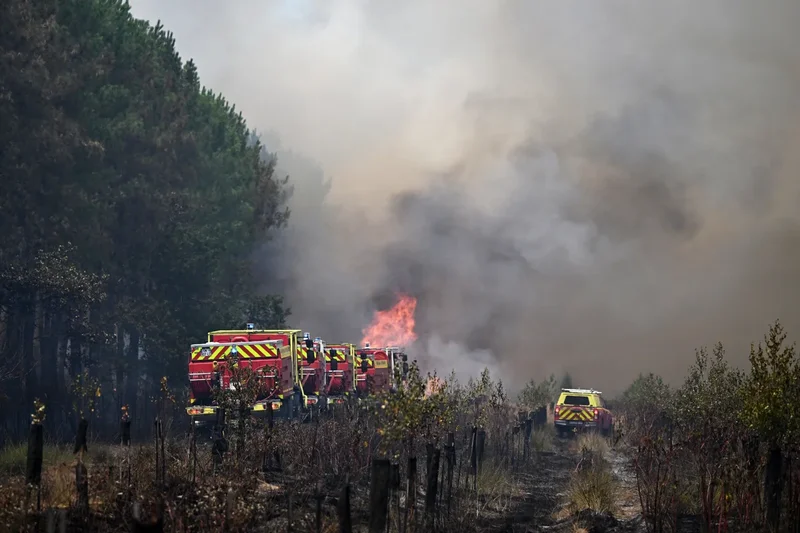
Greece was struck by devastating wildfires on Thursday, becoming the latest European country to suffer from a wave of uncontrollable fires that have forced the evacuation of hundreds of thousands of people.
Villages have been evacuated on the Greek island of Paros as firefighters raced to extinguish a large wildfire raging for a second day, while three firefighters were killed while battling fires on Crete and mainland Greece.
Europe is reeling after one of its worst wildfire seasons on record, and while Greece has so far escaped the worst of the flames that have devastated France and Spain, prime minister Kyriakos Mitsotakis warned there are “difficult days ahead”.
The area of land burned in France is already 40 per cent larger than the previous record year. President Emmanuel Macron has described this season’s wildfires as the worst disaster to face the country since the Second World War.
In Spain, fires in eastern Castellon have burnt more than 10,000 hectares as weather conditions continue to trigger several flare-ups. At least six regions in the country have been placed on orange alert, the second-highest level in the country's weather alert system.
The country has brought one blaze under control but facing new threats as intense heat, dry vegetation and powerful winds kept much of southern Europe on alert.
Spain has downgraded the emergency level for a major fire on the border between Madrid and Castilla y Leon, but warned the danger had not passed as at least 10 other blazes caused concern across the country.
In Bordeaux, where The Independent was on the ground, French firefighters have kept a major blaze west of stable - but officials warned it was far from over yet.
Lecornu promised that more than 1.5 million face masks would be provided as even areas unaffected by the worst of the blaze saw air quality deteriorate and smoke spread.
Below we look at the areas affected and evacuated as a result of the wildfires.
Greece
In Crete, more than 220 firefighters have been deployed, as well as 11 specialised forest units on foot and 53 fire engines, along with volunteers to tackle the inferno - made worse by gale-force winds, droughts and heat.
Two firefighters died after becoming trapped between two fire fronts in the region of Rethymno on Wednesday, and a third firefighter was found unconscious near the southern Peloponnese port town of Gytheio and was later pronounced dead.
In Crete, two firefighters died after becoming trapped between two fire fronts in the region of Rethymno on Wednesday.
According to local authorities in the Greek island of Paros, around 10 villages have been evacuated on the popular tourist island since the blaze erupted at midday on Tuesday.
The fire broke in the Kampi area, near Paros' landfill site, initially burning rubbish and vegetation. It is not clear how many residents and visitors have been forced to leave their homes.
The blaze has since spread to form multiple fronts on the southern and southeastern side of the island.
"We barely made it... we were running and the fire was behind us, chasing us," said Lia Galata, a Greek seasonal tourism worker who found shelter in an indoor gym and had to be evacuated by boat as a blaze tore through the hills above a resort on Crete late Wednesday.
"I didn't know if I was going to die from the fire or the ash, or from drowning in the sea. It was insane."
**France **
The French fires tore through pine forests and forced about 220,000 residents and holidaymakers to evacuate, although some 60,000 have been allowed to return.
Thousands of businesses which briefly suspended operations are gradually reopening, while a key motorway would fully reopen on Thursday after days of partial closures, officials said.
Conditions were expected to ease around Bordeaux on Thursday, with the possibility of thunderstorms, greater humidity and temperatures below recent peaks.
But an extreme heat warning remained in force in Gironde, the department of which Bordeaux is the main city.
Meteo France warned in its latest bulletin on Wednesday afternoon that the highest danger of wildfires was now centred on southeastern France and the Mediterranean arc.
Wildfires in France have now burned more land than in any year since 2006.
In the past few days, the entirety of the Cap-Ferret peninsula was cleared as the wildfires spread throughout the Gironde region, burning in Le Porge and Saumos.
French officials told Sky News on Sunday that they were considering a total evacuation of the city of Bordeaux – the sixth largest city in the country.
Local prefect Sophie Broca described the fast-spreading blaze throughout Gironde as an “XXL fire”, with the French army drafted in to help with the crisis as the inferno showed no signs of slowing down.
In Lanton, also in the southwestern area of France ravaged by wildfires, volunteers carrying buckets of water have been trying to help protect their village.
"It’s hard, really, very hard, because we don’t have many resources. We try to help people however we can, with the little we have," local pastry chef Jonathan Segalas-Talous, 29, said on Tuesday.
"We’ve lived here for years, and we want to stay. So, we do everything we can, whatever means we have to help, we use. We help."
Spain
The government of Spain previously declared a national emergency as the worst of the fires burned close to the country’s capital of Madrid, which is home to 6.8 million people.
But Spanish prime minister Pedro Sanchez says authorities have downgraded the emergency level in the affected area between Madrid and Castilla y Leon, but added the crisis was not over.
"The emergency continues; we are downgrading to operational level 2, but will remain on alert," he said.
Overnight weather helped firefighters consolidate the fire's perimeter, with no active fronts or further spread reported for several days. Crews continued monitoring and cooling hot spots, while around 1,000 residents remained evacuated from housing developments near the San Juan reservoir west of the capital.
In Castellón province, on Spain's Mediterranean coast, the Vall d'Uixo wildfire remained active, but firefighters were able to strengthen control lines and consolidate the perimeter and residents evacuated from several small towns were allowed to return home.
Some of the 70,000 people that had been evacuated from 15 towns around Madrid and Avila were beginning to return to their homes, interior minister Fernando Grande-Marlaska said late on Tuesday.
One man died in Manises, near the Spanish city of Valencia, the country’s interior ministry has said, after he was found in a car in a ravine hundreds of kilometres away from the severe wildfires spreading near Madrid.
Spain’s health minister Monica Garcia warned people to be mindful of the air quality across Madrid as she advised residents to stay indoors and pay special attention to vulnerable people.
The impact on wildlife in Spain has also been severe. Highlighting the devastation of the wildfire on the countryside and wildlife, Reuters drone footage from El Tiemblo, in Spain's Avila province, near Madrid, showed charred deer carcasses in a forest burnt to ashes.
Other areas impacted by wildfires include parts of Scotland where a major incident was declared following a blaze in Cairngorms National Park, with smoke drifting as far as Aberdeen nearly 150 miles away.
Parts of Italy and Tunisia have also been affected.