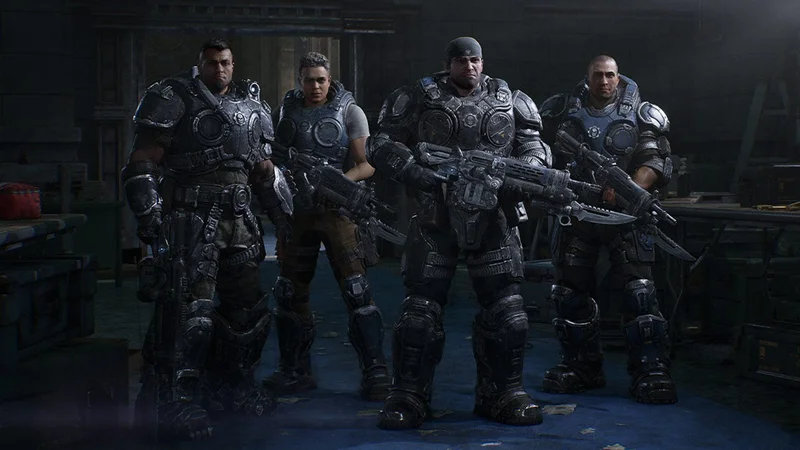
It's almost hard to believe it's been seven years since the last new mainline Gears of War game, and as one of Xbox's marquee franchises, it seems a lot is riding on the upcoming Gears of War: E-Day. I recently played about 10 hours of its revamped multiplayer, and yup, it sure is Gears of War. Even with that long gap, it feels both extremely familiar and refreshing for reasons you may not exactly anticipate. The meaningful changes I've noticed so far are perhaps more subtle – specifically, the refined control scheme which shined in both the Versus and new Horde Siege modes I played. There's a lot to dig into, so gear up for my breakdown on how the big, chunky COG boys are back.
I'm going to mostly dive into Horde Siege mode, since that's where I spent most of my time – and it's also the most exciting thing that'll carry Gears E-Day's multiplayer component. But first thing's first, Gears E-Day features some important changes to how the series has traditionally controlled. The A button is fully dedicated to taking cover and moving around cover now, while sprinting (aka The Artist Formerly Known as Roadie Run) is now mapped to a left-stick click (LS) by default, and the Y button is dedicated to vaulting – and you can actually jump in this game! It took quite some time for me to rewire my brain since we've all been so used to the A button controlling all of these actions depending on the context you press it. But once I acclimated with the new controls, I couldn't really go back.
The Gnastiest of Gnashers
The PvP Versus portion of the beta was pretty standard fare with two modes on two maps. Team deathmatch works like it usually does in Gears games, where two teams of four (COG vs. Locust) have 15 cumulative lives to live, and once a team hits zero, their respawn gets disabled as each player gets one more life before elimination in that round. Conquest is the normal control point-style mode where two teams battle for marked territory that moves across the map as each point gets held down until one team holds it for long enough. The two maps in the beta, Market and Outpost, reflect the traditional symmetrical map design with close quarters shootouts dictated by lanes, sightlines, and cover spots to take advantage of and flank opponents.
Playing your angles and corners and exploiting the stickiness of the cover system is still very much the bread and butter of Versus, as is the usual shotgun meta – basically, sprint then go into a slide as you hip-fire a Gnasher into opponents before dodge-rolling out of danger. It's not exactly interesting anymore, and hasn't been for a while, but it's still decent fun to give a whirl for a bit, and let’s be honest: it wouldn't be Gears PvP without it, huh?
However, what my time with PvP highlighted is that despite still feeling like you're controlling big-ass dudes slamming into cover, you're a lot more nimble thanks to the new movement system. I can pop in and out of cover quicker, vault over cover spots easily, and get into a sprint without much friction, loosening up the flow of Gears without losing its identity. Whereas before, I found myself fighting the control scheme itself where the A button would too often not do the thing I intended to do, especially in tense firefights and panic-induced situations where split-second decisions matter. There's also a bigger emphasis on verticality since you have a dedicated jump and mantle action with the Y button; it may not sound like much, but in a game all about positioning and angles, it adds a dimension to the Gears combat formula for both what you can do as a player and how maps are designed when they don't have to be as flat.
Horde Siege Carries the Multiplayer
Okay, now let's get into the star of the show: the brand-new Horde Siege mode. The series pioneered the wave-based PvE multiplayer formula with its Horde mode back in Gears of War 2 and it’s been a staple ever since. But instead of loading into a confined singular level specifically built for a Horde mode, Horde Siege matches spread objectives and enemy waves across a much bigger map where everything happens at once. This is the city of Kalona where Gears E-Day's story takes place, and these are the ruins left in the wake of Emergence Day when the Locust attacked. So, right off the bat, there's a thematic coherence between the campaign's story and the multiplayer mode itself.
Your team isn't alone, either; three teams of four queue into a Horde Siege match, and each team is given their own starting point and objective locations. The main task seems to always be defending a R.I.G. from waves of Locust, but teams have optional side objectives they can complete beforehand. These usually involve destroying a set of Locust assets as they spawn into the area surrounding it, and you'll get additional rewards and in-match currency for gear and defenses. For the main objective, your team will decide when to initiate the fight, and once you do, you're locked into defending the position until you fend off all waves.
You have three types of Horde Siege missions to pick from – Blitz gives you one main objective against three waves, normal Siege gives you three objectives against three waves each, and standard Horde gives you one objective against a full 10 waves. Regardless of mission type, you'll need to extract after the final wave to get the full set of match rewards – a helicopter will fly-in and land at different locations while you try to survive an indefinite wave of even more Locust, which heightens the stakes and keeps you fighting until the very end of the match.
It's almost open-world-ish, and has the slight vibe of a persistent world as multiple teams are playing in any given instance in parallel. While you don't necessarily share objectives, you'll often see them fighting off their own waves of Locust in the distance or next door. It's cool to see, but it can be a nuisance when they drag their set of enemies toward you, especially when you're in between waves trying to prepare for the next one. In a pinch, though, you can naturally get some assistance if another team wants to help mow down your Locust, lest they become targets themselves.
That also plays into an element of emergent gameplay, if you will, since you never really know what positions you'll have to defend when queuing into a match, forcing you to adapt to the surroundings of each key area around Kalona as objectives get assigned. I played about six hours of Horde Siege specifically and I eventually got some of the same tasks, but it still felt fresh – especially in the normal Siege mission type, since part of the deal is running across Kalona as you're fighting to survive each moment. I imagine some folks will prefer the mechanical, clear-cut nature and defined space of the traditional Horde mode, but so far I feel like this is a more dynamic take that really complements what Gears has historically done well.
As for the action itself, it's the tried-and-true Gears gameplay with my usual combo of Gnasher and Longshot working as well as I've always remembered. And tossing a frag into a Locust hole to nip the wave in the bud is as satisfying as it's always been. The aforementioned quality of the new movement system. The way you play Horde as opposed to Versus is very different due to the chaotic movement patterns of actual players. But for the purposes of PvE, repositioning and getting between cover feels smoother than ever, which is important because Locust hordes seem to barrel down on you at an alarming rate in each wave – and in a way I don't remember being a problem in previous Gears games. Handling fast-moving Wretches and normal Drones backed by the occasional Boomer isn't too challenging. But when multiple Berserkers and those new hulking tanks five times the size of a Boomer pile on at once, it's tough to manage. Frantically repositioning and making extra effort to revive downed squadmates seemed to be the remedy, and once I came to grips with this, I was able to get through a full 10 waves consistently.
Currently, it's not quite as intricate as Gears 5's Horde mode in terms of character classes and the more strategy-focused gameplay elements like building barricades and turrets for defense. You still earn currency based on performance, but so far, it's mainly for building turrets in predefined positions or restocking ammo at supply caches. As a reminder, it's an early beta so the progression system, unlocks, and rewards aren't exactly final. The class system seems to be simplified for now with Assault, Breacher, Marksman, and Medic having a tactical cooldown related to their specialty. But I am looking forward to the attachment and upgrade system for specific weapons as I get deeper into it when the full game comes out.
Despite putting in about 10 hours in the beta, there's still plenty more I want to see and do, which isn't something I would have necessarily said about a Gears game in the past. This has been the longest gap between major entries, so hopefully the wait results in a multiplayer suite that has the legs to sustain the series for the long-term. We won't have to wait long since Gears of War: E-Day fully emerges on October 6 for Xbox Series X/S and PC.
Michael Higham is an editor at IGN who regularly contributes with reviews, previews, features, and news in written and video form. He's usually entrusted with covering long RPGs and tech products, but he's got range when it comes to games. You'll also catch him at events and hosting video content, including IGN's weekly podcast Unlocked.