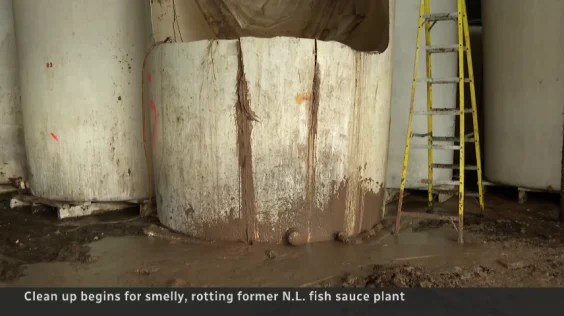
Take capelin, a small silvery fish in the smelt family. Now add salt. Then throw those two ingredients in 110 vats, each of them about 10 feet tall, and let them sit in a defunct factory for over two decades. The resulting stench might haunt an entire community, as it has the people of St. Mary's, a coastal town of about 300 people in the Canadian province of Newfoundland and Labrador. In 2019, one resident described the ritual of abandoning her home every summer, boarding up the windows and doors so the smell doesn't permeate her belongings. The people of St. Mary's have long fought for the fish sludge to be cleaned up; after an aborted attempt in 2016, that work finally began in earnest this week.
There are 900,000 liters of fish sauce to remove—some of it just liquid, some of it with fish solids. The province of Newfoundland and Labrador budgeted $2 million for the job, which was taken up by a local engineering firm and is expected to be completed in October. As workers cut open the vats, viscous brown fish goo shot out onto the factory floor. It will be mixed with peat moss, hauled out in about 200 truckloads, and thrown in a landfill lined with polyethylene, after which it will be sealed up "like a Ziploc," according to the lead engineer on the project. St. Mary's Mayor Steve Ryan reportedly teared up while describing new hope. "To be known as the 'sauce plant mayor' … it's time for that to be over," he said.
Even in ideal circumstances, the creation of good fish sauce is a stinky process, but the resulting umami bomb is well worth it. The Atlantic Seafood Sauce Company began in 1990 with the (sound!) idea to make use of someone else's waste product. A processing plant in St. Mary's was sending female capelin to Japan so their eggs could be used for masago; the male capelin were of no use to them. Vietnamese immigrant Sahn Ngo saw in these castoff fish an opportunity to brew one of the signature sauces of his cuisine. But after his company was blocked by regulators—check out this Eater feature for nuance—it closed up shop in 2001, leaving behind the vats of sauce in progress. I can't be the only person out there staring at these torrents of fish mud and wondering about the tasting notes. In fact, I know I'm not, having spoken to food scientist Bryan Quoc Le earlier this week. Given his background in chemistry and Vietnamese cuisine, he was the ideal expert to unpack this horrifying and possibly delicious situation.
Our conversation has been edited and condensed for clarity.
I wanted to start off and take a more normal scenario and understand the chemistry in a more traditional fish sauce, where we start with the fish and the salt. My understanding is that enzymes from the gut of the fish do the work of digesting the proteins, and breaking them down into amino acids, which have tasty properties, and that's why we like the fish sauce. And the high salt content helps keep this process safe and makes sure that the right kinds of bacteria are able to outcompete the harmful kinds.
That's exactly right. Basically what's happening is in the intestines of the fish, the enzymes are being released, and the enzymes start to break down the proteins. First, they chop them up into fairly large chunks, but then over time they start to liquefy as you get down to the amino acid content. And most proteins are about 30 percent or 40 percent glutamic acid, and so a lot of the initial flavor profile is from that glutamic acid content that gives you the umami flavor.
The salt helps protect the fish. It protects it from the presence of pathogens. That's the really important part of that process. But it also protects it from bacteria and yeast that might cause some kind of rancidification that is undesirable, right? Then it serves as a sort of amplifier of the flavor, too. In order to have glutamic acid be experienced as umami, you also need sodium ions. Together, it's necessary—pure glutamic acid actually tastes like soap.
Fish sauce is typically made on something like a yearlong time frame. This is a very, very different situation, and I doubt there's any literature on long-term fish fermentation.
I would want to fly there and just see what happens.
That's how I feel.
There are studies to be done.
Definitely. This is an incredible resource. Based on your knowledge of the underlying chemistry, what else do you think is happening once the process extends for this long?
Within that one- to two-year time frame, generally speaking, a lot of the process is the enzymatic breakdown [that produces amino acids].
Now, there are certain yeasts and bacteria that are super slow, but they tend to work their magic on the same timescales as something like a wine or a whiskey. There are these 100-year-old soy sauces that are made in Korea, these monasteries that just have this continuous soy-sauce broth going on and on. Apparently it's supposed to be really good. I haven't tried it myself, but I would imagine something similar is happening, where you have these 20-year-long timeframes, and the initial strong fermentation action, because there is going to be some bacteria or yeast that lives on the skin of the fish, these are not necessarily sterile conditions.
This bacteria or yeast that exists can tolerate really high levels of salt. But because what salt really does, and why it prevents the growth of pathogens, is it inhibits the breakdown of a lot of enzymes. With these long timescales, the yeast is able to not only grow, but they'll die and then release the contents of their enzymes. So there's this ongoing forever process that's happening, as well as the more conventional chemistry that would occur.
An example: There's the reaction between amino acids and very minute amounts of sugars. That's why soy sauce is black, right? It's a chemical reaction that occurs called the Maillard reaction, and is accelerated when you heat or roast something. The baking of bread or roasting of coffee gives you those dark compounds. But if you give something a year or two, or 10, the darkening occurs so long as there's some kind of sugar in the vat. So that would be an interesting thing to see: What are the flavor profiles that form because of this Maillard reaction? Again, you can also see that in wine. The chemical reaction that changes the profile of the really rich, strong flavors that you see in 10-year-old or 20-year-old wines is because of this Maillard reaction that takes forever to occur at room temperature.
That's a good detail to point out, because this abandoned factory isn't climate-controlled in any way. It's just been exposed to the elements, and I imagine it's basically refrigerated for a huge chunk of the year, based on where it is. So this is probably very unusual fermentation playing out: every few months, going back in the fridge, and then getting warmed up again.
Exactly. You have that seasonality to it.
The locals in the town have reported scents so strong that they board up their house in the summer, they can't hang their laundry out. Do you know what compounds might be produced by fermentation of this time length?
It's primarily amines, a class of compounds that basically come from the breakdown of amino acids. So the amino acids—there's some kind of biological reaction with the bacteria. They sort of split off a carbon dioxide, that breaks off that acid portion of the amino acid. The amines themselves, generally speaking, humans are extremely sensitive to them because they're indications of death, right? A corpse, a dead animal or a dead fish, it's giving off amines, and a lot of them tend to be toxic to humans. Even if it's minuscule concentrations that are going into the air, people are going to sense it a lot more, especially if you're not used to it. The people who live in this island Phu Quoc in Vietnam, the fish sauce capital, I'm sure they can tolerate quite a high heavy dose versus, you know, if your cuisine doesn't really have it.
People are describing rancid odors, too. Is there something about the fat content of the fish?
Yeah, definitely. That's the same sort of process with the enzymes, but with the added bonus of oxygen. [The fat is] oxidizing, and then as it's breaking down, which is still a slow process, those molecules are really, really volatile. Aldehydes and ketones that form from the breakdown of fatty acids, that's gonna give you that smell. Again, humans are very sensitive to that. We don't tolerate it very well.
I've seen footage of the workers cutting open these vats, and it's not a pretty sight. It's this gray-brownish sludge hitting the factory floor, but obviously real fish sauce is processed and strained. Would you be a little bit tempted to taste this forbidden fish sauce if it was processed?
I would 100 percent taste the forbidden fish sauce. I would do it for science. My wife would kill me if I'm not already dead. I will. If there was a way, if I would be able to fly out there, I would do it, and write a whole report about it because I think that would be a pinnacle achievement for me.
For the record, I agree, and I don't even have the scientific pedigree. I just want to taste it. With the prospect of dying, what kind of pathogens would you be worried about specifically?
Honestly, I don't think there would be any pathogens, because the salt content is so high. There's really nothing that lives in that. There are a lot of products that are shelf stable as long as they have a high concentration of salt, decently acidified, or high concentration of sugar. Basically, the only thing that can live is a handful of bacteria and yeast. It's one of the principles of food safety.
So this is speculative, but given your knowledge of fish sauce, and just extending some of these chemical processes out more and more years, what would be your tasting notes, if you had to guess, for this fish sauce?
Oh my gosh, that rancidity. Unfortunately I think the rancidity and amines are going to be forward, in a way that is probably going to be overwhelming. That said, there's so many complexities with that. You have not only the reactions forming those molecules, but also the molecules are interacting with each other. So amines and aldehydes really like to form bonds, and in doing so, they might create a level complexity that we've never seen before, right?
There could be an undercurrent of sweetness, even. That would be very bizarre, right? But if you think about the chemistry of sweeteners, artificial sweeteners, some of them have that kind of structure. So that would be interesting. It could be like where you're hit with a horrible bitterness, a rancidity, a horrible fishy overwhelming—but maybe there's something underneath, right? Or maybe we just need to acidify it a little bit. Add a little lemon juice. This is common in Vietnamese cuisine, when you have the fish sauce dressing that's used for a lot of noodle dishes. Maybe we could cut it.
[Both laughing, with hunger]
Maybe we can cut those amines and just not even taste them. That could be really cool. Then you would know: What level of savoriness could we actually achieve out of it? Because this is the fun part. Worcestershire sauce is fish sauce. Basically, what happened was a bunch of chemists accidentally abandoned it for a couple years, they put a barrel of anchovies or mackerel or something like that, and then just threw in some vinegar.
What could happen is, oh, actually this is kind of flavorful in a way that we wouldn't expect—something that's 20 years old, especially the umami flavor, the intensity of the glutamic acid. Maybe the glutamic acid from the amino acid breakdown is reacting to other components like these amines and these aldehydes, and now we have all sorts of new molecules. It's actually a black box. We don't really know.
Oh man, that's so interesting. We've got to get a hold of this somehow. They've got a million liters of it.
Right? If it turns out to be some kind of goldmine ...
I reached out to you because I love the piece you wrote about fish sauce, and I was wondering what you like most about it in its ordinary form.
Being Vietnamese, it's such a quintessential part of my cuisine. My mom would always cook with it. It was always incorporated in some way, but it was also kind of the situation where my friends would come over and be like, "What? What is that horrible smell?" You know you're in a Vietnamese household because you can smell the fish sauce, because it's always in the air. It has a childhood element of warmth; it helps me think about Mom a lot.
Then, as an adult, I use it, and now that I understand the chemistry, it makes a lot of sense. It's a very versatile ingredient because what you're doing is just dumping a lot of glutamic acid, but it's from a very specific flavor profile. It's not soy sauce, which tends to be have a caramelized element to it because of that long-term processing, and has more sugar because it requires rice to jump-start that fermentation process. Whereas fish sauce is pure, right? It's just fish, guts and everything.
There's an element of authenticity to it. Not that, of course, soy sauce isn't really authentic, but I just like the idea of that. There's that piece, and then one of the reasons why my wife and I started dating is because she's Israeli and Romanian, totally removed from my culture, and one time we went out on a date, and she took me to a Vietnamese restaurant, and I'm like, "How does this person even know anything about Vietnamese food?" I kind of wrote it off, like, She's not gonna understand. Of course, they bring out the food, and she's like, "Could I get more fish sauce?" My friends would stay away from my house. But this person who ended up becoming my wife, she's like, "I love fish sauce. I need more of it in my life."