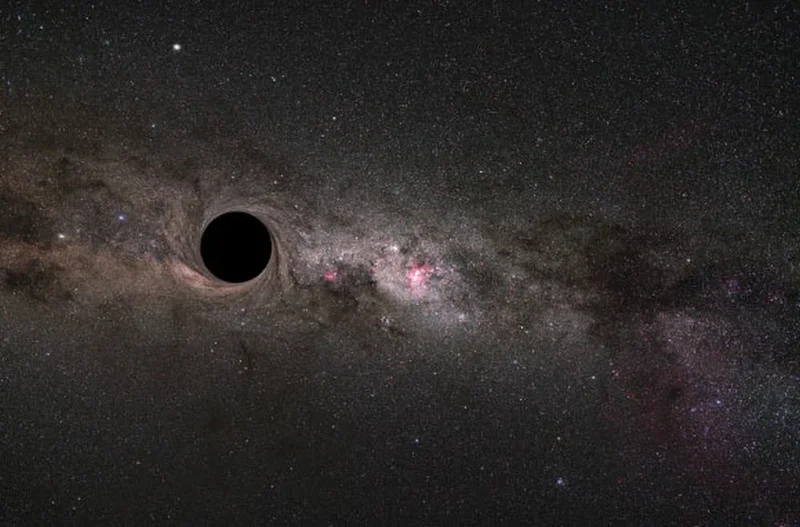
Theoretical cosmology and astrophysics can take us to strange places. Researchers in these disciplines can have long, detailed back-and-forth conversations about things that may not even exist. This is true of primordial black holes.
Primordial black holes (PBHs) are only hypothetical, but they generate a lot of interest. If they're real, they formed immediately after the Big Bang from direct collapse of dense clumps of subatomic matter, without the need for any stellar progenitor. Researchers have long thought that they could be the prime component, or even the only component, of dark matter.
If PBHs are real, then it should be possible to figure out how they interact with other astronomical objects, and what evidence they leave behind, even if we can't detect PBHs themselves. That's the basic idea behind new research in The Astrophysical Journal titled "Primordial Black Hole Triggered Type Ia Supernovae. II. Comparison with Supernova Remnants and Galactic Chemical Evolution." The lead author is Shing-Chi Leung from the Department of Physics at SUNY Polytechnic Institute and the Kavli Institute for the Physics and Mathematics of the Universe (WPI), at the University of Tokyo Institutes for Advanced Study.
"The asteroid-mass class of primordial black holes (PBHs) is one of the candidates for the dark matter in the Universe," the authors write. They have masses that range from a large asteroid up to a small moon or dwarf planet, and could be the major component of dark matter. "The infall of these PBH into a white dwarf could be one triggering mechanism of Type Ia supernovae (SNe Ia)."
This schematic shows a PBH passing through a white dwarf. As it passes through, its gravitational force creates tidal heating in the middle of the white dwarf. Once the material reaches the threshold temperature of <~0.5 billion Kelvin, it triggers uncontrolled nuclear burning. If the region burning is big enough, then thermonuclear runaway will trigger a Type Ia supernova. Image Credit: Kavli IPMU/Gemini AI (Banana Pro)
Type Ia SNe occur in binaries where one star is a dense white dwarf (WD). In this scenario, the WD draws gas away from its stellar partner, where it accumulates on the WD's surface. Eventually, enough material accumulates and the WD explodes as a SN. Unlike other SN explosions, there is no remnant star. The WD is annihilated in the explosion. All that's left is an expanding shell of debris with a particular chemical fingerprint.
The researchers have previously published research into PBH-triggered type Ia SNe, and in this work, they expand on it. "In a previous work, we studied the ignition, explosion dynamics, radiative transfer, and postexplosion nucleosynthesis of the PBH-triggered SNe Ia," they write. In this work, they focus on SNe light curves and metallicity of the SN remnants. They contend that they can identify the SNe through their particular chemistry. "We further investigate how these supernovae could affect the chemical evolution on the galactic scale by adding the new SN Ia models as a new chemical source," the authors explain.
The researchers extended their previous work across a greater range of stellar metallicities. Some of the resulting light curves from these PBH-triggered SNe Ia match existing supernova remnants. "We show that these PBH-triggered SNe Ia behave similarly to ordinary SNe Ia, where higher metallicity flavors the production of Mn and Ni," the authors write. "We show that some of these observed SNe Ia could be the consequence of the PBH-triggered explosion."
From there, they fed these results into a Galactic Chemical Evolution (GCE) model. "We include the PBH as a new stellar chemical source in the code," the authors explain. The GCE illustrated how these SNe would affect the chemistry of stars over long durations of cosmic time.
From there, they looked at the observed elemental abundance in stars to see if any matched what the GCE showed. With that, they determined the fraction of all SNe Ia that could plausibly have come from PBH-triggered SNe Ia. Their results show that these supernovae could've been a major contributor to Type Ia SN, especially in the early Universe. "The PBH channel thus could be an alternative to explain the widespread elemental abundances in high-metallicity stars from various stellar surveys," the researchers write.
âOur work suggests that some supernova that we observe in the sky could be a result of the PBHs," lead author Leung said in a press release. "Therefore, even though we cannot directly observe these evasive entities, they leave many interesting clues in nature for us to probe their properties.â Leung said.