Donald Trump appeared Thursday to be on the verge of tanking one of his own nominees as his battle with reluctant Republicans in the Senate continued, perplexing many on Capitol Hill.
The president’s fixation on preserving the terms of a settlement deal the courts have seemingly already rejected is just the latest angle of a months-long feud he has engaged in with several members of the Senate Republican caucus. But those terms, which include the creation of a $1.776 billion “weaponization” fund for the Department of Justice and granting him and his family immunity to IRS audits seem to be a crucial sticking point for the president.
And that could cost him the appointment of one of his closest and most valuable political operatives.
The president wrote on Truth Social Thursday that he may pull the nomination of Todd Blanche until two Republican senators currently opposed to his confirmation, Thom Tillis and John Cornyn, leave office at the end of the year.
Unstated, however, was the political reality: This is a death sentence for Blanche’s nomination.
Republicans are projected by most election models to lose one if not more seats in the Senate this upcoming midterm cycle, and it’s highly unlikely Blanche will ever get a more favorable playing field than he has now.
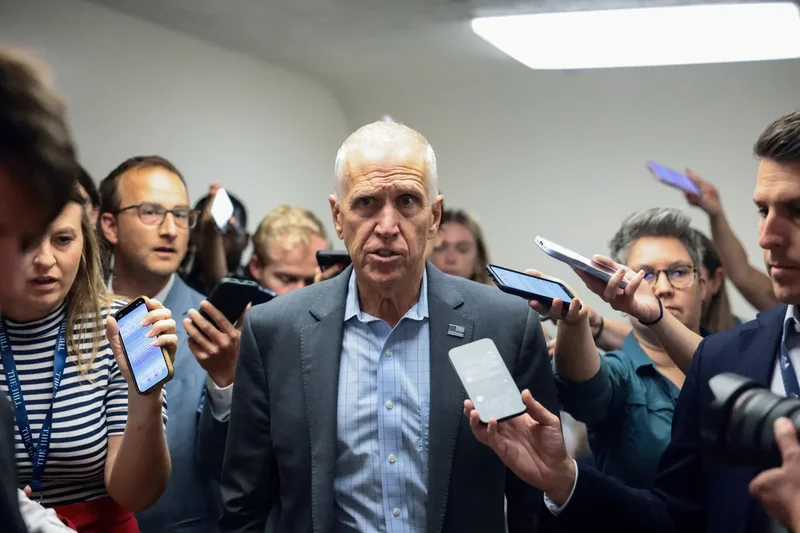
Asked by The Independent why the White House and Justice Department weren’t agreeing to the counter-proposals offered by their side, Tillis replied that it was clear the president hoped to revive the fund Blanche has verbally declared “dead” on several occasions.
“Well, I guess it means that he wants to revive it at some point later on,” said Tillis.
“Why aren't we taking this off the table? It's not helping the president's popularity,” added the North Carolina Republican. “It's not helping our candidates who are up for election. Nothing good is coming from this. And Blanche recognizes it.
“The president's getting bad advice. He should listen to Blanche and others who think if it's dead, it should be rendered completely dead.”
As the president wages war with Tillis and Cornyn on social media and in comments to reporters, it seems clear that, at a minimum, his own personal animus for the two senators is preventing the president from achieving any kind of progress in the GOP-controlled Senate at a bad time for Republicans. Staring down the midterm deadline, the chamber is eyeing what it can pass before the lame-duck session begins, including government funding legsislation ahead of a September deadline.
Meanwhile, the eyes of voters are on Washington in greater numbers as the midterms inch closer and closer. Further signs of a dysfunctional Republican congressional majority in either chamber could further worsen the party’s chances of protecting those majorities in November.
Republicans in both chambers eye the terms of the Trump/IRS settlement agreement as a detriment to their re-election efforts. They openly say the effort to establish the so-called “slush fund”, which they argue could benefite Jan. 6 rioters, stinks of corruption.
But Trump, according to multiple accounts of those close to him and with knowledge of his thinking, is not concerned about protecting Republican majorities and especially the careers of members whose votes he cannot control. He’s spent months publicly pressuring Senate Majority Leader John Thune to pass voter ID legislation, the SAVE America Act, and has been making his frustrations about the Senate leader clearer even as Thune tries to hold on to power.
“He gets obviously frustrated with me,” Thune said in an interview with Politico, claiming that he and Trump “get along” despite the criticism.
“Math is math, arithmetic is arithmetic,” said Thune. “And part of it, too, is the active role he played in some of these primaries.”
“He thinks I can wave the magic wand,” he added. “I wish it were that easy.”
Cornyn, speaking to MS Now on Thursday morning as a planned committee vote on Blanche’s nomination was postponed, said that the president had not spoken with him and “could fix this [situation] in a minute”. He added that a phone call from the president would be helpful to clear up their disagreements.
That phone call looked unlikely by the afternoon, as the president returned to attacking Cornyn and Tillis on social media.
“John Cornyn, of Texas, and Thom Tillis, of North Carolina, both of whom I refused to Endorse, and whose political careers have been ended by my action, are refusing to vote for this Great Nominee, who will remain, in any event, as Acting,” said Trump on Truth Social. “Remember, both Cornyn and Tillis voted for Merrick Garland, and others, too numerous to mention.”
Tillis, responding to a question from The Independent, asserted that he’d never asked the president for his endorsement and added that Trump would’ve received “a Tillis reply” had he ever threatened him directly with support for a primary opponent. Cornyn and another Republican senator, Bill Cassidy, were ousted this cycle by Trump-backed primary opponents. Tillis chose not to seek re-election last year after a public break with Trump, and as it was clear he’d face a Trump-backed opponent were he to run.
And Cornyn, in his own comments to reporters, insisted that the resistance to the “slush fund” would not dissipate within the GOP caucus with his and Tillis’s departure from the chamber.
“I mean, we were having a perfectly good conversation with Todd Blanche. I think he's a smart guy, a good lawyer, and we just wanted to confirm what he already swore to. And now the president's pulled him back, thinking that well, he can out wait Tillis and me,” said the Texas senator.
“But ... there are more than just two people who have reservations about the weaponization fund and about the scope of the settlement agreement.”