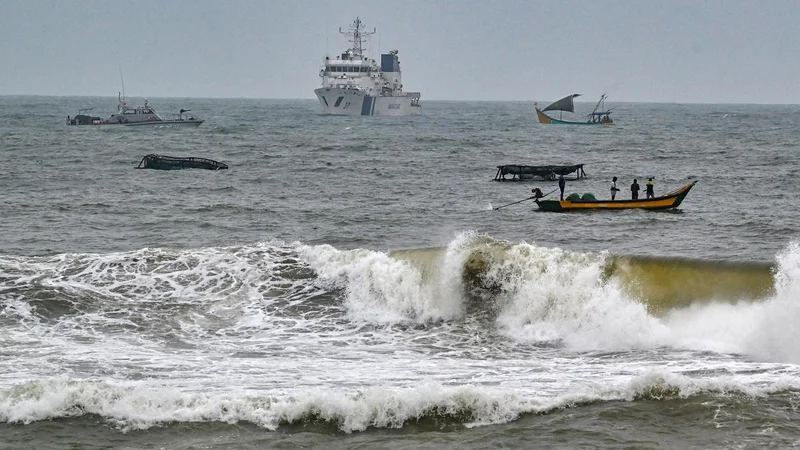
The Bay of Bengal region, one of the world’s most disaster-prone regions, lacks coordinated mechanisms to respond to natural disasters. Non-traditional threats such as climate-induced disasters, illegal fishing, cyber vulnerabilities, and supply chain disruptions require regional cooperation beyond bilateral aid or maritime power. This gap — growing capacity without shared norms — highlights the need for stronger maritime security.
On July 13, External Affairs Minister S. Jaishankar introduced Securing Holistic Advancement through Norms, Trust and Integrity (SHANTI) while launching India’s candidature for the UN Security Council (UNSC) for the 2028-29 term. Building on Security and Growth for All in the Region (SAGAR) and Mutual and Holistic Advancement for Security and Growth Across Regions (MAHASAGAR), SHANTI provides a normative framework for shared maritime spaces, with the Bay of Bengal serving as the ideal region to operationalise it before expanding it across the wider Indo-Pacific.
The Bay’s centrality
In recent years, the Bay of Bengal has moved from the margins to the centre of India’s strategic thinking. Historically, it connected South and Southeast Asia through trade, culture, religion, and the exchange of ideas long before the Indo-Pacific entered diplomatic vocabulary.
Today, it links India’s Act East policy with the Association of Southeast Asian Nations (ASEAN), provides access to the strategically vital Malacca Strait, and connects the eastern Indian Ocean to major global trade and energy routes. China’s heavy reliance on the strait — often described as the “Malacca dilemma” — has driven its expanding regional presence through ports and infrastructure projects, intensifying geopolitical competition. As economic connectivity, maritime governance, and strategic rivalry converge in the Bay, SHANTI offers a framework that places norms, trust, and integrity — not tonnage — as the currency of durable advantage.
A maritime security evolution
As such, SHANTI can be best understood as a logical evolution of its maritime outreach. SAGAR, articulated in 2015, supplied the vision of ‘equity in development’ and MAHASAGAR, announced in 2025, expanded that vision’s scope recognising the interconnectedness of security (both vertically among nations and horizontally in threat perception) in the wider Indo-Pacific and the Global South. SHANTI offers the grammar of maritime security framework, the norms, trust and integrity in cooperation through which vision can be translated into tangible action that is well received and reciprocated. It shifts the emphasis from competition to demand driven cooperation, from influence to non-prescriptive institution-building, and from episodic crisis management to long-term resilience. This shift — from protecting maritime spaces to governing shared maritime commons — reflects India’s new security mantra. If SAGAR was a statement of intent and MAHASAGAR a statement of reach, SHANTI is a statement of method to situate India as the “preferred security partner” and “first responder”.
Because the Bay of Bengal is a single interconnected system, its cyclones, fish stocks, shipping lanes and pollution cross national boundaries almost by default, and its littoral states face remarkably similar challenges and concerns — disaster risk reduction and response, coastal erosion, fisheries management, port resilience, undersea cable protection and climate adaptation.
Unlike the western Indian Ocean, which is marked by active conflict, fragile economy and contested spaces, the Bay of Bengal’s strategic geography encourages cooperation. Yet, the region suffers less from a lack of institutions than from institutional fragmentation. What is missing is a common framework to align existing mechanisms. SHANTI fills this gap by providing principles to strengthen cooperation in maritime security, disaster response, the blue economy, and environmental resilience. India’s geography gives it a natural convening role, but its centrality should rest on regional stewardship — not dominance — through trust-based, rules-based cooperation among states with shared challenges and opportunities.
Principles to practice
Taken together, these conditions make the Bay of Bengal India’s most governable maritime sub-region — a natural laboratory where SHANTI can move from principle to practice before shaping wider cooperation across the Indian Ocean. This was reflected at the July 2026 Bay of Bengal Initiative for Multi-Sectoral Technical and Economic Cooperation (BIMSTEC) National Security Advisers’ meeting in New Delhi, where member-states adopted common principles for maritime law enforcement and humanitarian assistance and disaster relief. BIMSTEC also agreed to hold its first joint maritime security exercise in the Bay, in November 2026, while a white shipping information-sharing agreement remains under discussion. These initiatives reflect the norm-building and trust-based cooperation that SHANTI seeks to promote. Its lasting contribution, therefore, will not be another acronym in India’s maritime lexicon, but a redefinition of security — from deterrence to resilience, from rivalry to shared responsibility, and from crisis management to governance of the shared maritime commons.
Rajeev Ranjan Chaturvedy is an Associate Professor at the School of International Relations and Peace Studies, and Coordinator of the Centre for Bay of Bengal Studies at Nalanda University, Rajgir, Bihar; Raghvendra Kumar is a Post-Doctoral Fellow at the School of International Relations and Peace Studies, Nalanda University, and a Non-Resident Fellow with the Africa Program at the Foreign Policy Research Institute, Philadelphia. The views expressed are personal
Published - July 31, 2026 12:08 am IST