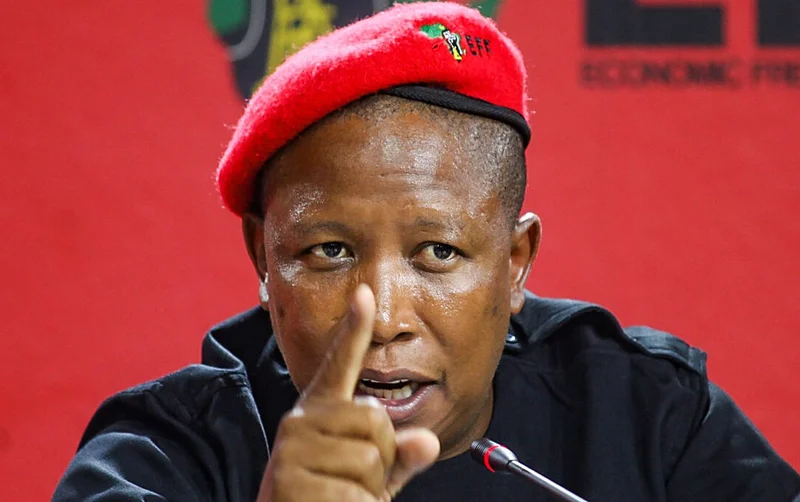
âDespite all attempts to cast doubt over the organisation and its leadership, thereâs been no evidence that ties the EFF to any wrongdoing, and this is a fact we remain proud of,â said Economic Freedom Fighters (EFF) leader Julius Malema on Thursday, 30 July.
He hit back at allegations linking him to figures implicated at the Madlanga Commission, including former Investigating Directorate Against Corruption (Idac) head advocate Andrea Johnson and criminally charged Crime Intelligence deputy head, Feroz Khan.
Malema addressed the controversy hanging over the EFFâs local government election campaign during a press conference at the Radisson Blu Gautrain Hotel in Johannesburg.
The briefing was intended to build on the partyâs manifesto, which was unveiled during its 13th-anniversary celebrations at Thohoyandou Stadium last Saturday. While Malema began by elaborating on the manifesto and announcing the partyâs election candidates, questions surrounding the commander-in-chiefâs ties to key figures in the Madlanga Commission inquiry soon took centre stage.
Malema directly addressed two major controversies. First, he clarified his comments equating Johnson to the late Struggle stalwart Winnie Madikizela-Mandela, which he made during an 11 July sitting of the parliamentary ad hoc committee probing corruption.
Addressing Johnson directly, Malema said, âI thought Winnie Mandela died, but Winnie Mandela has multiplied.â
In the weeks that followed, Johnson was grilled at the Madlanga Commission over her ties to Khan and allegations that she gave the suspended deputy head of Crime Intelligence access to a docket in which he was accused of assault and intimidation, before he submitted his warning statement. President Cyril Ramaphosa accepted her resignation from Idac on Monday.
At the press conference on Thursday, Malema clarified that his praise for Johnson was based strictly on her presentation to the parliamentary ad hoc committee and was unrelated to the allegations that subsequently emerged against her at the commission.
âMy comparison to Winnie Mandela was in relation to what she [Johnson] presented at the ad hoc committee. The ad hoc committee and Madlanga Commission are not the same thing, and they donât use the same style of investigation,â said Malema.
âShe might have impressed me in the Madlanga commission, I donât know. Or in the Madlanga Commission, she might have said things that were not put forward in the ad hoc committee. So comparing the two is not reasonable.â
Malema denies shielding Khan
The second allegation he addressed was made by uMkhonto Wesizwe (MK) party MP Vusi Shongwe, who in late June accused Malema of protecting Khan by preventing him from being summoned before the parliamentary ad hoc committee.
Malemaâs connection to Khan had already drawn public scrutiny after evidence surfaced at the Madlanga Commission suggesting Khan may have used the EFF leader to advance his own agenda.
Text messages from June 2021 between Malema and Mohamed Sayed, a close associate of Khan and a senior executive at the tobacco company Carnilinx, were read into the record by the evidence leader, advocate Matthew Chaskalson. Chaskalson argued that Khan drafted questions for Malema to put to former Inspector-General of Intelligence Isaac Dintwe, aiming to trap Dintwe into false statements to justify his removal. The draft questions were allegedly routed to Malema via Sayed.
Malemaâs name re-emerged in connection with the VBS Mutual Bank scandal following testimony at the commission that Khan supplied Malema with the home address of VBS liquidator Anoosh Rooplal via Sayed, who had initiated corruption charges against Malema.
At the press conference, Malema denied any responsibility for Khan not appearing before the parliamentary ad hoc committee, laying the blame at Shongweâs feet.
âItâs wrong for that young man of MK to say I prevented Khan from coming to the ad hoc committee. I never did that. I asked the question, âOn which basis are we calling Khan? Whoever said we must call Khan should have given the reasons why.â They donât say anything. And then Khan doesnât get called; they blame it on me as if I was running the committee alone,â said Malema.
He added that he had merely requested the reason for calling Khan, noting that other figures, such as former president Jacob Zuma, who were also named during committee proceedings, were not called.
Malema did not directly address the claim that Khan had sent questions to him using Sayed as an intermediary. He denied any involvement in orchestrating Dintweâs removal in a written affidavit presented on 7 July.
At the press conference, Malema added that while he knows Khan, he has not communicated with him since his first appearance at the Madlanga Commission. Instead, he had communicated with Sayed â only to enquire about Khanâs condition following his shooting in late June.
âI never got an opportunity to interact with Khan. He was shot, and then we were told heâs in a hospital, he canât speak, and all of that, and I left it at that. Any call I made was to Mohamed,â Malema said, adding that Sayed had confirmed that Khan was shot.
âIf there is anything wrong Khan has done, then the Madlanga Commission must take him on,â said Malema. DM