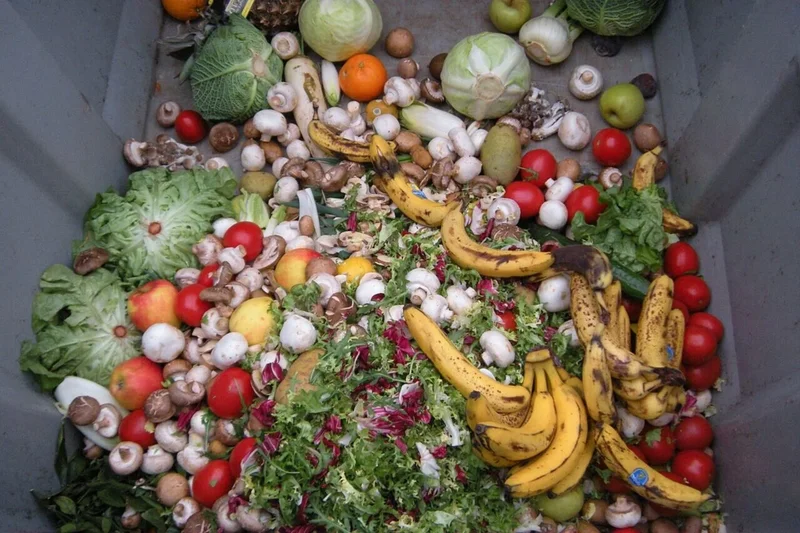
Between 30% and 40% of the U.S. food supply goes uneaten, according to the Environmental Protection Agency. Most of this organic waste ends up in landfills, where it rots and emits planet-warming gases. New research shows that implementing nationwide food recycling would have enormous climate benefits, but it would come with a troubling tradeoff.
In a study published July 23 in the journal Nature Food, researchers at the University of Vermont found that using food-derived compost and digestates (the nutrient-rich material left over after bacteria break down organic waste) could dump 20,000 tons of plastic onto agricultural soils each year. That is, if we don’t change the way we package our food.
âIf you don’t intentionally intervene and have a plan for how you’re going to minimize plastic in your recovered soil amendments, there will probably be plastic there based on just how pervasive it is in our food system right now,â lead author Kate Porterfield, a postdoctoral researcher at UVM’s Gund Institute for Environment, said in a statement. âIt’s literally everywhere.â
The complexities of cutting food waste
The EPA has set a goal to cut U.S. food waste in halfâdown to about 160 pounds (74 kilograms) per capitaâby 2030. The country is nowhere close. A 2025 analysis based on data from 2022 found that, even when taking reduction measures into account, the U.S. still generates roughly 328 pounds (149 kilograms) of food waste per person annually. That’s equivalent to the 2016 baseline.
Some states have made more progress than others. In 2020, Vermont banned residents and businesses from throwing food scraps and yard waste in the trash. In 2024, the state reported that food scrap waste in landfills had decreased 13% since 2018. And yet, the authors of that 2025 analysis concluded that state-level policies alone will not be sufficient to meet the EPA’s 2030 goal.
This new study evaluates the impact of implementing food waste bans nationwide. They found that diverting food from landfills through composting and anaerobic digestionâwhich uses bacteria to break down organic material into biogas and digestatesâcould reduce the current climate impact of food waste by a whopping 89% to 99% if implemented at national scale. What’s more, nutrient pollution, which causes harmful algae blooms, could drop by up to 54% for nitrogen and 98% for phosphorus.
The trouble is, the compost and digestates produced by a national food waste ban would contain a significant amount of microplastics.
The plastic problem
Plastic is pervasive in the U.S. food system. A recent survey of more than 1,000 produce product lines nationwide found that 81% were sold with plastic packaging and another 6% were sold unpackaged but with a plastic sticker. Only 12% of surveyed product lines were plastic-free.
Research has shown that plastic packaging contaminates food with micro- and nanoplastics through mechanical stress and heat. A 2024 study by the Ocean Conservancy estimated that American adults could be consuming up to 3.8 million microplastics per year from protein alone.
When contaminated food is composted or anaerobically digested, those tiny plastic particles wind up in the end products. What’s more, a lot of plastic packaging gets mixed in with food waste accidentally or through inadequate sorting, Porterfield told WBUR. Even when people and machines are working together to remove plastic from the waste stream, “a small amount sneaks through,” she said. “And if you’re talking about very, very large amounts of food waste, that can add up.”
Scientists are still working to understand the consequences of plastic pollution in agricultural soils, but dumping 20,000 tons of microplastics on fields each year could impact crop yields and further contaminate the food system.
While the authors do not believe their findings should discourage wider adoption of food waste bans and composting programs, they do emphasize the need to improve sorting and remove plastic from the waste stream. Doing so could help the U.S. tackle both its carbon emissions and plastic pollution.