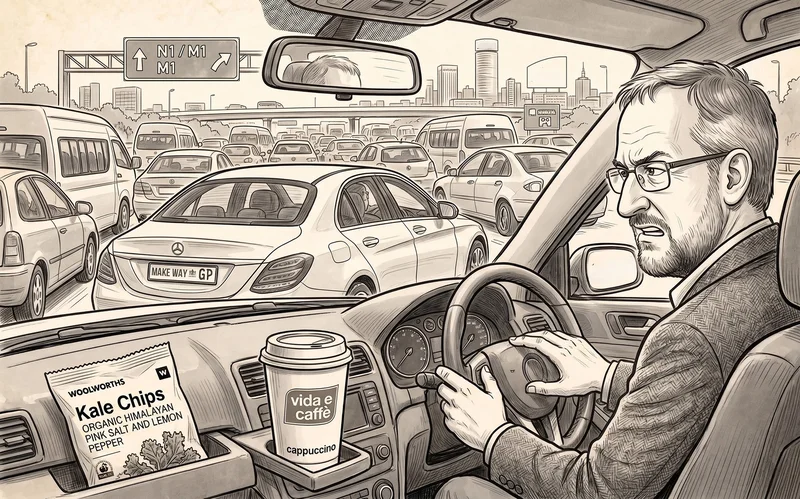
This morning, while stuck in the usual rushing wrestle that is getting my daughter to school, I was slightly amazed, again, at how insane it all is.
I think the low point was at an intersection where a major road intersects a highway. There are two lanes to turn right, and I was happily ensconced in the left one, confident that as the green arrow attempted to flicker, I would be first in the queue.
Only to find the car on my left, in the lane going straight, had put himself there deliberately to jump in front of me.
My hooter, nearly worn out by Joburg drivers, was again put to good use.
But it made me wonder if higher fuel prices are having any impact on us at all.
It is well known that in Joburg traffic is seasonal, there is a lot more traffic in summer than in winter. But even so Iâm always amazed at how many people are in a car going somewhere so early in the morning.
It made me wonder if this showed that the big hike in fuel prices (Stats SA helpfully reminded us it is the biggest jump in fuel prices this century) was having literally no effect on the economy.
It turns out, like my optimism about being first in the turning queue, I was wrong.
Yesterday FlySafair held one of those briefings where they discuss what is really going on under the skin of a company.
Turns out that while most of us are probably still using fossil fuels to move around where we live and work, we are absolutely cutting down on when we fly.
They estimate that their fuel price surcharge on tickets has pushed demand down by about 14%. By any measure thatâs a huge figure.
It also shows how we think about flying.
Ten years ago, if you had to have a board meeting, well, you had to have a board meeting. And you all had to be in one place for your board meeting.
Now, of course, people spend their days in their home offices connected to their co-workers on screens for the entire day, bantering and allegedly at work.
This must mean that demand for flying is much more elastic than it was.
It also shows how deep an airlineâs pockets need to be to survive something like this. Most of us are in businesses that probably would not survive a 14% drop in demand.
More evidence of the impact of higher fuel prices on our discretionary income came this morning from a business that has made an entire industry out of getting you to pay more for quality and convenience.
Woolworths said in their 52-week update today (I canât tell you why companies can employ very clever people but no one has told them that 52 weeks is also one year) that their growth slowed in the second half to just 3.3%. They said in their Sens statement that this reflected a particularly difficult quarter to the end of June.
The interesting thing about Woolies is that last year they reported that their in-store price inflation was 5.3%, compared with, say, Shoprite which for the same period had a figure of just 2%.
This showed how Woolies was able to make a huge profit from richer people, because they were choosing to shop there rather than at Checkers.
Now, obviously, more people are either just not eating (which is unlikely) or are going elsewhere for their 25g packet of organic Himalayan Pink Salt and Lemon Pepper-Flavoured Kale Chips.
I do think that where we can, we are trying to cut down.
Surely even those accustomed to kale chips (who Iâm sure also drink cappuccinos regularly) are having to make some sacrifices.
And, in my darker moments, I worry that there is just no way the Trump administration and the current leaders of Iran are going to be able to find common ground on anything.
At the same time the rand has really taken a pounding in the past week. I thought last week that the significant weakening of the rand to the dollar was more of a knee-jerk reaction than anything else. Virtually no one expected the SA Reserve Bank to keep rates on hold, and when investors expect something and it doesnât happen, then there is a shock.
But it should have worn off by now. Last night the US Federal Reserve kept their rates on hold, meaning the difference between our rates and their rates will stay like this for some time.
As a result the rand might stay relatively weak for a while, meaning fuel prices will rise further still.
And our only solace?
The rand may stay weak. But at least Woolies kale chips are made right here, in Mzansi. DM