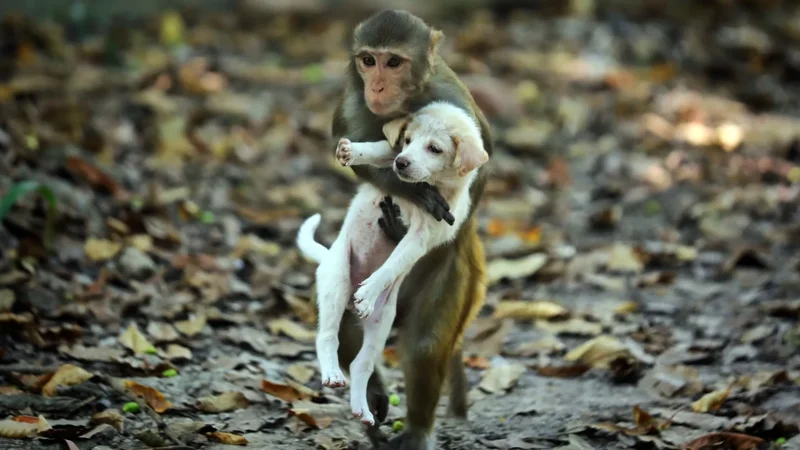
We humans love our pets, but we aren’t the only great apes who buddy up with other species. Researchers have documented multiple instances of primates forming bonds with different animals, but a recent study indicates these relationships may be even more common than expected. In a first-of-its-kind comprehensive review published in the journal Primates, anthropologists at the University of Oxford explored various instances of monkeys and apes carrying, grooming, playing, and sometimes actually adopting other creatures.
The data pool sources 303 cases across available scientific literature, 66 primatologists surveys, and 58 media accounts describing cross-species interactions involving humans’ close relatives. Situations included tufted gray langurs (Semnopithecus priam) petting squirrels in Sri Lanka, snub-nosed monkeys (Rhinopithecus bieti) playing with domesticated pigs in China, and even one case of capuchin monkeys (Sapajus libidinosus) in Brazil raising an infant marmoset for months.
While anthropologist and study-coauthor Cyril Grueter cautioned against viewing these situations as identical to pet ownership in humans,they potentially hint at traits that developed millions of years ago, long before Homo sapiens arrived on the planet.
“They may represent some of the evolutionary building blocks from which human-animal companionship eventually emerged,” he said in a statement. “More broadly, these findings provide new insights into the evolution of empathy, social flexibility and the remarkable capacity of primates to engage with animals beyond their own species.”
These inter-species relationships are found throughout nature, but most of them develop out of purely practical reasons. For example, different types of fish may swim together in large, blended schools to increase their odds of survival, while ostriches and zebras hang around each to avoid predators thanks to their respective scent and sight capabilities.
However, these examples of mutualism are markedly different from those reviewed by Grueter and colleagues. Primates napping next to another animal or playing with them offers no readily apparent rewards—suggesting that this innate curiosity and friendliness is more deeply ingrained in humanity’s evolutionary journey.
Beyond a better understanding of positive inter-species relationships among apes and monkeys, the researchers say further analysis could also benefit mixed animal facilities at wildlife sanctuaries and zoos.
“Humans have long been considered unique in forming close social relationships with other species,” said Grueter. “Our study shows that many primates also display remarkable curiosity, tolerance, and even caregiving towards animals that are not their own species.”