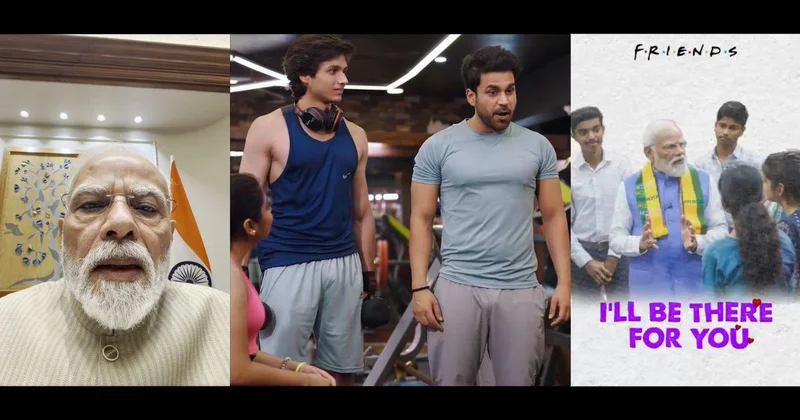
Late on the night of July 23, Prime Minister Narendra Modi appeared on Instagram in an unusual selfie-video. His post went viral soon after – but for all the wrong reasons.
The video was aimed at addressing the growing anger among protesting young Indians, led by the fledgling Cockroach Janata Party movement, demanding the resignation of education minister Dharmendra Pradhan over examination glitches and paper leaks.
Modi’s video was an attempt to reach out to students and young Indians on Instagram, a platform they have used to organise the protests. However, the video exemplified a complete algorithmic and cultural disconnect with how Gen Z communicates.
The prime minister’s upload violated almost every aesthetic rule of short-form content: it lacked an engaging visual hook, featured unusually slow speech and used an awkwardly-framed front-camera angle. Why are
The reel shattered viewing records, crossing over 300 million views in 24 hours. But the viral explosion was driven by Instagram’s unique sharing dynamics: millions of young users flooded private group chats with the clip, passing it along via direct messages to mock Modi’s stiff delivery, to overlay ironic audio tracks and slice the video into endless reaction memes.
The ruling Bharatiya Janata Party celebrated the raw view count as a monumental digital triumph, failing to realise that the algorithm was amplifying the video because Gen Z had transformed an attempt at earnest political outreach into a national meme.
Varghese K George of The Hindu remarked that the BJP was a party created on WhatsApp but it has now lost the battle on Instagram. How did this happen? Central to this is a fundamental disconnect between how the BJP has perfected its dominance of text-based platforms through a top-down, broadcast style of communication.
Over the past decade-and-a-half, the BJP dominated Twitter, Facebook and WhatsApp but was not able to gain significant traction on Instagram. The legacy social platforms exploited by political machines were fundamentally text-first ecosystems.
But the demographic driving the recent protests barely uses Twitter or Facebook, viewing them as outdated platforms populated by older people. Instead, they mobilised on Instagram, where reach was dictated by visual hooks and the ability to retain attention. This neutralises the traditional top-down political architecture that the BJP, especially, has relied on in controlling perception.
Digital divide
When students and young people filled the streets around Jantar Mantar in Delhi and in other Indian cities during the protests last fortnight led by the Cockroach Janata Party, established political observers struggled to make sense of the crowd. Their banners lacked formal party symbols, slogans bypassed predictable scripts and the demographic profile was overwhelmingly young.
A distinct cohort had stepped into public space and completely commandeered the national conversation, generating its primary momentum on Instagram. India’s “Gen Z” population, of youngsters between the ages of 14 to 29, is estimated at between 300 million and 400 million.
This is a cohort that seems difficult to connect with. I recently told a fellow academic that a generation that won’t open its mouth in the classroom has made one of the most authoritarian governments kneel in front of them.
As someone born in 1991, I have lived through a prolonged technological transition, with a clear memory of life prior to constant connectivity.
Our generation grew up in the era of dial-up tones, the slow rollout of broadband, the sudden arrival of cheap mobile data and the eventual digital takeover. For us, familiarity with digital tools was acquired over time in computer labs, cyber cafes, Nokia mobile phones and so on.
But for the generation that gathered at Jantar Mantar, digital connectivity was the baseline reality from the get-go. They grew up inside a world that was well networked. That reality was further cemented by two years of the Covid-19 lockdowns during their formative years, confining their social development to digital interfaces.
This shapes how “Gen Z” organises politically, where they operate within digital environments using an entirely different set of instincts than the generations that preceded them.
Online battleground
Between 2012 and 2016, the Bharatiya Janata Party established a formidable digital apparatus on Twitter, Facebook and WhatsApp. Back then, the Congress was widely criticised for failing to recognise the migration of public discourse onto mobile screens and being a late entrant on Twitter.
The BJP’s early playbook relied heavily on social networks and text-based distribution architectures.
The party is lauded for managing perception in India through its tight control over media and all other forms of communication. For more than a decade, the BJP ensured that dissenting voices were pushed into oblivion with its formidable social media cell.
Any public, online critique of the ruling party or overt expression of support for the political opposition invited an immediate, relentless swarm of organised, digital attacks. Coordinated accounts deployed vitriol, gendered abuse, and character assassination, transforming open discourse into a hostile, digital battleground.
Overwhelmed by targeted harassment, thread hijacking and doxxing threats, independent commentators, journalists and opposition voices gradually muted their accounts, stepped back from public timelines, or abandoned online spaces.
The BJP’s political machinery learned to exploit Twitter by organising coordinated hashtag campaigns, instructing thousands of accounts or automated bots to tweet a specific phrase within a 15-minute window to artificially trigger trending algorithms.
The deterioration of Twitter accelerated dramatically after trillionaire Elon Musk took over the platform in 2022 and rebranded it as X. By dismantling moderation teams, replacing traditional verification with paid subscriptions, and monetising user engagement, X has incentivised rage-baiting: algorithms amplify sensationalism and hostility, offering an ideal environment for right-wing ecosystems to thrive on misinformation and outrage manufacturing.
WhatsApp relied on closed, peer-to-peer connections where incoming messages from familiar contacts bypassed critical defenses, allowing party strategists to deploy broadcast lists that communicated with millions of personal numbers.
Facebook, meanwhile, distributed content based on interaction, allowing massive, centralised pages to push emotionally-charged material that relied on outrage to gain organic distribution. This entire apparatus operated on a top-down, broadcast model where party command structures crafted a unified narrative at the centre and relied on army-like coordination to flood timelines.
Short-form videos challenge playbook
Instagram’s pivot to short-form video altered the playbook that had long sustained the ruling party’s digital dominance. Virality on text-first networks such as WhatsApp, X and Facebook relied on accumulating follower counts, coordinating broadcast groups and deploying automated text swarms.
But the generation that participated in the protests inhabits Instagram, which differs from text-based platforms. It operates on an interest graph driven by complex, machine-learning recommendation systems rather than explicit social connections.
On an interest-graph platform, having millions of followers does not guarantee content reach. An official account with massive follower numbers can publish a video that stalls at a few thousand views if the initial algorithmic tests fail. Conversely, an account with 50 followers could reach millions of viewers in 48 hours if the content triggers the right behavioral signals.
When a new reel is uploaded, the recommendation engine isolates what is embedded in the content by analysing its audio tracks, visual frames and automated transcripts. It serves the video to a small test pool of users based on predicted interest rather than existing follower relationships, cascading the video to exponentially larger distribution rings only if that initial cohort satisfies key completion metrics.
Instagram places maximum weight on whether a viewer watches a video to completion or re-watches it immediately. If a viewer loops a 15-second video to read a fast-moving caption or observe a background detail, the system interprets the content as exceptionally valuable. Traditional political speeches or press conferences suffer immediate drop-off within the first two seconds, causing the algorithm to suppress their distribution.
The platform also heavily prioritises private sharing via direct messages over public likes or comments. Because younger users communicate primarily through private group chats, a video that prompts a user to share it with a friend sends a high-value signal of peer relevance to the algorithm. Instagram also exploits audio indexing by layering footage over viral sound effects or songs, riding onto the pre-existing algorithmic momentum.
Cultural disconnect, a different algorithm
Beyond technical algorithmic differences, the failure of traditional party machinery on Instagram stems from a profound cultural disconnect. Traditional political propaganda relies on authoritative tones, stark polarisation and the repetition of official slogans.
“Gen Z” digital culture relies on irony, self-aware humor, absurdity and hyper-stylised visual editing. This was evident during the demonstrations where protesters deployed absurd props, satirical signboards, and ironic pop-culture references, framing tense situations alongside video game audio or lighthearted voiceovers.
This artistic choice neutralises traditional counter-propaganda, especially since framing young protesters as “dangerous enemies” of the state appears ridiculous when confronted with self-deprecating, absurd media creations.
Centralised party networks built for command-and-control messaging cannot compete with thousands of individual creators generating organic, locally-resonant, and culturally-sharp visual content simultaneously.
Even aside from technical and algorithmic barriers, scaling short-form video content is expensive and operationally-difficult for a centralised political machinery. Pushing text-based propaganda on X or WhatsApp is dirt cheap and scalable: a single operator or automated computer script can generate thousands of text posts, paste copied narratives and flood comment sections in seconds at virtually zero cost.
Short-form video requires completely different resources. Producing high-impact reels demands specialised video editing skills, pacing considerations, retention hooks, audio-syncing, visual framing and authentic creators. Replicating this at scale through a centralised social media cell will require hiring teams of video editors, scriptwriters and content creators, inflating operational budgets exponentially compared to traditional text-and-graphic farms.
More importantly, top-down, corporate-style video production often backfires on Instagram because the algorithm and its users value raw authenticity, spontaneous pacing and native platform humor over polished, high-budget party broadcasts.
Traditional political units face a double bind: attempting to manufacture short-form video at scale is too expensive and labor-intensive to sustain, while the rigid, rehearsed videos they do produce are systematically rejected by the algorithm and an audience tuned to recognise manufactured content instantly.
Moreover, platforms like Instagram actively monitor and throttle coordinated, inauthentic behavior, flagging patterns of identical video uploads as automated spam. The platform rewards novel and highly-varied visual inputs. A decentralised movement where every participant creates an original video clip from their unique perspective on the street aligns perfectly with how the system distributes content.
The shift from 2012 to the present represents a fundamental evolution in digital politics. Victory on the early social web required controlling network distribution channels through sheer volume and organisational speed, but victory on modern, short-form platforms requires cultural fluency, aesthetic agility and an understanding of algorithmic interest engines that prioritise genuine engagement over manufactured consensus.
None of this suggests that Instagram is a revolutionary platform. Meta has systematically demonstrated its willingness to suppress political discourse when corporate or geopolitical interests align. Moving forward, the political establishment and Meta will almost certainly find common ground, refining algorithms to suppress dissent, amplify official propaganda and convert the app’s granular user metrics into a tool for state surveillance.
Yet, for a fleeting window, the ruling party’s unfamiliarity with the mechanics of short-form video created a crack in the digital armor. Before corporate policy and state control fully close the gap, the algorithmic naivety of the political apparatus have allowed a new generation to carve out a space for democratic resistance.
Kaustubh Naik is a doctoral candidate at the University of Pennsylvania.
We welcome your comments at letters@scroll.in.