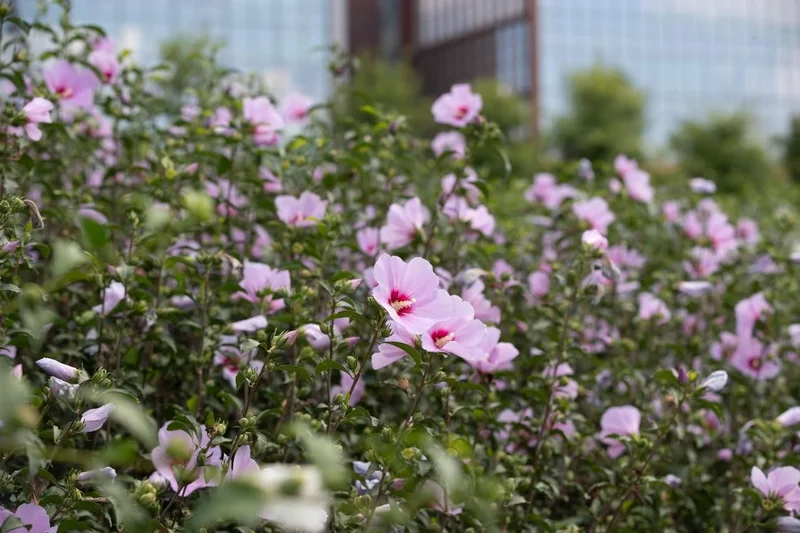
Long before it became the official national flower of Korea, the "mugunghwa" — or Rose of Sharon — held a quiet, defiant place in the country's collective memory.
During decades of Japanese colonial rule in the early 20th century, the resilient pink and white blossom was systematically targeted for eradication, viewed by imperial authorities as a dangerous symbol of Korean independence and cultural endurance.
As Korea prepares to mark the 81st anniversary of its liberation from colonial rule on Aug. 15, the Seoul Botanic Park said Friday it will open a massive, 18-day exhibition celebrating the historical flower. Featuring 6,086 mugunghwa plants spanning 104 distinct varieties, the outdoor display in the park's Open Forest aims to reintroduce urbanites to a blossom whose story is deeply intertwined with the nation's modern sovereignty.
Running from Aug. 1-18, the showcase goes beyond standard horticulture to feature rare floral bonsai and preserved genetic lineages. Among the highlights is the public debut of a "descendant tree" saved through advanced genetic preservation techniques. The sapling was cloned from an iconic, 80-year-old mugunghwa tree on the grounds of Kyungbock High School in central Seoul — designated a historical landmark in 2013 — which withered and died in 2025. Botanists at the park intervened just prior to its death, extracting genetic material to raise a viable successor and preserve its living history.
"The mugunghwa is a quintessential summer flower that blooms tirelessly every day for nearly a hundred days during a season when few other flowers thrive," said On Su-jin, director of the Seoul Botanic Park. "It is a key species that our institution focuses on breeding, and we will continue to lead efforts to research and promote our national flower."
Visitors to the free exhibition will encounter vibrant color variations of the hibiscus — including the red-centered hongdansim, pure white baekdansim and rare bluish cheongdansim — alongside educational photo displays and weekend family workshops detailing the botanical science behind the species.
For city residents navigating midsummer heat, the exhibition offers a reflective encounter with a flower that continuously drops its petals only to bloom fresh the following morning — a natural metaphor for endurance that helped sustain a nation through its darkest historical chapters.
This article was published with the assistance of generative AI and edited by The Korea Times.