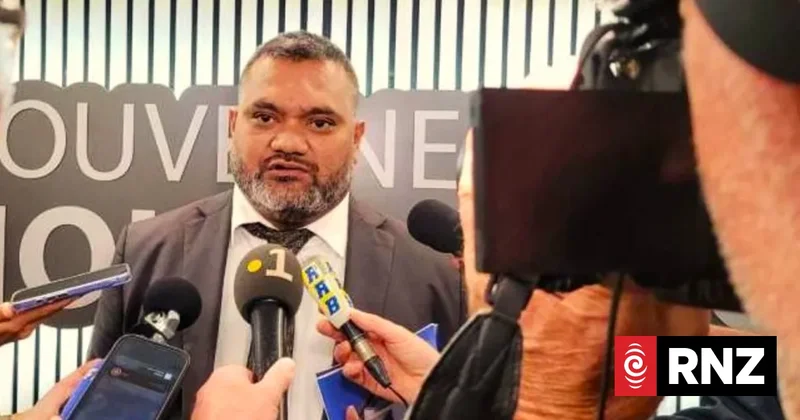
A member of New Caledonia's Eveil Océanien kingmaker's party, Milakulo Tukumuli, has been elected as the new president of the territory's 'collegial' government.
He was elected by New Caledonia's 54-member Congress during a special sitting on Friday where the 11 members of the French Pacific territory's "collegial" government were elected.
The Congress sitting directly stems from the recent provincial elections held on 28 June.
Based on the principle of proportional representation, the new executive is a reflection of the recent provincial elections, as well as the "governance pact" sealed between the pro-France bloc and the small Eveil Océanien party, often dubbed the "kingmaker's party".
Under the pact, which already propelled pro-France candidate Virginie Ruffenach (pro-France Rassemblement party) to the Chair of the Congress earlier this month, the head of Eveil Océanien (a Wallisian-based party he founded in 2019), Milakulo Tukumuli, 41, takes the helm of New Caledonia's government as its President.
Tukumuli is the first New Caledonian government President of Wallisian ascent.
Who is in the mix?
Another prominent figure from the previous government, Christopher Gygès (Les Loyalistes party), is now the local government's Vice-President.
Gygès previously held key economy-related portfolios and is also likely to follow-up on the implementation of a massive economic and social recovery plan mostly financed by France by way of a mix of loans and grants.
Another key figure in the new government is Alcide Ponga (Rassemblement party), who was Government President under the previous government.
Ponga's tenure as former President was marked by a difficult period especially after the serious unrest which started in May 2024 and caused 14 dead and over €2.2 billion, as well as the economic and social repercussions from massive destructions and job losses in the economic and business sector.
Ponga is also a former executive in the nickel mining sector and is highly likely to be given New Caledonia's mining portfolio to address the sector's worst crisis in decades.
Pro-France Philippe Blaise (Les Loyalistes party), a former Vice-President of the Southern Province, is also part of the new team with an experience mostly related to the economic and finance sector.
Another newcomer, pro-France Laurent Bonnefond, (Les Loyalistes party) also specialises in matters related to business and civil society initiatives.
Meanwhile, Nina Julié (pro-France Les Loyalistes party), whose pre-politics career includes experience in teaching, is one of the newcomers to government, and is widely tipped to take charge of the education sector.
On the pro-independence (UC) side, Johanito Wamytan, with an artistic and cultural background, is also part of the new government, one of a new generation of leaders brought forward by pro-independence grouping, UC-FLNKS.
Also from the UC-FLNKS, Ernest Déméné specialises in youth and social-related issues.
Meryl Marlier, another pro-independence new member of the government, has a background marked by agricultural, rural and farming matters.
Billy Forest is the only minister from New Caledonia's other pro-independence party, the UNI (Union for Independence). He has a finance and budget-oriented background.
Sensitive allocation of portfolios
After the vote in Congress, on Friday morning, the local Parliament held a separate vote, at New Caledonia's government house, for the 11 new government members to elect, in restricted committee, their President and Vice-President.
Even though the position of President was reserved for Milakulo Tukumuli, under the "governance pact" struck between the pro-France bloc and Tukumuli's Eveil Océanien, the most difficult part of the ministerial "conclave" seems related to a formal announcement regarding the allocation of ministerial portfolios.
The announcement has not yet been made, but New Caledonia's government has ten days to do so.
Tukumuli is expected to deliver his general policy address before the Congress in the coming days.
The finalisation of New Caledonia's government, under previous tenures, has sometimes proved lengthy, painful and marked by eleventh-hour intense negotiations between opposing camps.
On occasions, the position of President was left vacant for as long as five months (from February to July 2021) after the election of the government.
This was due to differences within the pro-independence camp before UNI's Louis Mapou effectively took office on 8 July 2021.
On other occasions, in 2019, for similar reasons, the delay (one month) was caused by divergence within the pro-independence camp regarding the appointment to the position of Vice-President.
During the installation of the previous government, in 2025, one minister who demanded more powers under his portfolio (environment), also delayed the ministerial sectors' distribution process by almost two weeks before he finally obtained what he claimed.