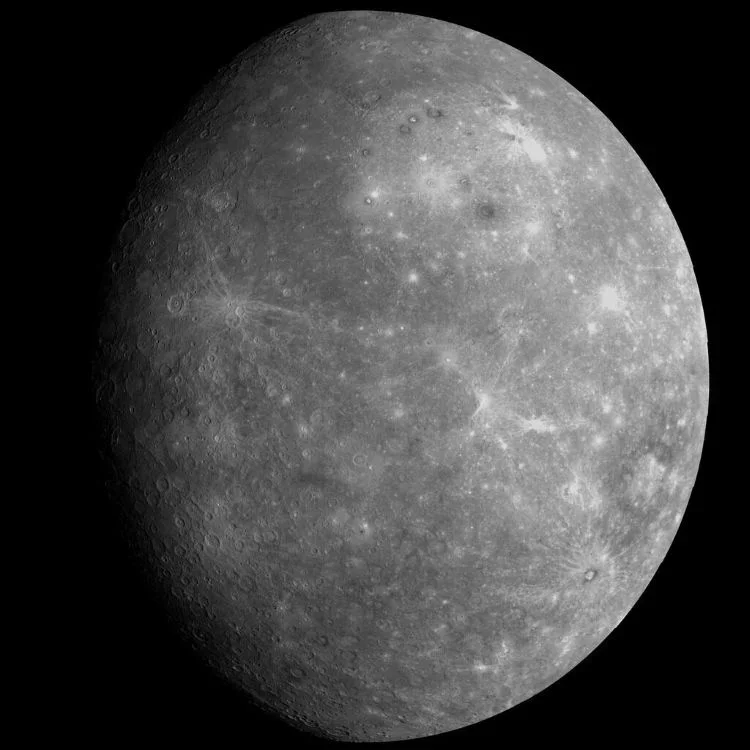
The planet Mercury is the first planet from the Sun but also one shrouded in mystery. This is primarily due to the limited number of spacecrafts that have visited it, but this limited data has provided scientists with new and exciting characteristics previously thought impossible. One fascinating aspect is its magnetic field, which was first discovered in March 1974, which both surprised and puzzled scientists due to the planetâs small size, which is measured at about half the size of the continental United States from coast to coast.
Even after more than 50 years, scientists might have learned something new and exciting about Mercuryâs magnetic field. As discussed in findings recently published in Nature Astronomy, a team of scientists from the United States and France explored the potential for Mercuryâs magnetic field, which has long been known to be only about 1 percent as strong as Earthâs magnetic field, to trap the solar wind during certain locations in the small planetâs orbit, resulting in producing radiation belts long thought not possible.
For the study, the researchers used a combination of data obtained from NASAâs MESSENGER mission, new data analysis methods, and computer models to simulate whether Mercury could possess a radiation belt. The primary motivation behind the study was to settle a decades-long debate regarding whether Mercury and its small magnetic field could produce radiation belts potentially on par with Earthâs Van Allen Belts.
These belts are donut-shaped regions of charged particles produced and trapped by Earthâs magnetic field that protect the Earth from harmful space radiation but can also damage spacecraft that fly through them. The debate regarding Mercuryâs magnetic field began from data collected by NASAâs Marnier 10 spacecraft in 1974 while NASAâs MESSENGER spacecraft later refuted these findings.
In the end, the researchers found that Mercuryâs magnetic field captures the solar wind and produces a radiation belt at various points throughout its elliptical orbit around the Sun. For example, the team found that the radiation belt exists about half the time that Mercury is at its farthest point from the Sun (called aphelion) and about 20 percent of the time when Mercury is closest to the Sun (called perihelion), with each radiation belt having a lifespan of between 8-12 hours.
âExtreme space weather events at Earth are actually normal on Mercury,â said Dr. Weijie Sun, who is an assistant research physicist in the Space Sciences Laboratory at UC Berkeley and a co-author on the study. âMercury provides a natural laboratory to infer what the radiation could look like at other planets that orbit close to their stars, as well as distant planets during extreme space weather.â
Unlike Earth, which has a near-circular orbit, Mercury has an elliptical (oval-shaped) orbit, meaning it travels both farther and closer from the Sun throughout its orbit. Orbital shapes are known as eccentricity and are measured from 0 to 1 with Earth having an eccentricity of 0.0167 while Mercury has an eccentricity of 0.2056.
Like Mercury, our solar system serves as its own natural laboratory for what activity other stars and exoplanets could be exhibiting. While Earthâs magnetic field and Van Allen Belts both play a vital role in shielding our planet from harmful space radiation and preserving life, this could potentially be the case on exoplanets. Additionally, out of the more than 6,300 confirmed exoplanets, it is estimated that between 4,500 to 5,000 of them orbit closer to their stars than Mercury orbits our Sun.
What new insights into Mercury and how its magnetic field traps solar wind will researchers make in the coming years and decades? Only time will tell, and this is why we science!
As always, keep doing science & keep looking up!