I’m almost relieved it’s regnet junge Hunde (“raining cats and dogs”) in Munich as it gives me an excuse to head back to my accommodation, the Hotel Vier Jahreszeiten Kempinski.
I don’t feel guilty because I’ve already ticked off the city’s glorious sites: Marienplatz, the historic plaza; the Viktualienmarkt, the famous food market; and the English Garden, Munich’s answer to Hyde Park. Besides, the hotel is an attraction in itself.
Hotel Vier Jahreszeiten, which literally means “four seasons”, was built in 1858 by King Maximilian II, head of Bavarian royal family. He wanted somewhere for the nobility to stay at any time throughout the year (that is, all seasons). The building was considered astounding for its modernity, including an elevator and six marble bathrooms. In 1970, this long-running establishment joined the Kempinski Hotels group.
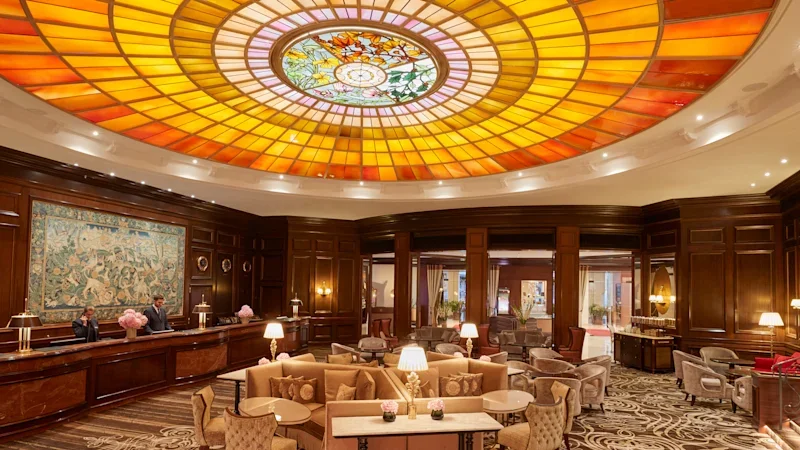
In the lobby, I’m enveloped by the comforting murmur of visitors, who chat over coffee as they relax in low-backed velvet chairs; unsurprisingly, this is touted as “Munich’s best living room”.
But my attention is on the round stained-glass ceiling that crowns the space. The central motif, four types of flora, is surrounded by vibrant oranges and yellows, a magnificent spectrum that reflects nature’s four seasons.
Get exclusive travel deals delivered straight to your inbox. Sign up now.
Nods to the seasons appear elsewhere throughout the building, including above the breakfast buffet, where a series of hand-painted plates are affixed to the ceiling. They reveal the stages of an apple tree throughout the year. (These were made by the porcelain company Nymphenburg, which is owned by Prince Luitpold of Bavaria, the great-great-grandson of Maximilian II. The prince has also lent chandeliers from royal Bavarian castles to the hotel.)
I admit that on my first morning, I don’t notice the porcelain sculpture. I’m too focused on the incredible breakfast: an array of Bavarian sausages and charcuterie, breads, fruits and pastries, and even an impressive honeycomb from the hotel’s rooftop bee hives. Quality local produce and cuisine are key here.
Chef Franz-Josef Unterlechner heads the hotel’s two restaurants: the Michelin-starred Schwarzreiter Restaurant (on break during my stay), and the Schwarzreiter Tagesbar, where I dine one evening.
I miss the restaurant’s must-try dish, schnitzel, but I view one as it’s whisked by. It’s decorated with tiny flowers and micro herbs, so colourful it could be straight from the walls of the Pinakothek der Moderne, Munich’s modern art gallery. My choice, gazpacho soup, is bright green and equally as vibrant.
Nothing is more evocative of royal times than the afternoon tea, hosted in a glorious heritage-listed space with a chandelier and a frieze that depicts hunting scenes. Crisp white cloths, flower posies and fine china set the scene. With pinkie firmly up, I taste four courses of delicacies, from a pina colada cube to a guava-and-chocolate mousse (plus scones and jam with clotted cream), the works of chef patissier Ian Baker.
It’s a different vibe in the cosy Jahreszeiten Bar, a 1950s-American-style bar with a shiny, low-slung wooden counter, swivel seats and massive copper lamps that emit a muted orange glow. I half expect to spot Sean Connery cradling the hotel’s signature martini. Connery is just one of many famous guests, who also include Queen Elizabeth, J. Lo, and Usain Bolt.
On my final morning, I can’t decide whether to enjoy the 12.5-metre pool near the recently opened new spa or lounge in my room, a deluxe executive suite. Cream hues, Moorish-style lamps and parquetry floors make it stylishly cosy. But the sun appears.
Almost reluctantly, I head out to explore and tackle the changing seasons of another kind.
THE DETAILS
Stay
Rooms at Hotel Vier Jahreszeiten Kempinski start from €400 a night. See kempinski.com/en/hotel-vier-jahreszeiten
Eat
Afternoon tea costs €75 a person, and an additional €10 for a glass of champagne. Bookings required.