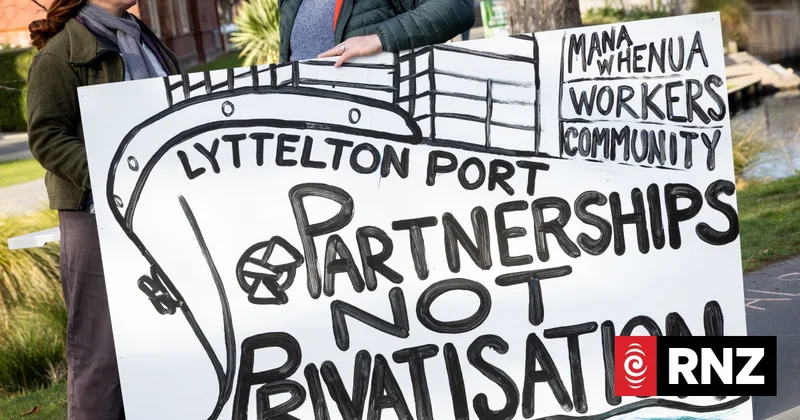
Union protesters say a decision to reject an unsolicited bid by global port operator DP World and three Canterbury rūnanga to run Lyttelton Port does nothing to allay their concerns about privatisation.
On Thursday the city council's investment arm Christchurch City Holdings Limited (CCHL) announced that it had declined to proceed with the Tōnui consortium's proposal to lease the port's operations.
Protesters rallied outside CCHL's Cambridge Terrace office on Friday morning, saying they still wanted to emphasis their call to keep the port in public hands.
Maritime Union Lyttelton branch secretary Gerard Loader said the decision was good news but he feared the next tempting offer would not be far away.
"This would be in my short career the fourth time we have had to beat this down. It has happened in Auckland and they beat it down there. The private interests are always trying to get in through the ports because as we know everything initially comes through a port and if we get privatisation in the port it will just flow through to every other asset that we have," he said.
Rail and Maritime Transport Union's Lyttelton branch secretary Mark Wilson said the port company's $800 million plan for an expansion and modernisation project remained a concern.
"We have concerns around the potential of holding on to a significant amount of debt on to a company, with someone else coming on later on and saying lets partially privatise this to get rid of the debt. That's generally how things go. We're not saying no but we're saying you need to involve mana whenua, you need to involve the community, you need to involve Christchurch in this," he said.
Wilson said the proposal should go out for public consultation.
Keep Our Assets spokesman Murray Horton said it was an ongoing battle fending off the sale of CCHL assets despite community feedback repeatedly showing people did not want assets privatised.
"It's not just us. We are not just speaking on our behalf or for a couple of unions. The public of Christchurch have made it very clear that they want the assets that they own and paid for to remain in public ownership," he said.
CCHL did not respond to a request for further comment on Friday.
In a statement announcing its decision, chair Bryan Pearson said the council's 2026/2027 letter of expectation to CCHL did not support leasing the port and encouraged retention of a directly employed workforce.
"Our assessment of the proposal, as presented, is it does not meet the threshold for ongoing consideration and is not sufficiently compelling to warrant further detailed investigation by CCHL, or additional consultation with council given its letter of expectation," he said.
Pearson said CCHL had considered the port company's improving operational and financial performance, as well as its advice about infrastructure resilience and maintaining a culture of safety and efficiency.
"CCHL maintains full confidence in the LPC [Lyttelton Port Company] board and management and their operation of the port, and continues to work closely with LPC in considering the port's long-term development and associated investment," he said.
Tōnui spokesperson Dr Liz Brown said the consortium was disappointed by CCHL's decision.
"Our concern is not simply that the proposal was rejected. Our concern is whether it was ever given a genuine opportunity to be assessed on its commercial merits," she said.
Brown said the proposal would have retained public ownership while bringing together Christchurch, three Ngāi Tahu papatipu rūnanga and one of the world's leading port operators in a partnership that shared investment, risk and international expertise.
"CCHL says it carefully considered the proposal and concluded it did not meet the threshold for ongoing consideration. That raises an obvious governance question. What was that threshold, how was it established, and how was this proposal assessed against it," she said.
If assessment was robust, there should be no difficulty explaining at a high level the process the board followed and why it concluded that the proposal did not warrant further consideration, Brown said.
"Given the scale and significance of the proposal, we also believe there is a legitimate question as to whether it should have been considered more broadly by Christchurch's elected representatives before the process came to an end," she said.
Brown said CCHL's response raised governance questions.
The group was assessing its options and considering any next steps.