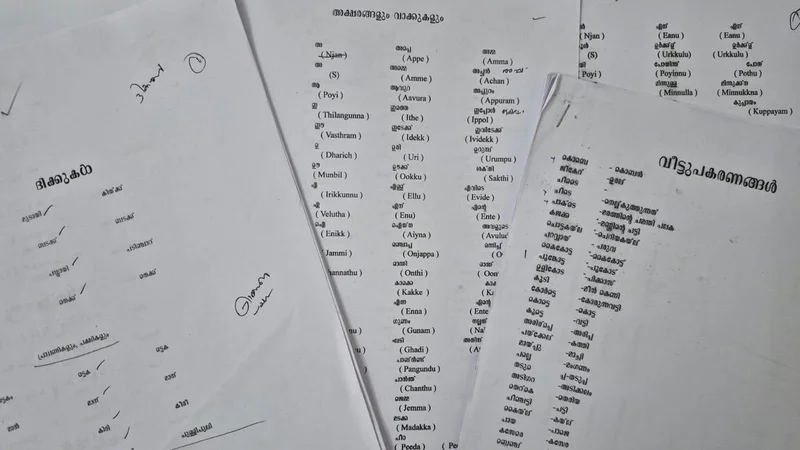
Two endangered tribal languages spoken by the Mavila and Malaveduvan communities in north Kerala are being documented in separate dictionaries to preserve their linguistic heritage before they disappear.
The dictionaries are being jointly prepared by writer and Sir Syed College faculty member Dr. Mohanan V.T.V. and tribal writer O.K. Prabhakaran Vattamathatta.
The project records the vocabulary, oral traditions and cultural identity of communities with a combined population of around 60,000, spread across the Kannur and Kasaragod districts.
The Mavila dictionary has been completed and is scheduled for publication in the first week of August, while work on the Malaveduvan dictionary is under way. Together, the volumes will document more than 5,000 words collected through extensive fieldwork in tribal settlements.
Dr. Mohanan said the initiative was driven entirely by a personal commitment to preserving rapidly disappearing languages.
“This is entirely an effort born out of personal interest. We realised these languages are slowly vanishing, and unless they are documented now, future generations may lose them forever,” he said.
The project builds on Dr. Mohanan’s earlier Malayala Bhashabheda Nighandu (Malayalam dialect dictionary), published by the Kerala Bhasha Institute, while Mr. Prabhakaran’s research from Iyyama Jovv traces the history of the tribal communities’ struggle for rights.
Language loss
According to Dr. Mohanan, migration, formal education and increasing interaction with mainstream society have accelerated language loss, particularly among Mavila families who migrated from Kasaragod to Kannur. Many have already lost their ability to speak their mother tongue.
“During fieldwork, an 84-year-old man residing in Naduvil in Kannur told me that his father knew the language, but he himself could no longer speak it. That shows how rapidly it has disappeared,” he said.
The researchers faced significant challenges in documenting the languages because community members were reluctant to trust outsiders. Dr. Mohanan said he initially visited settlements on his own, but his efforts were met with suspicion, despite repeated visits and long stays.
“No matter how much effort I put in, they remained hesitant. Eventually, I realised that this approach would not succeed,” he said.
Documenting the language
He later identified a trusted member from within the community to continue the documentation work, which greatly improved acceptance. However, he observed that some members still stayed away from community meetings. He said it took nearly three years to establish an effective process for documenting the language.
Dr. Mohanan said language shift begins early, with children adopting Malayalam, Kannada, and other dominant languages after joining schools or moving outside their settlements. Adults working in offices or across the Kerala-Karnataka border also gradually abandon their native language, accelerating its decline.
He criticised the institutions created for the welfare of the communities for failing to provide adequate employment opportunities to tribal members.
“An institution meant for their development does not even employ people from the community,” he said, describing it as a major setback to language preservation. Fluent speakers are now found mainly in tribal settlements around Neeleswaram and nearby areas of Kasaragod district.
Tulu, Kannada and Malayalam influences
The Mavila language, meaning “the language of those who produce food”, is also known in some places as Markoli Tulu, while the Malaveduvan community speaks the Malaveduvan language. Both languages show strong influences of Tulu and Kannada, with Malayalam words entering later through migration and education.
The dictionaries also reveal distinctive linguistic and cultural features. The communities traditionally have no separate words corresponding to the Malayalam concepts of happiness and sorrow, reflecting a unique worldview. Everyday kinship terms are also marked different in ‘Mavila’. Father is ‘Amme’, mother ‘Appe’, husband ‘Mere’, wife ‘Merithi’, sister ‘Megthi’, and younger brother ‘Megya’.
“These are not just words. Every entry reflects the life, culture and worldview of the community,” Dr. Mohanan said. The researchers also plan to publish a separate research volume documenting the oral traditions, history, culture, and way of life of the Mavila and Malaveduvan communities.
“Our objective is not merely to compile dictionaries but to ensure these communities and their languages receive the recognition they deserve before they are lost,” Dr. Mohanan said.
Published - July 31, 2026 11:26 am IST