When Stefan Rahmstorf walked through the ruined streets of Dresden after the river Elbe flooded in 2002, and again when severe heat killed 70,000 people in Europe the following summer, the German climatologist wondered if worsening weather would make the political world “wake up and do something really decisively” to cut emissions.
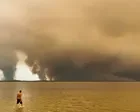
But two decades and 750bn tons of atmospheric carbon pollution later, Rahmstorf is still wondering when the wake-up call will come. Last week, as he was surfing off France’s Atlantic coast with his partner, he watched towering smoke plumes darken the sky as a ferocious inferno raged outside Bordeaux.
“The sun through the smoke was looking really blood red, and it put the whole landscape into an eerie orange-coloured tint, like being on Mars or in some dystopian sci-fi movie,” says Rahmstorf. “It felt totally surreal.”
Europe is suffering through a hellish summer of relentless heat. I’m writing this from Berlin, where temperatures are set to reach 37C (99F) on Thursday – and ferocious wildfires that have broken records in France and Spain.
What are the impacts of this, and should it really have come as a surprise? All that and more, after the headlines.
Essential reads
In focus
Rahmstorf had avoided summer holidays in the Mediterranean for years because of his knowledge of the science of climate breakdown, but he did not expect Europe’s cooler Atlantic coast to also be so hot. Yet as he looked back to the land from his surfboard on Wednesday last week, he saw a plume of smoke rising behind the dunes. Two days later, the fire that had caused it it had escalated into a blaze so great it generated a rare thunderstorm cloud capable of igniting even more fires. Rahmstorf cut his holiday in Lacanau a day short and headed to smoke-choked Bordeaux on Friday evening, eager to take the train back to Germany the next day.
“The air was much better when we woke up Saturday morning,” he says. “But the idea of having to inhale this kind of air for any length of time seemed something we really wanted to avoid.”
This summer’s fire weather across the EU has broken records for severity for this time of year, data published on Thursday shows, while more of France has already burned than in any previous full year on record. More than 300,000 people across France and Spain were forced to flee homes and tourist accommodation within a week, and some are returning to burned-out homes and destroyed belongings.
The ever-increasing toll of heat and fire has risen almost too fast for scientists to track. Rapid analyses have found June’s heatwave would have been “virtually impossible” in a world without climate breakdown, while the recent level of soil dryness in western Europe – a driver of bigger blazes – was made five times more likely. Heatwaves are estimated to have claimed at least 10,000 lives and cost grain farmers €2bn in lost crops.
Climate scientists say the extreme weather ravaging the world is in line with what models have long predicted, though some disasters appear to be striking earlier and with more strength than expected. The underlying relationship between fossil fuel pollution and global temperatures was well known even to oil companies, who were at the forefront of corporate efforts to stymie action to cut pollution, as far back as the 1970s. A study Rahmstorf co-authored in 2023 found ExxonMobil’s predictions of global heating over the following decades to have been mostly accurate, as skilful as independent academic and government models, and also very much at odds with its public statements on the matter.
“When you’re among young people, it’s hard for them to understand how long we’ve known all the basic facts about climate change,” said Rahmstorf, a scientist at the Potsdam Institute for Climate Impact Research who has worked on the topic for 35 years. “Even when I started as a PhD student in the 1980s, it was very clear that our emissions were causing global warming and all the consequences it would have.”
Europe has warmed about twice as fast as the global average and extreme weather events were already being strengthened by climate change when Rahmstorf was an early-career researcher. But it is only in the last brutal few years that the explosive effects of climate breakdown have been widely acknowledged as an immediate threat to the continent. A string of particularly deadly floods whose rains were made worse by carbon pollution – including Germany’s Ahrtal in 2021 and Spain’s Valencia in 2024 – have hit amid successive scorching summers that bring intense wildfires.
Yet even as Europe’s leaders acknowledge the scale and cause of the problem, they have weakened the very rules in place to stop it from getting worse. Two weeks ago, the European Commission proposed watering down the continent’s emissions trading system, a form of carbon market widely hailed as its most successful tool to cut pollution.
“What people are not getting is that we can’t turn this back – the CO2 to a large part remains in the air for thousands of years,” said Rahmstorf. “Some people think we can wait and, when it gets too bad, then we reduce emissions and things will get better again. People don’t realise that we can’t make it get better again. We can only prevent it from getting much worse.”
Read more:
Almost 4,000 people evacuated from tourist sites near Bordeaux as wildfires rage in France and Spain
‘Ash fell from the sky’: Tourists describe fleeing ‘apocalyptic’ wildfires in France
Major incident declared in Suffolk as 90 firefighters tackle wildfire on heathland