- English made official language in New Zealand
- Opposition MPs call move 'unnecessary' and 'political'
- See more Daily Mail on Google - save us as a Preferred Source
English has been formally ratified as an official language of New Zealand alongside Te Reo Māori and sign language, prompting criticism from opposition MPs.
The bill, passed on Thursday, said English 'has long been a de facto official language in New Zealand, that is, widely used and accepted as an official language, but its official language status is not set out in legislation'.
Despite tabling the successful bill, Justice Minister Paul Goldsmith of New Zealand's ruling conservative coalition did not take part in the debate.
Casey Costello, from the Right-wing NZ First Party told the House of Representatives the bill was important for the 'hard-working Kiwi battlers' her party represented.
'It is not trivial, unnecessary, or a distraction to this House in a democracy to deliver for those who elected us to this House,' she said, according to RNZ news.
'This is a practical measure.
'It aligns the statute book with long-standing practice and provides a clear statement about the status of English within New Zealand's official framework.'
However, the bill drew strong criticism from Greens MP Tamatha Paul, who said supporters were a 'bunch of snowflakes that hear the word "Aotearoa" and cry themselves to sleep'.
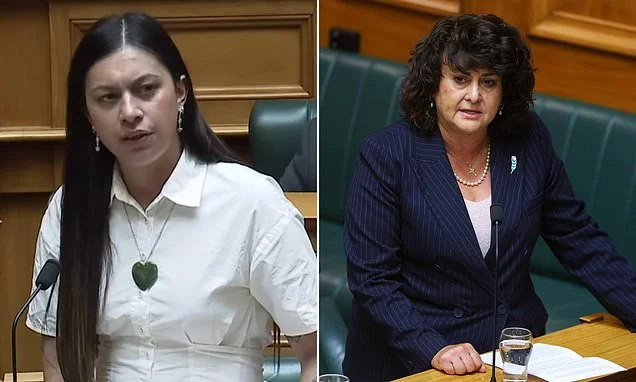
The New Zealand House of Representatives (pictured during question time) passed a bill ratifying English as an official language of New Zealand
Te Pāti Māori MP Oriini Kaipara criticised the time wasted in debating the bill
'Let me tell you why Te Reo Māori has a protected language status - because it was beaten out of Māori systematically,' she said.
'We had to march our arses to Parliament, demanding that the indigenous first language of this country be recognised and not beaten out of the mouth of its native speakers.'
Te Pāti Māori MP Oriini Kaipara, speaking in Māori, also took aim at the bill, and criticised its proponents for wasting time by seeing it ratified.
'What benefit will come from this kaupapa (plan), from this event? Why are these hours and the time of all of these Members being used up in this way?' she asked.
'Why are we spending all this time on this bill, when we know that English is already the main language of New Zealand?'
Critics also pointed out that the UK hadn't needed to legally declare English as its official language.
Thursday's parliament sitting wasn't the first time fiery comments had been made about the bill.
In February, New Zealand First leader Winston Peters said the bill would fix a 'virtue signalling narrative' that had taken hold of the island nation.
Tamatha Paul was critical of the bill, labelling politicians who advocated for it as 'snowflakes'
Simon Court, a coalition member of the ACT Party, added that the bill had support of regular New Zealanders.
'When we go to a hospital, for example, and we want to find our way to the ward, find our way to an appointment, of course, the English language is important,' he said.
Court also seemed to suggest that New Zealand's air safety record could come under threat if English wasn't recognised as an official language.
'If you're an air traffic controller (you had) better make sure you're using English, so the pilots understand how to land, where to land the plane,' he said.
The Labour Party voted the bill through, despite members calling it 'silly' and 'meaningless'.
MP Camilla Bellich said English was already an official language of New Zealand and didn't need to be politicised, adding that the coalition has tabled other meaningless bills.
'I (wonder) if they might want to legislate for the changing of the seasons?' she said.
'Or for the fact that there are sometimes four seasons in one day in Auckland, or whether they should legislate for the southerly winds to blow through Wellington?'
Casey Costello of the New Zealand First Party was a vocal supporter of the bill
Members of Prime Minister Christopher Luxon's National Party, the biggest member of the ruling coalition, gave notably clipped remarks about the bill.
Nationals MP Vanessa Weenink appeared to echo some of the objections of the left with her comments.
'English was the principal language of this house before this bill. It will be our principal language after this bill,' she said.
'The only thing, Madam Speaker, that has really changed, is that we've spent several hours speaking in English about it.'
New Zealanders will head to the polls this November for a general election.
The latest Taxpayers' Union–Curia poll has the Labour Party on 31.5 per cent and the Nationals on 30.5 per cent of the popular vote.