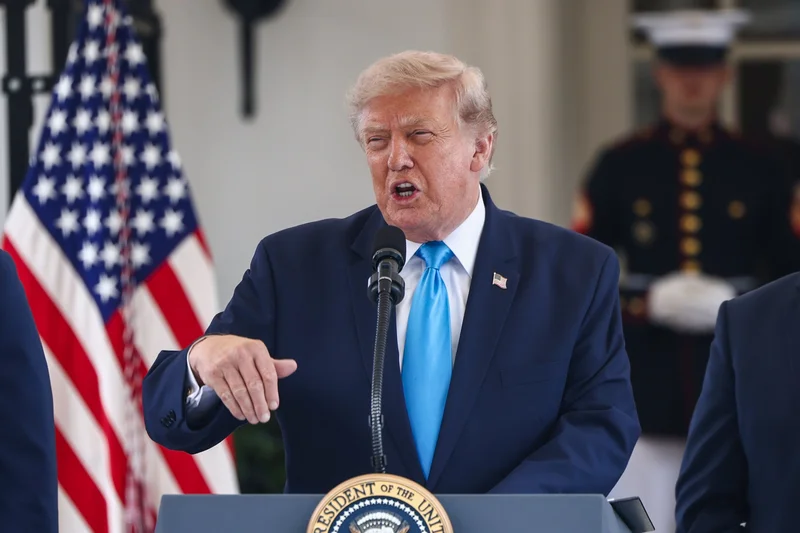
President Donald Trump announced Thursday that Hamas has agreed to disarm as part of a phased plan that would lead to a gradual Israeli military withdrawal from Gaza, marking what his administration described as a major breakthrough in efforts to end nearly three years of war.
But with Israel yet to publicly endorse the agreement and many implementation details unresolved, significant uncertainty remains over whether the deal can be fully carried out.
The announcement comes about nine months after a U.S.-brokered cease-fire took effect, a truce that dramatically reduced large-scale fighting but failed to produce a lasting political settlement.
Since then, negotiations have repeatedly stalled over the most contentious issues, particularly Hamas' future military role, Israel's withdrawal and the governance of postwar Gaza.
In a post on social media, Trump said the agreement would unfold through "carefully structured phases," with Hamas surrendering its weapons while Israeli forces withdraw in parallel.
"As disarmament is completed, Israeli forces will withdraw, and the International Stabilization Force will work with a new Palestinian police force to take responsibility for Gaza being safe for its residents and its neighbors," Trump wrote.
According to U.S. officials and representatives of Trump's Board of Peace, the agreement is built around the president's previously proposed 20-point peace framework.
The plan envisions the complete dismantling of Hamas' military capabilities, including its extensive tunnel network, weapons depots and arms production facilities.
In return, Israel would gradually withdraw from Gaza, allowing a technocratic Palestinian administration to assume control with support from an international stabilization mission.
The National Committee for Administration of Gaza (NCAG), established under the Board of Peace, would oversee the territory's transition to civilian governance.
Trump described Hamas' disarmament as the most difficult element of the cease-fire process and portrayed the reported agreement as a critical milestone toward creating a new Palestinian government capable of administering Gaza without the group's armed presence.
Hamas confirmed Friday that it had agreed to a deal aimed at ending the war, including provisions addressing its weapons and Israel's gradual military withdrawal.
The group said its weapons would be placed under the supervision of a committee established by the Board of Peace as part of the transition process.
Ghazi Hamad, a member of Hamas' negotiating team, said the organization was making painful concessions to spare Palestinians from continued suffering.
"We are making concessions for the sake of our people in the Gaza Strip, to save them from killing and displacement," Hamad said.
He stressed, however, that Hamas' commitment depends on Israel fulfilling its own obligations.
"The agreement contains a clear provision stating that Israel must commit to and implement its obligations. If Israel does not implement the agreement, neither will we."
Hamas officials said they would spend the coming days negotiating implementation mechanisms with mediators, including timelines and verification procedures.
The group estimated those discussions could take at least two weeks before implementation begins.
Despite the announcement, officials acknowledged that dismantling Hamas' military infrastructure will be a lengthy process.
According to U.S. and Board of Peace officials, Gaza's police force is expected to transfer its weapons to the new administration within approximately two weeks. However, those weapons represent only a small portion of Hamas' overall arsenal.
Heavy weapons, rockets, anti-tank missiles and military infrastructure would be addressed later through a broader demobilization process expected to last between 200 and 350 days.
Officials also said Hamas' vast tunnel network, long considered one of its principal military assets, would be systematically dismantled during that period.
Nickolay Mladenov, the Board of Peace's high representative for Gaza, emphasized that implementation would determine whether the agreement succeeds.
"Implementation and verification have to be real," Mladenov wrote on X. "Withdrawal must move in lockstep with decommissioning."
While U.S. officials said Israeli negotiators were consulted throughout the talks, Israel has not publicly confirmed that it has accepted the agreement.
The Israeli Mission to the United Nations declined immediate comment following Trump's announcement.
According to a senior U.S. official, Israel is not being asked to make concessions beyond those contained in Trump's original peace proposal, which calls for ending military operations in Gaza and gradually withdrawing Israeli troops as Hamas completes disarmament.
The official added that Trump would be "very, very disappointed" if Israel failed to honor the agreement.
Trump met Israeli Prime Minister Benjamin Netanyahu at the White House earlier this week, although neither leader publicly disclosed details of their discussions.
Attention now shifts to regional mediators expected to oversee implementation.
Egypt's state-linked Al-Qahera News reported that Cairo will soon host a new round of talks involving Egypt, the United States, Qatar and Türkiye to coordinate the second phase of the cease-fire.
Officials said the mediators will focus on sequencing Israel's withdrawal, verifying Hamas' disarmament and establishing mechanisms to resolve disputes that arise during implementation.
U.S. officials also described Iran as an unpredictable factor.
Although Tehran reportedly encouraged Hamas to reject the proposal, officials believe Iran's ability to influence events has diminished as it remains preoccupied with its confrontation with the United States following this year's conflict.
Although the October cease-fire remains formally in effect, violence has continued across Gaza.
Israeli forces have maintained near-daily airstrikes and artillery attacks across much of the territory, while Hamas has repeatedly accused Israel of violating the truce through military operations, attacks on civilians and advances beyond agreed military lines.
According to Gaza health officials, more than 1,200 Palestinians have been killed since the cease-fire began. On Thursday alone, local officials said Israeli strikes killed at least four people, including two children.
Israel continues to control more than half of Gaza, while tens of thousands of Palestinians remain displaced in overcrowded tent camps or heavily damaged neighborhoods after years of fighting devastated much of the enclave.
The war began following Hamas' Oct. 7, 2023, incursion into southern Israel, in which about 1,200 people were killed and 251 were taken hostage.
Israel's military campaign in Gaza has since killed more than 73,000 Palestinians, according to Gaza's Health Ministry.