Los Angeles is a jumble of neighborhoods, styles, cities, people and problems that is hard to explain. But perhaps one example says it all. On July 16, a water main ruptured in West Hollywood, one of the city’s wealthiest, most central and trendiest areas. A break of barely three feet caused damage to homes and cars and opened up a massive sinkhole on Sunset Boulevard, one of Los Angeles’s main thoroughfares. The street remained closed for 10 days, bringing traffic to a standstill. If a rupture of less than a meter can cause that much disruption, what will happen when several million people descend on this sprawling, Frankenstein-like city — with its limited public transit system, scarce hotel capacity and already high costs — for the Olympic Games two years from now?
The FIFA World Cup served as a stress test for what lies ahead beginning on July 14, 2028. That may sound a long way off, but given everything that remains to be done, despite preparations having been underway since 2017, it is just around the corner. Another major event, the Super Bowl, which will be held in the city on February 14, 2027, will also present challenges, though those will be concentrated over a much shorter period. The FIFA World Cup, however, highlighted Los Angeles’s strengths and shortcomings more clearly than any event to date. The eight matches played in the city drew more than half a million spectators, while the fan zones attracted another 250,000, according to the city’s tourism office. They also provided a glimpse of how Los Angeles manages a global sporting event, welcoming visitors from dozens of countries, speaking multiple languages, many without access to private transportation and all with very specific needs: lodging, meals, sightseeing and transportation.
“The tournament has shown the power of major sporting events to boost tourism, create economic opportunities and bring the global community together,” Adam Burke, head of the city’s tourism office, said in a statement. “Looking ahead to Super Bowl LXI and the 2028 Olympic and Paralympic Games, Los Angeles is ready to seize this momentum and roll out the red carpet to welcome visitors from around the world on the biggest stage.”
But is the city really ready at this point? So far, it appears to have plenty of boxes left to check. Among them is the thorny issue of homelessness. Data released in late July showed that, after two years of decline and despite billions of dollars in spending, the number of people living on the streets in the city rose again by 3.4%, surpassing 45,000. Across Los Angeles County, the figure has reached 73,000.
Because the 561,656 spectators who attended World Cup matches, along with the thousands more who gathered around the venues and in fan zones after being unable to secure often pricey tickets, are still fewer than the number expected for the Olympics. Organizers told EL PAÍS that Los Angeles is preparing for about five million visitors. They also expect more than 15,000 athletes, including “approximately 11,200 Olympic athletes and 4,480 Paralympic athletes from 206 National Olympic Committees and 185 National Paralympic Committees.”
In 2024, Paris welcomed 4.2 million visitors during the Olympic Games, according to OECD figures. Of those, 1.2 million were international visitors. But the French capital is served by several airports, all well connected by public transportation, and boasts 16 metro lines with more than 240 stations that carry more than four million passengers a day, according to the regional transit authority.
Los Angeles, meanwhile, has only one major airport, with its other airports serving primarily local and regional traffic. Its rail network consists of 101 stations and six lines, carrying only about 230,000 passengers a day, according to Metro data. Even when buses are included, public transit in Los Angeles County serves roughly one million passengers daily. Paris and its surrounding Île-de-France region move 41 million passengers a day.
The Californian city plans to invest $120 billion over the next 40 years to improve its transportation system. In fact, it recently opened three new stations as part of a four-mile extension that took 12 years to complete. That makes it difficult to imagine all of the planned improvements being ready by 2028.
The numbers speak for themselves. So do the traffic jams. Los Angeles International Airport, or LAX, is a bottleneck, a horseshoe-shaped maze that traps both arriving and departing travelers and that has spent years trying to improve its links with the city. The airport’s long-awaited rail connection finally opened in the summer of 2025. Even so, it does not provide a direct ride to downtown Los Angeles; multiple transfers are required. What’s more, passengers traveling between the airport terminals and the Metro system must still rely on aging, chaotic shuttle buses.
A small automated people mover known as SkyLink will run along a 2.2-mile route linking the terminals with the rail station, parking facilities and rental-car agencies. Construction began seven years ago, and the system was originally scheduled to open in March 2023, but it has yet to enter service. After months of testing, officials now estimate it will open in October. But after three years of delays, who can say whether everything will be ready in time for the Games?
Accommodation is another major concern. The hotel industry’s trade group, Los Angeles Hospitality, already describes the Games as the biggest event to hit the city since the 1984 Olympics and estimates that roughly 10 million tickets will be sold. Organizers told EL PAÍS that more than five million people signed up during the first ticket-registration window, which was open only to local residents, although they declined to say how many tickets have actually been released or sold. Organizers are also already recruiting volunteers for the Games: no fewer than 60,000 will be needed, and the application process is already underway.
The hotel industry expects the Games and the influx of visitors to put enormous strain on daily life in Los Angeles. It estimates that room rates will rise by 40% to 80%. With the average nightly rate already around $218, prices could climb above $300 a night. The sector also estimates that an additional 25,000 to 35,000 workers will be needed to meet demand.
During the World Cup, Los Angeles hosted eight matches involving 12 teams and drew more than half a million spectators over nearly a month, all centered on a single venue, SoFi Stadium. The Olympics are expected to bring roughly eight times as many visitors in half the time, spread across dozens of venues throughout the county.
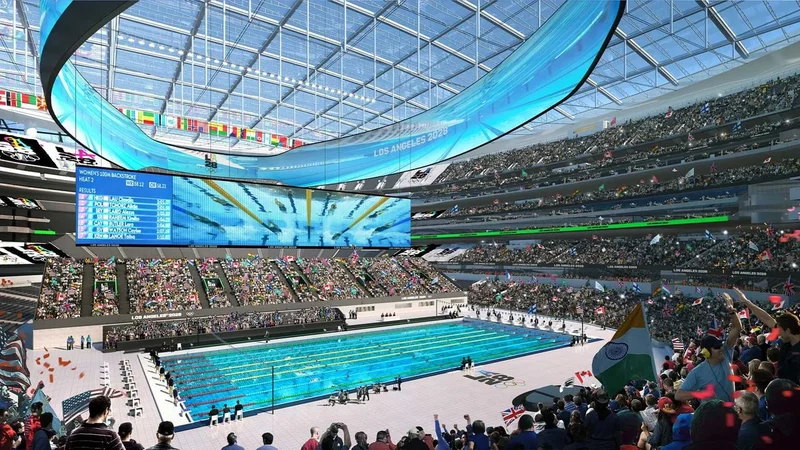
The venues themselves are well advanced and promise to be among the most sophisticated in the world. SoFi Stadium will be the centerpiece, hosting the opening ceremony alongside the Los Angeles Memorial Coliseum, the only stadium ever to host events at three Olympic Games. SoFi will also be transformed into an Olympic swimming venue for the swimming competitions. The stadium, which opened about a decade ago and cost $5 billion to build, sits just a couple of miles from the airport.
The Olympics, of course, are pulling out all the stops. They will be a massive event, quite possibly the largest ever staged. That relentless drive to outdo previous editions, to make each Games bigger and better than the last, is one reason the Olympics have generally lost money. Every edition has done so except one: Los Angeles 1984, which made the city more than $235 million, according to UCLA research.
As the Los Angeles Times reported last summer, the 2028 Games are projected to cost about $7 billion, with organizers forecasting roughly $1 billion in profit. Those finances will be managed by LA28, the private organization responsible for staging the Games. But if costs exceed projections or the expected profit fails to materialize, the city will be responsible for the first $270 million in overruns, after which the State of California would cover an additional $270 million.
In other words, the Games will affect Angelenos not only through traffic, longer lines, higher prices and transportation challenges, but potentially through their wallets as well. It will take another couple of years to find out whether that impact is ultimately for better or for worse.