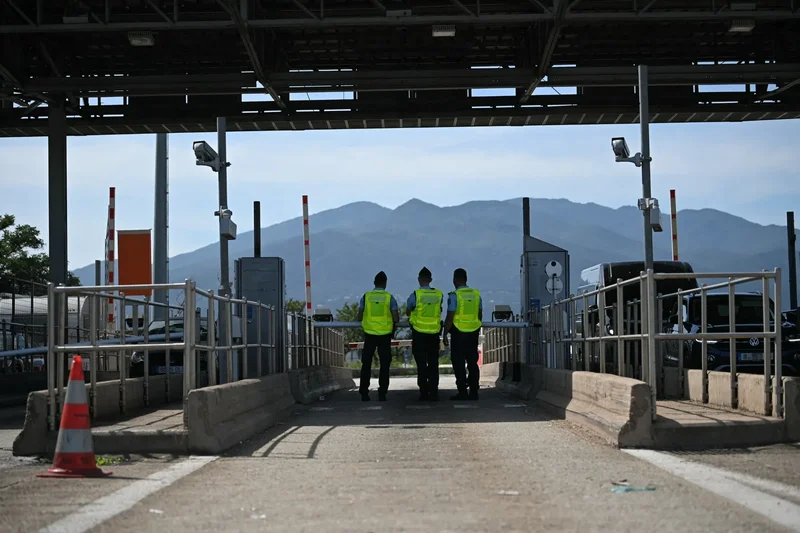
French Interior Minister Laurent Nunez said on X that he had "given instructions to immediately step up controls at the Spanish border" on Thursday night.
He also announced the activation of the rapid intervention border force "for in-depth inspections."
Speaking separately to broadcaster RTL, he said he had spoken with his Spanish counterpart and would do so again Friday.
"We have controls at the French-Spanish border, they already exist, and in fact they have been reinforced in recent months," Nunez said.
"We have a mobile force permanently deployed. We will, of course, take measures if there are movements toward French territory," he added.
"In any case, we will obviously strengthen border controls."
Travel between France and Spain - both part of the Schengen area - usually does not involve any checks, but governments within the zone retain the right to bring back controls if they believe it is necessary.
Lunez did not clarify exactly how or where the checks would take place, but it is likely to involve land crossings between the two countries, either by car or by train.
There are several road crossing points between the two countries, with border posts equipped for checks by customs officers or border control - or both.
People driving between France and Spain should bear in mind that the A63, the main road between the two countries, remains closed south of Bordeaux due to wildfires in France.
Likewise mainline train services south of Bordeaux are halted and French rail operator SNCF says they will not resume until at least Sunday, August 2nd.
READ ALSO: Road closures, deliveries suspended - ongoing disruption from French wildfires
Nunez's announcement came after thousands of migrants crossed overnight from Morocco into Spain's north Africa's Ceuta enclave, a police source said on Friday, as Spanish Prime Minister Pedro Sanchez was set to arrive to manage the latest migrant crisis on the border.
In recent days, a total of around 40,000 migrants have crossed into the territory - population 80,000 - the source added.
The sudden massive influx has sparked a crisis for Spain's government, with Madrid sending troops to boost security in Ceuta.