PSEi sinks on PH’s record-high debt
MANILA, Philippines — Local stocks fell on Friday as investors weighed the Philippines’ record-high national government debt, Middle East tensions and a busy week of key economic data ahead.
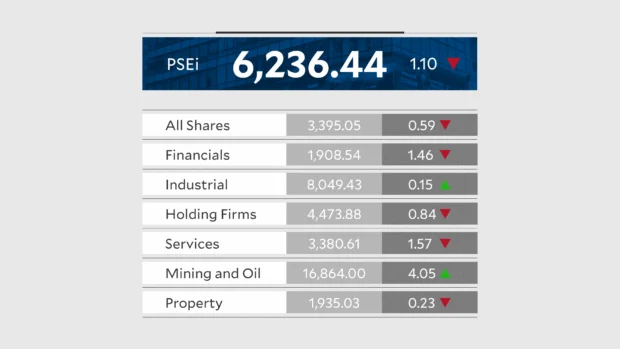
The benchmark Philippine Stock Exchange Index (PSEi) slipped 1.10 percent, or 69.31 points, to close at 6,236.44.
READ: PH government debt stock tops P19 trillion
Article continues after this advertisement
Philstocks Financial Inc. said investor sentiment was weighed down after the government’s outstanding debt reached a fresh record of P19.07 trillion.
Uncertainty surrounding the United States-Iran conflict also kept investors on the sidelines.
Market participants likewise turned cautious ahead of several major economic releases next week, including the July inflation rate, the June labor force survey and second-quarter gross domestic product data.
Luis Limlingan, head of sales at Regina Capital Development Corp., said sellers eventually took control of the session, driven by positioning adjustments related to the PSEi rebalancing.
“The increased selling pressure weighed on the broader market and pushed the benchmark lower by the close,” Limlingan said.
Article continues after this advertisement
Despite the decline, trading activity remained robust, with net value turnover reaching P9.55 billion.
Strong demand
Foreign investors, however, remained sellers, posting net outflows of P1.04 billion.
Article continues after this advertisement
Sectoral performance was mixed, with the mining and oil index leading the gains after climbing 4.05 percent. The services sector posted the biggest decline, falling 1.57 percent.
READ: PSE revises index rules ahead of 2027 rebalancing
Among index members, Converge ICT Solutions Inc. emerged as the day’s top performer, rallying 6.10 percent to P10.78.
Meanwhile, JG Summit Holdings Inc. was the session’s biggest loser, dropping 3.89 percent to P22.25.
Analysts said the market’s retreat reflected investors’ preference to reduce risk as they monitored both domestic economic indicators and overseas developments, particularly geopolitical tensions that could continue to influence global financial markets. /pai INQ