Energy utility nexus building on PH as an upper-middle income country
MANILA, Philippines — Early this month, the Philippines got the news that it is now an upper-middle income country. This was after it entered the World Bank’s gross national income (GNI) per capita threshold of $4,636-14,375, recording $4,850 in 2025.
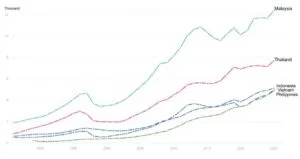
That growth in income wasn’t inevitable. While the reclassification was the product of “broad-based expansion”, “gains across all major industries”, and “an economy-wide shift”, it had taken almost four decades before the country advanced out of the lower middle-income bracket. Even then, it continues to rank below the progress of its neighbors, namely Vietnam ($4,970), Indonesia ($5,120), Thailand ($7,690), and Malaysia ($12,380).
If the Philippines intends to build on and sustain being an upper-middle income country (or maybe even aspire for the upper extreme), the government, private sector, and civil society cannot leave its growth and development to chance.
Article continues after this advertisement
From the perspective of someone in the electric power industry, a rise in a country’s income and wealth suggests that demand for electricity for industrial production, infrastructure, commercial services, and residential appliances is also bound to increase. As such, the energy utility nexus of energy access, sufficiency, and affordability must be improved to help fuel growth and development.
But to offer a caveat, GNI per capita isn’t the be-all and end-all of progress since it does not account for inequality, deprivation, and poverty. Using the lens of the energy utility nexus, there are still shortcomings when it comes to energy access and sufficiency, with about two to three million Filipino households still living without electricity and many enduring frequent rotational blackouts.
At the same time, according to data from the International Energy Agency (IEA), the share of residential energy expenditure over mean income in the Philippines is 11.2% (2025), much higher than Thailand’s 6.4% (2024), Vietnam’s 4.8% (2025), Indonesia’s 4.6% (2023), and Malaysia’s 2.2% (2024).
In other words, Filipinos are allocating a much larger portion of their household budget for gasoline, electricity, and other energy products relative to their regional peers. Again, the Philippines has the lowest GNI per capita among the group.
Article continues after this advertisement
From an electric power industry standpoint, how do we go about changing the Philippines’ circumstances in order to broaden the pie while ensuring a just amount of slice for those at the bottom?
First, the country must double down on expanding energy access and securing energy sufficiency. Luzon, Visayas, and Mindanao need all forms of energy to provide ample supply, attract investments and enterprises, and produce new jobs and a competent workforce.
To cite a study by the Department of Energy, when the electricity access of low-income families is improved to 16-24 hours a day, their income is projected to increase by 49.4% while their expenditure rises by 52.2%. These are substantial gains, indicating how expanding access and sufficiency uplifts human value and economic potential.
Article continues after this advertisement
Another study by the University of the Philippines Center for Integrative and Development Studies found that electrified primary and secondary schools performed 10-12% better on their National Achievement Test, with the Science subject seeing “a larger median improvement”.
Second, the Philippines needs cheaper energy sources to help drive down its cost as a percentage of mean income. Energy must be economically sustainable because high costs limit the utility and value it can create for society.
Greater flexibility via diversification in supply chains, technologies, and energy sources can hedge the country against extreme price volatilities. At the same time, while maximizing indigenous energy with mostly variable renewable sources, the Philippines must consistently calibrate and balance the impact on total systems cost. After all, the intermittent power generation of solar and wind represents added cost for the consumer in the form of reserves and/or energy storage.
Third, the government, private sector, and civil society must all work together to attain a fair and viable energy utility nexus. Ensuring energy access, sufficiency, and affordability is too big a task for any single sector, much less one organization, to accomplish alone. It is precisely because it develops, not just inside the power plants and networks, but also within a policy environment all the way to where the energy is finally consumed.
Much like the journey that has brought the Philippines to upper-middle income status, the energy utility nexus is a whole-of-society affair. Similarly, if we do not want it to suffer from delays and setbacks, it cannot be left to chance.
Guest columnist Suiee Suarez is AboitizPower VP for Corporate Affairs