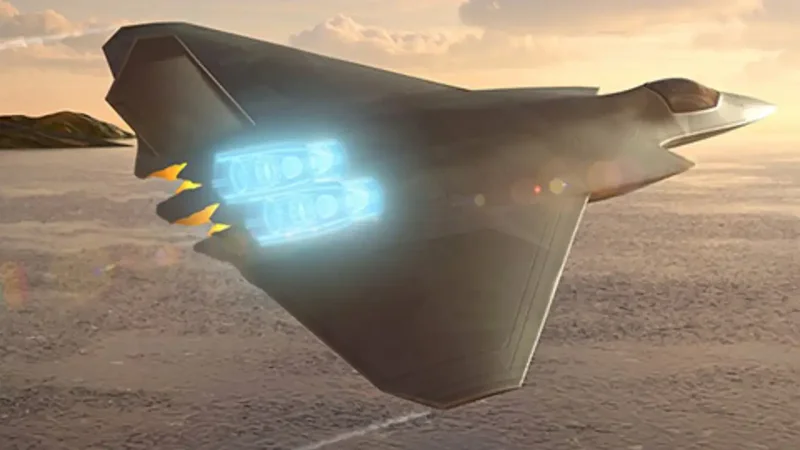
As air forces around the world gear up to induct sixth-generation fighters, different technologies and considerations such as all-aspect stealth, loyal wingmen, and directed-energy weapons are taking the limelight.
One of the most important aspects of this new paradigm of aerial warfare will be Variable Cycle Engines (VCEs). These engines will not only power these fighters, but also provide the energy needed for the power-hungry systems that will take them to the next level of combat effectiveness.
Delivering additional thrust and energy in a fuel-efficient manner is essential, especially since the presence of a solitary, non-stealthy large-bodied aerial refueller could reveal the presence of a stealthy fighter.
Variable Cycle Engines work in a way that reduces an aircraftâs fuel consumption. They operate more efficiently by altering their bypass ratio, allowing aircraft to switch between modes tailored for endurance and those designed for combat performance.
Jet engines have historically been built to prioritize either fuel efficiency, such as those used by airliners, or performance, such as those used by fighters.
A VCE acts as a two-in-one power plant, combining both qualities.
One of the leading VCE programmes currently under development is General Electricâs XA100. The same firm also makes the F404 power plant for the Tejas and the F414 for the Tejas Mk-2.
Unlike most jet engines, which use a two-stream airflow design, this powerplant adds a third stream in efficiency mode, improving fuel economy while also enhancing thermal management by cooling the engine. In power mode, that same third stream is directed to the engine core, increasing power output. The same engine can therefore be configured for either efficiency or maximum thrust.
These next-generation powerplants also incorporate advanced materials such as ceramic composites for heat resistance, advanced cooling systems, and digital engineering techniques that accelerate development while managing risk.
Ground tests have already shown that the XA100 can deliver both increased thrust and superior fuel efficiency compared with current fifth-generation engines.
Fuel efficiency across different flight profiles extends range, enabling aircraft to loiter longer or penetrate deeper into hostile airspace. A reduced thermal signature also enhances stealth, making aircraft harder to detect and target using infrared sensors.
European nations are also working on their own VCE projects. Under the Future Combat Air System (FCAS) programme, French firm Safran is working on an adaptive propulsion system, with a focus on adaptive fans, compressors, and advanced thermal management systems.
For the UK-Japan-Italy Global Combat Air Programme (GCAP), British firm Rolls-Royce, Italian firm Avio Aero, and Japanâs IHI Corporation are working to develop a VCE. This ensures that propulsion technology will remain central to maintaining air superiority.
Civil aviation could also benefit from engines that reduce fuel consumption while enabling faster travel.