Municipal councils across Canada are seeing outside influence creeping into local agendas in the form of lengthy submissions by people who don’t live where decisions are being made.
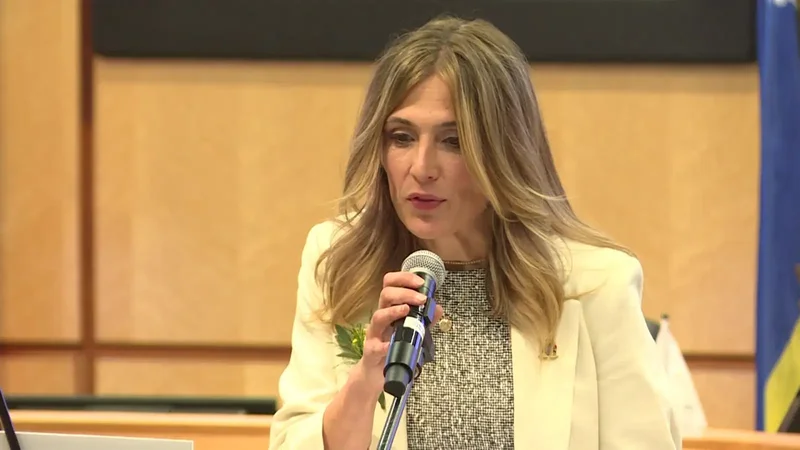
Sarah Turnbull, a councillor in the City of Regina, told Global News she receives hundreds of “copy and paste” emails in her inbox daily from people across Canada and even outside the country that dilute the concerns of her own constituents.
“When you are actually representing people in your ward and community, you want to hear from people from your ward and your community,” she said.
The issue came to a head in Regina last year when Turnbull brought forward a motion that would limit out-of-town delegates to written submissions or require them to have a councillor’s endorsement before speaking at a council meeting.
The motion reached council following an eight-hour meeting where Turnbull said a “significant” number of people from outside of Regina registered to speak about the decision to fluoridate the city’s water supply.
According to the meeting minutes from May 2, 2025, more than 100 delegates were registered to speak on the issue.
“It’s a municipal filibuster,” Turnbull said.
Turnbull’s motion was ultimately defeated but she says she continues to hear from a growing number of people outside her constituency, especially on issues she says are “politically charged.”
“There’s a lot of ideology questions, which get a lot of outside influence,” she said, speaking about a discussion surrounding a local mosque’s call to prayer.
Get breaking National news
“You can read between the lines in their email that like, if it happens in Regina, it’s going to happen in their town or whatever. They’re worried about that,” she continued.
While some remote appearances are well-intentioned and relevant, others can be mostly unrelated and bog down the work of council.
The City of Toronto faced a similar issue when it decided to rename Yonge-Dundas Square to what is now Sankofa Square.
City council voted to give the square a new name in December 2023 following a petition to remove the name associated with the transatlantic slave trade.
During a council meeting in June 2024, Toronto Coun. Stephen Holyday brought forward a petition signed by more than 30,000 people that he said stood in opposition to the city’s decision to rename the square.
Coun. Paula Fletcher said she saw the petition and many of the signatures came from people living outside the city.
“Petitions, I think they’re great to have. They’re usually from residents from the City of Toronto about an issue,” she said in the chambers at the time. “I appreciate Coun. Holyday bringing that forward but I’ve happened to have looked at it quite extensively and there are names from all over, including Tampa, Florida.”
Global News reached out to the City of Toronto for a copy of the petition but did not receive a response before deadline.
Council ultimately decided to move forward with the renaming.
More recently, Vancouver Mayor Ken Sim called on the B.C. government to amend the Vancouver Charter so only Canadians can register to speak at public hearings after countless people from the U.S. called into a meeting last week on the city’s villages plan. The lengthy hearing ran from morning to midnight.
Sim called it an act of “foreign interference,” stating “we do not want that democratic institution disturbed or disrupted.”
Debates around social policies, as well as school board topics like sex education and curriculum, can become heated, Michael Murphy, a professor of political science at Queen’s University, told Global News.
“The threats to those sorts of programs are within a highly politically charged, very online environment that doesn’t stop at the county line and can continue into broader social media-driven influencer culture” Murphy said.
Murphy has researched foreign influence on municipal elections, but said the advent of digital communications like email and social media channels has allowed more people to directly access councillors, mayors and other municipal officials.
“Municipal amalgamations in Ontario coincided with the introduction of councillor emails and public accessibility, although I wouldn’t expect that in the late 1990s councillors were overwhelmed to this extent,” he said. “Now they’re governing a municipality of a hundred or a couple hundred thousand and the email traffic is increasing rapidly.”
But he said many municipalities are not equipped to respond to this kind of public input.
“It is just unreasonable to expect that communities of a few hundred or a few thousand people will have the tax revenues to support this engagement or the staff time that can be allocated towards monitoring, especially advanced cyber attacks or foreign interference,” he said.
Many councillors, especially in smaller communities, are holding part-time positions at the municipality, Murphy added.