Ask the experts
How does smoke affect my health? What should I do if I have to evacuate? Globe reporter Jesse Winter and emergency physician Shazma Mithani answered your questions about wildfire season.
The call went out on Facebook. The answer came on horseback.
“It’s go time, folks,” Rhonda MacDonald wrote. “We need to evacuate our cattle and could use some good help on horseback.”
The instructions were practical, there was no time for anything else: Horses MUST be shod. Dogs welcome, but only if they were useful. The safety meeting was mandatory.
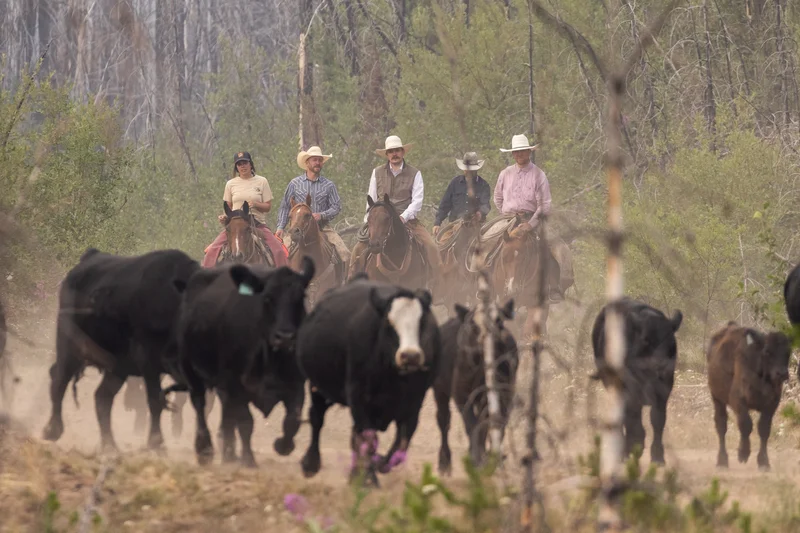
Hours later, in the darkness before sunrise, horse trailers began rolling into the driveway of the Bar FX Ranch, a family-run cattle and hay operation outside Merritt, B.C.
Headlights cut through the smoke. Horses shifted in trailers. Riders pulled on chaps, preparing for a day of work in a valley where the fire, though still a couple dozen kilometres away, was moving closer.
The cattle were heading uphill, away from the ranch, following water and instinct.
The MacDonald herd, some 150 in total, had spent the summer climbing into the high country roaming a vast, 100,000-acre expanse of Crown rangeland above the ranch. They followed grasses, waterholes and cooler air, escaping the valley heat and flies. Normally, riders drove them home on horseback each fall.
But this was not normal.
The team needed the herd to come down, away from the encroaching blaze. That demanded something maps cannot provide: riders who knew every ridge and hollow where frightened cattle disappear. The Nicola Valley is a landscape of grasslands and hay fields, pine-covered ridges and open range – a place where generations of ranchers have moved cattle between valley bottoms and high-country grazing grounds, following the rhythms of the seasons.** **
Across the broader Thompson-Nicola region, more than 96,000 cattle graze, spread among hundreds of operations. For ranchers here, wildfire does not just threaten homes and barns; it threatens the landscape that sustains their stock.
Before the riders headed up Mimenuh Mountain, Wayne MacDonald stood in front of a whiteboard with a red Sharpie and began drawing. Not a map, exactly. More like 50 years of memory. He sketched the ridges, draws and escape routes cattle would choose under pressure. There was one thing he kept returning to: the lack of escape routes. “As far as road, there’s one in and one out.” They knew there might come a moment when staying was no longer brave – it was reckless.
The whiteboard was mounted a little too high, so Mr. MacDonald stood on a wooden block to reach it.
“The cattle are going to be at the waterholes, right? We all know that,” he said. “So I’m kind of the guy that knows where the waterholes is.”
“It’s a high-risk move leaving the road with your saddle horses,” he told them. “There’s stump holes from the last burn. They’re deep. A horse can go down.”
Mr. MacDonald didn’t need anyone to explain how serious the Brunswick Complex Fire near Boston Bar had become. Days earlier, he had watched it punch a towering mushroom cloud into the sky above the valley. Ranchers knew what the cloud meant. The fire was now big enough to create its own weather.
“That fire is knocking on the back door of the range,” he told the riders. “It’s time to get the cattle down.”
Over 36 years, Rhonda MacDonald had built the kind of knowledge that cannot be hurried: how cattle move under pressure and the small signs that reveal when a herd is about to turn.
But the country that she and her husband had spent a lifetime learning no longer behaves the way it once did. Fire has altered the forest. Flood has altered the river. Drought is changing the calendar.
Last summer, the cattle came home from the range in August rather than October. By July, the Nicola River was lower than Ms. MacDonald had ever seen it in her 30 years on the ranch.
Five years earlier, wildfire had burned through the Nicola Valley, taking 85 per cent of the MacDonalds’ range. They were unable to get every animal off the mountains in time. They later found two dozen cattle in a line – heifers and their young, animals that had tried to make a run for it. “You could smell them before you saw them,” Mr. MacDonald said. “Those images are engraved in our brains.”
The herd represents years of breeding, work and hope.
“They’re part of us,” Ms. MacDonald said. “They’re our future.”
Since the catastrophic 2017 wildfire season, large-scale cattle evacuations have become an increasingly familiar part of ranching in British Columbia’s Interior. Some 10,000 cattle have been moved off wildfire-threatened rangeland across the province this summer alone, according to Kevin Boon, general manager of the BC Cattlemen’s Association. Every evacuation carries risk, as fast-moving fires leave ranchers with less time to find and gather animals. In 2017, the worst year for cattle losses in recent memory, an estimated 1,200 to 1,400 cattle died.
Even cows brought out alive are not always saved. Crossing scorched ground can leave them with severe burns to their feet, udders and bellies, injuries so serious they often need to be euthanized.
The 12 riders who answered the MacDonalds’ call reflected the many paths into ranching: through family, through mentorship and through choosing a place and making it their own. Their sons, Wyatt and Garrett, members of the Shackan Indian Band like their father, were among them.
When the terrain turned against them, the riders looked to one man: Butch Sahara.
Before age caught up to him, Mr. Sahara was a rodeo champion. Around the Nicola Valley, though, his reputation was never about the titles he won. The younger riders might outride him. They could not out-know him.
At 84, his body carried the evidence of a lifetime in the saddle. He was missing three fingers on one hand. He had a fused ankle, a fused wrist, an artificial knee.
During the evacuation, after hours in the saddle, arthritis made his feet hurt so badly he couldn’t dismount.
But getting off the horse was never the point. His body had slowed. His judgment had not.
He was still one of the valley’s best ropers. He politely declined an invitation to return the next day: he had a rodeo to compete in.
Melody Jacobsen was there because Wayne and Rhonda had taught her how to read cattle and country. She had recently bought a small acreage and 20 heifers of her own.
“From the time I was 16, I have wanted to own my own land, my own dirt, my own soil,” Ms. Jacobsen said. “I never wanted to rent.”
Ashley Pederson wore Wrangler jeans and a baseball cap, a trout tattoo running the length of her forearm.
She spent a day chasing cattle through wildfire smoke, then proudly showed a gallery of herself at her most battered – including the baseball-sized goose egg she got after losing sight of a fly ball in the sun.
She moved to the Nicola Valley as a farrier, expecting it to be temporary. Instead, the ranching community pulled her in – especially Ms. MacDonald. In a profession that has not always made room for women, Rhonda showed her she belonged exactly as she was.
“Rhonda is who I want to become,” Ms. Pederson said, pushing her sweaty hair off her face.
Ms. Pederson calls herself a “muleman,” which feels fitting.
Mules are often misunderstood. They are called stubborn. But Ms. Pederson sees something else: they are not animals you force. You earn their trust.
It is hard not to hear her describing herself.
Getting the cattle down Mimenuh Mountain required more than skill.
It is a broken landscape of sharp rock, dense timber and hidden holes left by fire. It is usually a place of long silences. On this morning, the valley echoed with bawling cattle, horses blowing and nickering, and riders calling across the slopes.
The cattle could duck beneath branches and vanish.
“They move like water,” Ms. MacDonald said. “They take the path of least resistance.”
The riders could not.
They crashed into tree trunks and pushed through branches that tore at their arms and faces. Ms. MacDonald came away with a nasty cut across her neck. One of the ranch horses finished the day with a sore leg and four gashes across her coat.
The team monitored the horses for heat exhaustion and smoke stress, hauling them in trailers whenever they could, saving horsepower for the mountain. When the riders broke for bannock or beer, some horses stood with their heads hanging, nearly asleep on their feet, soaked in sweat.
Except for the GPS collars blinking on Mr. Sahara’s dogs, there was something timeless about the scene. It could have been 1970. Or 1870. The tools had changed. The knowledge had not.
Then the cattle reminded everyone how quickly that knowledge would be tested.
They heard the cattle before they saw them.
For the first time that morning, the plan began to come apart. The riders had gathered the herd and were easing it downhill. Then, in an instant, it scattered.
Brown and black bodies surged through the forest, cows calling for their calves, turning back toward the country they knew.
The horses were stressed and exhausted. The riders had to stay calm.
When one group broke away, Mr. Sahara and his dogs went to work.
His reins rested loosely in one hand. Ahead of him, two dogs moved through the timber. He knew every fold of the mountain.
He rarely raised his voice. A quiet command was enough. One dog broke left. The other peeled wide to the right.
“Go get her,” he whispered.
The dogs disappeared into the smoky bush. Trained to stop when they found cattle, they waited for Mr. Sahara.
A while later, he rode in.
It was not magic. It was a lifetime of paying attention.
A cow does not understand fire maps or evacuations, only instinct: the calf beside her, the grass beneath her, pressure, escape.
Working from the edges, the riders slowly tightened the herd, pushing them to a mountain corral. Dogs swept wide through the timber, blocking escape routes before slipping back into the trees. Riders anticipated where the cattle wanted to go and quietly took away those options until the herd began drifting in the only direction left.
For a moment, it worked.
Then, once again, the cattle changed their minds.
Suddenly, the herd veered to the right and charged up another steep slope.
Ms. Jacobsen reined right and rode hard after them, her blonde braid bouncing behind her as she disappeared over the ridge.
One calf refused to leave the mountain.
It slipped back into the timber while the rest of the herd drifted downhill. The riders searched for it, but eventually moved on.
They knew it would come looking for its mother.
Later, someone rode back up to the mountain corral. There was the calf, waiting by the gate.
By afternoon, the heat had settled over the valley like a weight. The grass, bleached by drought, crunched beneath every hoof.
Dust coated faces and stuck to sweat. Dogs snuck naps in the shade. The fire remained somewhere beyond the next ridge, close enough to command everyone’s attention, far enough that no one could afford to panic.
In the pen, after the noise and confusion of the morning, a heifer nuzzled her calf’s ear.
Mr. MacDonald spotted them, a grin reaching his eyes before his mouth.
“Critters,” he called them.
Ms. MacDonald looked over the herd. “We got 58 cows, 53 calves and three bulls down. Pretty darn happy.”
Each one is worth $4,500 to $9,000, but to the MacDonalds, the real value lies in decades of genetics and careful breeding that cannot quickly be replaced.
Ms. Jacobsen was already looking ahead to the next day.
“It’s the only life worth living.”
Later, the cattle were moved to a pasture near Merritt, to wait out the fire. They might not stay there long. If conditions changed, the herd could be on the move again.
For years, when cattle and country turned against them, the people of the Nicola Valley knew who to call: Butch Sahara. Now, riders were looking to Wayne and Rhonda.
“They’re the next Butch,” Ms. Pederson said. “They’re the legends now.”
The valley still carried the scars of the fire, but years of recovery were visible too. Purple and white wildflowers bloomed among the blackened timber. New fences traced slopes where none had been before.
Five years earlier, bringing the cattle down the mountain had taken nearly three weeks. This time, the work took three days. In the years between, the MacDonalds had rebuilt more than the ranch. They had learned how to work with a changing landscape.
Saving the herd was one thing. Making sure someone knew how to save the next one was another.
By afternoon, the riders were met halfway down the mountain with sandwiches – and by four-month-old Jamie MacDonald.
He was too young to understand the fire, the smoke or the long day that had brought the herd home. Five years earlier, after losing part of her herd and much of her range to wildfire – then watching floods and a mudslide tear through the ranch – Ms. MacDonald had wondered whether this place could survive. She was, at the time, also grieving the loss of her mother.
Now she was a grandmother, watching her son’s boy babble on the ranch.
The cattle were safe. The ranch, somehow, was still standing. And a new generation was already learning what this place demanded.
Fires of the future: More from The Globe and Mail
The Decibel podcast
First Nations spent centuries managing forests with fire, though their practices were suppressed in much of Canada. Is it time to rethink that? Anishinaabe scholar Riley Yesno spoke with The Decibel about the history and politics of shaping the landscape. Subscribe for more episodes.