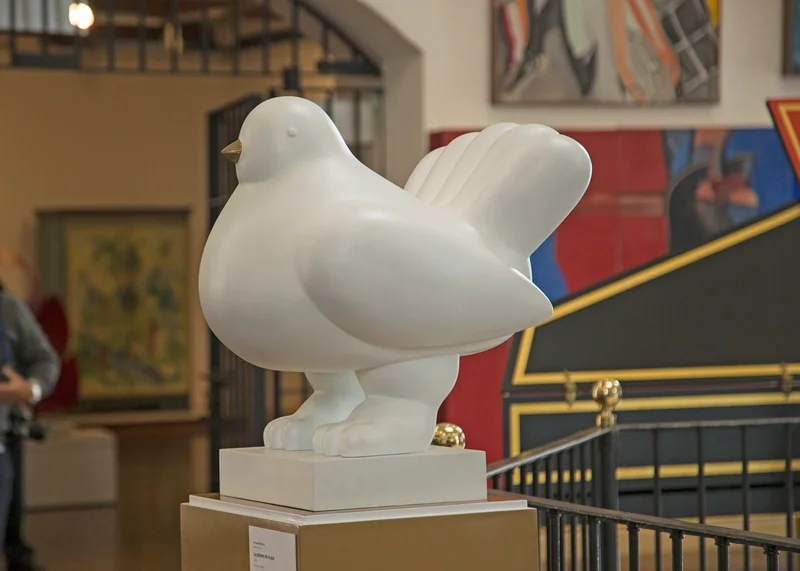
Colombia Returns Botero Dove of Peace Ahead of Transition
Culture · Colombia
Colombia has removed the Botero Dove of Peace from the presidential palace and returned it to the National Museum, officials confirmed, marking a symbolic shift ahead of the August 7 presidential transition.
A Sculpture Born from a Historic Moment
Fernando Botero (1932-2023) donated the bronze sculpture to the nation on September 24, 2016, just hours before the Colombian government signed a landmark peace agreement with the Revolutionary Armed Forces of Colombia (FARC).
The accord formally ended more than five decades of internal armed conflict that had killed over 260,000 people and displaced millions.
Botero, Colombia’s most internationally celebrated artist, was known for his signature ‘Boterismo’ style, which exaggerated the volume and roundness of figures to create a sense of monumental sensuality and political weight.
His works, instantly recognizable for their plump, oversized forms, hang in major museums from New York to Tokyo and command millions of dollars at auction.
The dove itself is a classic Botero interpretation: a plump, voluminous bird whose swollen chest and compact wings convey a heavy, almost burdened peace rather than a fragile one.
Botero also created a separate, widely exhibited painting of the same name, reinforcing the dove as a personal motif for reconciliation.
The Botero Dove of Peace and the 2016 Accord
The sculpture became an immediate symbol of the peace process, representing the fragile hope that followed the end of hostilities with the FARC, a Marxist guerrilla group founded in 1964.
President Juan Manuel Santos, who won the Nobel Peace Prize for his role in the negotiations, placed the dove in a prominent position to underscore the government’s commitment to the accord.
For international observers, the dove stood as a visual shorthand for Colombia’s long and painful journey toward ending the hemisphere’s last major armed conflict.
The 2016 agreement was deeply polarizing domestically, narrowly losing a public referendum before a revised version was ratified by Congress.
Botero’s donation was seen as a personal endorsement of peace from a figure who had transcended Colombia’s political divisions through his global artistic stature.
His death in 2023 at age 91 in Monaco prompted a national outpouring of grief and renewed attention to his public works.
A Routine Protocol During Presidential Transitions
Removing symbolic artwork from the Casa de Nariño, the presidential palace in Bogotá, is standard protocol during a change of government.
The same procedure was followed when President Santos left office in 2018, with pieces on loan from museums returned to their original collections.
Presidential officials and conservation experts jointly carried out the transfer to ensure the bronze sculpture was handled without damage.
The incoming administration of president-elect Abelardo De La Espriella will decide which artworks will decorate the palace during its term.
Outgoing President Gustavo Petro had moved the dove to the palace at the start of his term roughly four years ago, placing it in a visible location that connected his administration to the peace process.
The transition on August 7, 2026, will mark the latest chapter in Colombia’s democratic history, with the dove’s return to the museum signaling the formal end of Petro’s tenure.
The National Museum: Custodian of Colombia’s Story
The National Museum of Colombia (Museo Nacional) in Bogotá is the country’s oldest and most important museum, housed in a former prison built in the 19th century.
It holds the nation’s most significant collections of art, archaeology, and history, serving as the primary custodian of objects that define Colombian identity.
The museum previously displayed the dove before Petro’s government requested it on loan, and it will now reintegrate the piece into its collection.
For foreign visitors and expats, the museum is a central cultural reference point in Bogotá, located in the city’s international district and easily accessible.
The return ensures the sculpture remains publicly viewable in a controlled conservation environment, rather than in the working seat of government.
Museum officials have not yet announced whether the dove will be placed in a special exhibition or returned to its previous gallery.
What the Move Signals for International Observers
For expats, investors, and diplomats following Colombia, the orderly transfer of symbolic art reinforces the country’s institutional stability.
Colombia has a long tradition of peaceful democratic transitions, even amid deep political polarization and ongoing security challenges.
The dove’s removal is not a political statement but a procedural step, though its symbolism inevitably resonates in a nation still grappling with the implementation of the 2016 accord.
Sporadic violence involving dissident FARC factions and other armed groups continues in some rural areas, making the peace process an unfinished project.
International readers should understand that the movement of such a charged artwork is both a bureaucratic act and a quiet reminder of the peace that remains elusive for many Colombians.
The incoming De La Espriella administration will face immediate decisions on security policy and peace implementation that will shape how the dove’s legacy is perceived in the years ahead.
Botero’s Enduring Legacy in Colombia and Beyond
Fernando Botero remains Colombia’s most universal cultural ambassador, with his voluminous figures recognized on every continent.
Born in Medellín in 1932, he developed his distinctive style by the 1950s and went on to exhibit in the world’s most prestigious museums, including the Louvre and the Hermitage.
His public sculptures dot the streets of Medellín’s Plaza Botero, a major tourist attraction that houses 23 of his monumental bronze works donated to his hometown.
Botero also addressed Colombia’s violence directly, creating a powerful series of paintings depicting the drug war’s brutality in the 1990s and 2000s.
His donation of the Dove of Peace in 2016 was one of his final major public gestures toward his homeland, cementing his role as an artist deeply engaged with Colombia’s fate.
The sculpture’s return to the National Museum ensures that Botero’s vision of peace remains accessible to all Colombians and international visitors, regardless of who occupies the presidential palace.
Frequently Asked Questions
Why was the Botero Dove of Peace removed from the presidential palace?
The sculpture was removed as part of the routine protocol during Colombia’s presidential transition. Artworks on loan from museums are typically returned before a new president takes office on August 7.
What does the Botero Dove of Peace symbolize?
Fernando Botero donated the bronze dove on September 24, 2016, just before the Colombian government signed the historic peace accord with the FARC guerrillas. It symbolizes the hope for reconciliation after more than five decades of armed conflict.
Where can I see the Botero Dove of Peace now?
The sculpture has been returned to the National Museum (Museo Nacional) in Bogotá, where it was housed before being loaned to the presidential palace. It will remain in the museum’s public collection.
Sources & Further Reading
Infobae · El Espectador · Semana