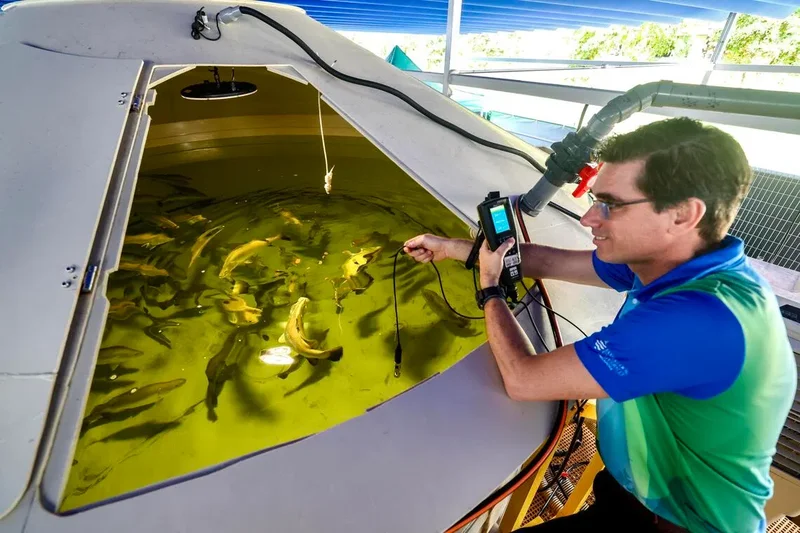
New broodstock and hatchery facility at James Cook University aims to produce better Asian seabass
SINGAPORE – James Cook University (JCU) launched a new broodstock and hatchery facility on July 31 for research, and teach its students to produce high-quality Asian seabass.
It is the first university-based facility of its kind for Asian seabass, also known as barramundi, said the university.
Students will get experience in managing breeding fish, spawning, running hatcheries, rearing larvae and optimising diet, while monitoring the different steps in the process.
Professor Dean Jerry, director at JCU’s Tropical Futures Institute, said that the facility allows the students and researchers to have control over the aquaculture production from the start — from managing the breeding fish to spawning to rearing the larvae.
“If we want to train students and develop the next generation of practitioners, they need easy and reliable access to the teaching resources,” he said. “(This facility) allows us to provide hands-on research and train in all those elements. At the moment, it’s almost not feasible for any other institution to have access to that sort of control in Singapore.”
Practical skills are becoming more important across the aquaculture industry, and employers require graduates who can apply scientific knowledge in real production environments, said JCU.
Other tertiary institutions such as Republic Polytechnic and Temasek Polytechnic also house labs for research in aquaculture.
Jerry said that the species was selected as it is one of the region’s most commercially important marine fish species and a popular food fish in Singapore.
Widely farmed across Singapore, South-east Asia and Australia, the Asian seabass also makes an ideal model species for research and training relevant to the industry and region, he added.
Before this JCU facility, the university had another research that housed only eggs, larvae and fingerlings but not breeding fish. Eggs were sourced from external vendors.
With the new 240 sq m facility. which started operating since May, students and researchers can breed Asian seabass with known parentage and genetics under carefully controlled conditions.
This allows them to carry out selective breeding to research and produce fish that not only can grow at a faster rate but which are also healthier and more resistant to diseases, such as the scale drop disease virus, which has a high mortality rate, said Jerry. This can reduce costs and risks of production, he added.
Currently, the facility houses about 50 breeding fishes weighing from 3kg to 8kg and can produce up to three million eggs and up to 500,000 fingerlings a month, said Professor Jose Domingos, deputy director at JCU’s Tropical Futures Institute.
The breeding fishes are housed in two 25-tonne tanks with recirculating aquaculture system - which is a land-based method that continuously filters and reuses water in a controlled environment so that temperature, water quality and biosecurity can be closely managed regardless of the climate outside.
The water temperatures and the tank lighting can also be toggled to simulate the natural environment of these fishes and maintain one that is optimal for breeding.
It also has six 2-tonne of RAS tanks that will be used as nursery to house fingerlings.
The facility – which was developed by JCU with funding support from the Singapore Food Agency – will also contribute to Singapore’s food resilience by supporting research that improves the sustainability and productivity of local aquaculture.
For example, it will study the reproductive biology of Asian seabass, including ways to slow or better manage their natural sex change from male to female, said Jerry.
Asian seabass are sex-changing fish that start life as males and later transition into females. However, Jerry noted that research shows seabass in Singapore undergo this transition earlier than in other regions such as Australia.
This earlier shift affects breeding programmes as it reduces the number of mature males available for spawning, he added.
Jerry added that the facility may look into breeding other fish species in the future depending on industry needs.