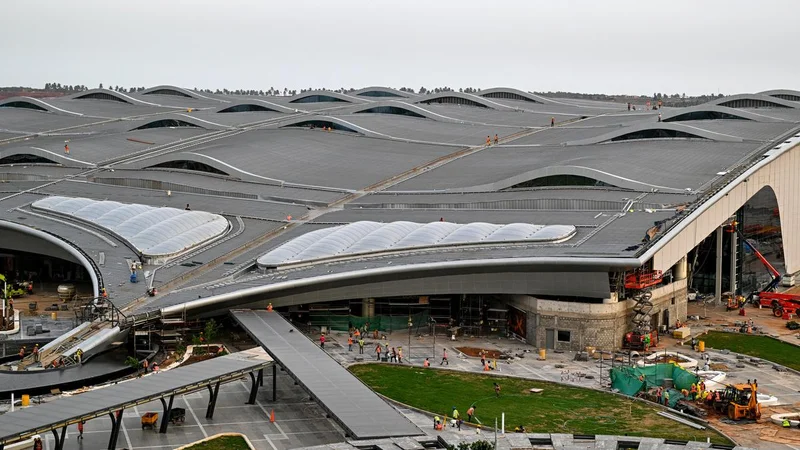
Exactly at 11 a.m. on Saturday (August 1, 2026), Andhra Pradesh will turn a new leaf in its post-bifurcation history. Prime Minister Narendra Modi, accompanied by Chief Minister N. Chandrababu Naidu, Union Civil Aviation Minister K. Rammohan Naidu, Governor S. Abdul Nazeer and others, will inaugurate the Alluri Sitarama Raju International Airport at Bhogapuram in Vizianagaram district.
The airport is the first international airport to be developed in Andhra Pradesh after the State’s bifurcation in 2014. Built to global standards by GMR Visakhapatnam International Airport Limited (GVIAL), a subsidiary of the GMR Group, it has come up on more than 2,200 acres, with nearly 500 acres earmarked for future expansion. The project, costing more than ₹4,700 crore, has been developed under the Public-Private Partnership (PPP) model on a Design, Build, Finance, Operate and Transfer (DBFOT) basis.
While the airport will be inaugurated on August 1, commercial operations are expected to begin on August 17, when the existing Visakhapatnam Airport at INS Dega will cease civilian operations.
Why Bhogapuram?
The existing airport at INS Dega is a civil enclave within the Indian Navy’s airbase. Civilian operations are constrained by military priorities, limiting flight slots, round-the-clock operations and the handling of larger aircraft.
More importantly, the airport has little room for expansion, being hemmed in by defence land and urban development. There is virtually no scope for extending the runway, building larger terminals or creating additional aircraft parking bays.
A new greenfield airport, therefore, became essential not only to meet growing aviation demand but also to support the overall economic development of north coastal Andhra Pradesh.
Bhogapuram was chosen because it is strategically located, serving the three north coastal districts of Visakhapatnam (45 km), Vizianagaram (20 km) and Srikakulam (60 km). The site is adjacent to National Highway 16, the Chennai-Kolkata corridor, offering seamless connectivity for passengers and cargo while complementing industrial and export corridors. Equally important, it has ample land available for future expansion.
There was another compelling reason. The Ministry of Defence has long envisioned INS Dega as a full-fledged naval air station. It already hosts several frontline squadrons operating Dornier maritime surveillance aircraft, Chetak and Dhruv helicopters, Kamov Ka-28 anti-submarine warfare helicopters, Sea King helicopters and Hawk Advanced Jet Trainers. In the future, the base is expected to play a larger role in supporting aircraft carrier INS Vikrant and operations involving MiG-29K fighters and MH-60R Seahawk helicopters.
Huge scope for expansion
GMR plans to develop an aerotropolis around the airport. In its first phase, the airport can handle around six million passengers annually, with the capacity to expand to 40 million passengers in the future.
Its 3,800-metre Code E runway is capable of handling wide-body aircraft, including the Boeing 777, Boeing 787 Dreamliner, Airbus A350 and Airbus A330. A full-length parallel taxiway has been provided for efficient aircraft movement.
The runway is equipped with a CAT I Instrument Landing System (ILS) and advanced LED airfield lighting. The airport also features an upgraded Airport Operations Control Centre (AOCC) integrating artificial intelligence. Its extensive glass façade has been designed to withstand cyclonic winds of up to 275 kmph.
Apart from the initial estimated traffic of six million passengers annually, the airport is expected to improve domestic and international travel, boost tourism, attract investment and support business expansion. Its dedicated cargo terminal, equipped with cold-chain facilities, will facilitate exports of seafood, pharmaceuticals, agricultural products and manufactured goods, enhancing the State’s global trade competitiveness.
The journey so far
The airport’s journey from concept to completion has spanned more than a decade. The project was conceived by the N. Chandrababu Naidu government after the bifurcation of Andhra Pradesh in 2014.
Following statutory clearances, GMR emerged as the successful bidder in February 2019. In June 2020, the Y.S. Jagan Mohan Reddy government signed the concession agreement with GMR. The foundation stone was laid in May 2023 after major approvals had been secured.
Construction gathered momentum between 2024 and 2026, leading to the airport’s completion. Its inauguration under Chief Minister N. Chandrababu Naidu marks not just the commissioning of a new airport but also a major infrastructure milestone in Andhra Pradesh’s growth and global connectivity.
Published - July 31, 2026 04:13 pm IST