The various Iran war live feeds were quiet today, but short-lived lower temperatures are misleading. The Saudis are still refusing to consider Ansar Allah demands for ending the conflict and are attempting what Erin Brokovich would call a lame-assed show of force, via a coalition of the weaklings. Note the US falls in that category by being repeatedly unable to subdue Ansar Allah. Egypt has still not assigned responsibility for a drone attack on an American-owned LNG platform. Iran has cleared its throat and depicted it as an Israel false flag. If so, this would hardly be the first instance; the Saudis among others have been on the receiving end of similar capers.
We’ll soon turn to an important new talk by Ted Postol with Daniel Davis, where Postol assesses certain Iranian missiles as more potent than even Russia’s Oreshnik. Postal also dismissed US claim that it has new bombing tricks up its sleeve.
On the economic front, oil eased a bit even though Lloyd’s is taking an even dimmer view of war risk in the Red Sea than it did a few days ago.
First to kinetic and related informational warfare matters. Aljazeera’s Iran war live feed: shows things are relatively quiet for now:
- Iran’s Islamic Revolutionary Guard Corps (IRGC) says it targeted a US base in Kuwait in response to US attacks on Iran on Thursday.
- The US strikes included one on a building on Qeshm island, which killed a couple and their two-year-old child.
A brief detour on Kuwait: the Wall Street Journal deigned to note that it is in quite a fix since the US is considering withdrawal. From The U.S. Liberated Kuwait but Now Struggles to Protect It From Iran
The U.S. is now rethinking the scope of its footprint in the emirate, said U.S. officials familiar with the deliberations, even as Kuwaiti officials have said they still need a firm commitment of American support.
Tehran has pummeled Kuwait with hundreds of missiles and drones, targeting its power and desalination plants, international airport and Persian Gulf port, as well as cutting off its oil exports through the Strait of Hormuz. The U.S. has said American-made air defenses have shot down most of the Iranian salvos and saved countless lives. Still, the U.S. installations have drawn repeated Iranian strikes, including one in March that killed six American servicemembers in one of the deadliest attacks of the war.
Kuwait has so far weathered the strikes on its power and water supplies, drawing on reserve capacity and emergency repairs. But the conflict has underscored the danger of a sustained campaign against Kuwait’s civilian infrastructure—and the vulnerability of longstanding U.S.-Kuwaiti defense ties.
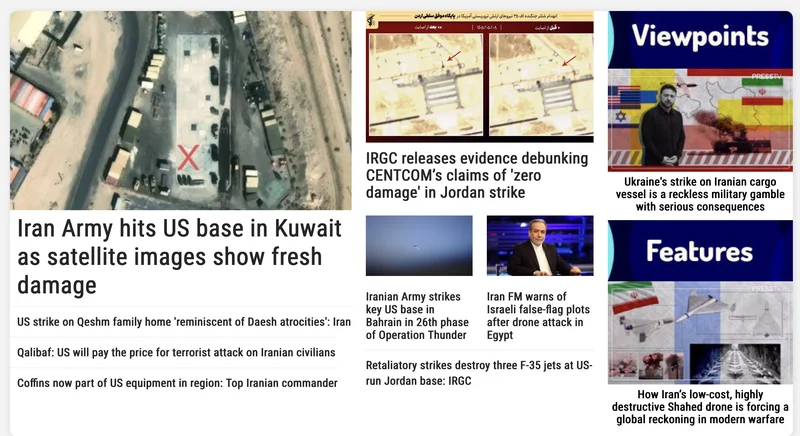
Back to a bigger picture view. Admittedly, Iran is at the epicenter of the conflict. Nevertheless, the landing page at PressTV provides the best quick tour d’horizon so far:
On the escalating Saudi-Ansar Allah conflict, Responsible Statecraft provided a primer in Houthis in YemenHouthis v. Saudi Arabia: Round 2. This time it’s regional. Frustratingly, the story uncritically takes up the Saudi claim that drones were fired on it by Iraqi militias, when not only did the Iraqis deny it but Ansar Allah was offended that they were not give credit.1 Nevertheless, key bits:
…it helps to picture the crises as a set of nesting dolls.
The innermost doll is Yemen’s own civil war: a decade-old fight between the Houthis (officially known as Ansar Allah), who rule the populous north from Sana’a, and Yemen’s internationally recognized government, formally led by a body called the Presidential Leadership Council. The roots of this war trace to the 2011 Arab Spring revolution, which toppled Yemen’s long-serving president and left a power vacuum the Houthis moved to fill, seizing Sana’a in 2014. Saudi Arabia and a coalition of partners intervened in 2015 with the explicit aim of reversing that takeover and restoring the internationally recognized government, and the war has continued in one form or another ever since.
The middle doll is Saudi Arabia’s broader rivalry with Iran, a contest for regional leadership that has run since Iran’s 1979 Islamic Revolution, when Tehran’s new theocratic government began exporting a revolutionary, Shia-inflected challenge to the Gulf’s Sunni monarchies.
Since the Houthis’ seizure of Sana’a in September 2014, Iran has absorbed the group into what it calls its “axis of resistance,” supplying it with weapons, funding and technical know-how, turning Yemen into an arena of proxy war between Tehran and Riyadh.
The outer doll is the American-Iranian war itself, now in its sixth month, which has all but closed the Strait of Hormuz and pushed oil prices to record highs. This conflict set the other two into motion.
Since March 2022, an unofficial truce kept Yemen’s civil war, the Houthi-Saudi war, and the Saudi-Iranian rivalry in Yemen quiet even as the outer dolls rattled. That calm helped pave the way for a Saudi-Iranian rapprochement in 2023. What is new, and dangerous, is that all are now moving together.
This month saw the fiercest clashes in years between Houthi fighters and government-aligned forces in the southern province of Dhale, which left dozens killed on both sides. Briefing reporters in Riyadh — where much of the official Yemeni government’s leadership operates — Yemen’s new foreign minister, Afrah al-Zouba, said, “at the end of the day, we are prepared for any escalations.” She also warned that the “Houthis want to copy the Iran experience in Hormuz.”
As we pointed out yesterday, Ansar Allah is considering imposing a tolling system.
Lloyd’s List is assisting Ansar Allah in chocking traffic by talking insurer-protective steps. From Marine underwriters extend high-risk areas after Houthi attacks on Saudi tonnage
- Range shifted 800 km north to take in Jeddah and Yanbu
- Going rate likely to emerge in next few days
- Move comes as VLCC Hormuz transit cover tops $10m
Joint War Committee decision will see more owners subject to additional premiums
Needless to say, the Saudi efforts to Do Something look inadequate to the task. From the Guardian in Saudi Arabia prepares sea and possible land offensive against Houthis:
Saudi Arabia is preparing for a major military offensive against the Houthis by sea and possibly by land in central Yemen, Yemeni sources believe, in a move to break the chokehold on its oil exports through the southern Red Sea.
Saudi forces have been seen withdrawing from the east of Yemen in what could be preparation for a land offensive. At the same time, Riyadh is trying to organise a naval coalition to protect shipping from Houthi attacks in the Red Sea and the Bab al-Mandab strait.
The Saudi defence ministry said on Thursday that 14 states including Turkey, Pakistan, Egypt, Sudan and Djibouti had issued a joint statement supporting a multinational maritime defence coalition.
The UAE has yet to sign up.
This pathetic effort fails Stalin’s “How many divisions does the Vatican have?” test. As As Larry Johnson said to Nima, “This is a bit of a joke.”
Note that PressTV had tried to link the Iran attack on Jordan that broke the pause by also discussing the US again trying to get ships through the Strait of Hormuz in the same article but did not go as far as depicting that action as the basis for the new strikes. There may have been more than one score to settle:
According to Iranian media, five IRGC instructors were killed in American-Saudi joint airstrikes against Iraq last night.
That's likely what prompted Iran to launch the "surprise missile attack" against Jordan. pic.twitter.com/edb2FUNSkV
— MoloMonitor 🇮🇹 (@MoloWarMonitor) July 29, 2026
Nevertheless, the hopium is strong:
This isn’t the final number yet. The U.S. is deciding how they will join, and the Europeans are waiting for that decision. Unlike the Strait of Hormuz, the Bab-el-Mandeb strait affects European commerce much more.
As I wrote days ago, the escalating is on the way and involving… https://t.co/oUqgWC1aC1
— Patricia Marins (@pati_marins64) July 31, 2026
Now to the important discussion by Ted Postol of the potency of Iran’s Al Fatah versus limited US means. Postol gives a very good overview of how traditional ballistic missiles work versus ones that can change their flight path in the terminal phase, so his entire presentation is very much worth a listen. Even so, certain parts were noteworthy.
From a lightly edited machine transcript:
Postol: I would say that they probably have a few tens of meters of accuracy at the target, which is very good, especially when you’re delivering a warhead. The warhead, I’ll show you delivers the equivalent of about a 4,000 or 5,000 lb explosive at the target.
That’s an enormous explosive charge. And most of the power of that explosive of that explosion comes from the kinetic energy of impact. In other words, this thing hits the ground so fast that it just vaporizes.It’s much it’s well beyond, you know, for example, it’s traveling at a speed well beyond that of the Oreshnik munitions.
Davis: Wow
Postol: [Oreshnik missiles] Are hitting the ground at maybe 3 kilometers per second. This thing is hitting the ground at over four kilometers per second.
Now 3 kilometers/s gives you the equivalent kinetic energy of gives you the equivalent explosive energy of the weight of the munition uh in TNT. In other words, all of this this is not explosion explosion from uh uh explosive materials. It’s an explosion from all of this kinetic energy being nearly instantaneously converted uh to kinetic energy from you know the the war the piece of material that hits the ground gets compressed so fast by the interaction with the ground that it superheats to 5,000 6,000 degrees Kelvin temperature of the sun surface and that expands violently outward like an explosion. It is an explosion.
Now, when it hits at 4 km/s, that’s 4 km divide by 3 km/s. So, it’s maybe say it’s one and a half or 1.6. Um, you square that and that gives you the rough equivalent energy in TNT of hitting the ground at a little bit over four kilometers/s, which is about two and a half when you do the arithmetic carefully.
So the weight of the warhead is 1,000 kilograms. So it’s say it’s 2,000 pounds.
You get a a factor. So 2,000 lbs of just non explosive material compressed turned into kinetic energy into an explosion by kinetic energy impact. So that brings you up to 5,000 pounds of explosive power. Plus, you have a couple of thousand pounds of explosive material in the warhead. So, this thing has the power of a 5,000 or 6,000 pound explosive when it hits the ground. And it does tremendous damage….
You can see that in the back of this warhead, it has a rocket motor. See the rocket motor is in the forefront and that rocket motor is able to generate a couple of thousand pounds of thrust over time intervals of 30 seconds, 40 seconds, you know, no problem at all.
So, so that’s during the entire time of re-entry. Now, if we go to slide six, we can actually see this is one of these warheads arriving in Israel. That long bright plume, the front. You can’t see the warhead, but that long bright plume is the rocket motor exhaust. So, it is accelerating this warhead to enormous speeds. And when that warhead hits the ground, it um it delivers a tremendous explosive force.
You can see the whole sky is lit up from the light. That’s the light generated by this enormously high temperatures in the generated by the kinetic energy and the explosion. That’s like four or 5,000 pounds of explosion explosive energy being instantaneously released. And if you look in the next slide, we can even see a powerful shock wave.
You can see um an an intense shock wave.
You know, this is really an intense explosion to have a visible shock wave generated by the explosion.
And some odds and ends:
Big if true:
1 I could spend all day cleaning up nonsense like this. Sloppiness and abject misrepresentations are widespread, particularly on podcasts.