For decades, the defense industry has been dominated by a small number of established contractors building increasingly complex and expensive systems through procurement programs that often take years, or even decades, to deliver.
But there is a new wave of startups hoping to challenge incumbents with a tech industry mindset that looks to move with speed, innovation, and of course, AI.
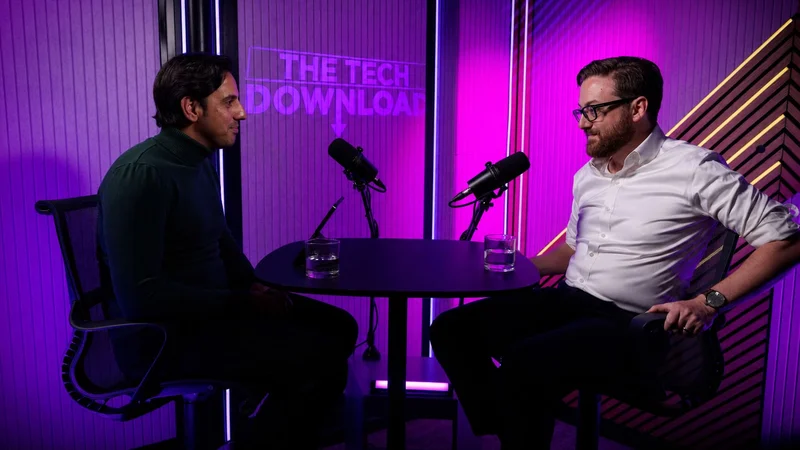
One of those companies is Anduril. CEO Brian Schimpf joined me on the latest episode of The Tech Download. We covered a lot of ground, from how the company operates to the growing conversation around tech sovereignty. And of course, the name of the company Anduril, which if you're a Lord of the Rings fan, you'll know about. If not, then make sure to listen to find out.
There were a few topics that stood out. The first regards autonomous weapons, which Anduril is making. Readers may be picturing weapons that are acting by themselves, out of human control. Schimpf is clear that this is not the goal.
"Nobody wants the insane version of this. Like, nobody in the military is talking about it. Nobody thinks it's a good idea," he said.
The reality, the Anduril CEO said, is that autonomous weapons already exist. He cited torpedoes and anti-radiation missiles that can identify and engage specific target signatures without a human making every micro-decision.
The counter view of not having AI in weapons is "just a deeply unethical view, where you're saying, oh, actually, we should have dumber weapons," Schimpf added.
"That seems like a strictly worse world to live in."
He made clear that there needs to be human involvement and that AI is intended to enable people to make better decisions.
"The fundamental thing is we have principles around how we think this should work ... which is very much around human supervision of decision making," Schimpf said.
Anduril is also trying to shake-up its manufacturing processes. Schimpf's thesis is that defense companies should own more of the design process, leverage commercial supply chains, and manufacture at tech-industry speed — rather than relying on the slow, specialized supplier networks that have traditionally characterized the sector.
I'll use a slightly crude example, which is Apple. The Cupertino giant owns a lot of its own processes, from the design of the device to the chips that go inside it. It also designs its own software. This is comparable with what Anduril is doing.
Anduril has signed a deal with the Pentagon to supply it with 1,000 missiles, which will effectively require ramping up production from practically nothing.
"The amount that we're producing very, very quickly is, I think, enabled by the fact that we've thought about the scalability of supply chain so much," Schimpf said.
I hope you enjoy the episode. Let me know what you think.
Earnings season has brought mixed fortune for megacap tech stocks, with Apple, Amazon, Meta and Microsoft among those filing.
China threatens retaliation against U.S. humanoid robot ban, saying it 'severely damages' relations.
Elon Musk's xAI sued Minnesota Attorney General Keith Ellison to challenge a law that would ban so-called nudify apps in the state.
EBay and several former executives have agreed to pay nearly $56 million in a settlement with a Massachusetts couple who were the target of a bizarre harassment and stalking scheme.
OpenAI is in discussions with Nvidia about a backstop of up to $250 billion that would help fund its ambitious plans to lease a massive new AI data center.
Topsy turvy doesn't do justice to the swing in fortunes of the biggest chip companies over the past few days.
The start of the week saw 20 of the world's most valuable semiconductor stocks lose $1.3 trillion of market value.
"Simply put, it's loss of confidence," Michael Field, chief equity strategist at Morningstar, told CNBC on Wednesday. But, he added, there was still "upside" in many AI stocks.
Investors cottoned on later in the week.
South Korea's chip heavyweights SK Hynix and Samsung Electronics — which both lost over $100 billion each on Monday and Tuesday — skyrocketed in Seoul on Friday. U.S. chip stocks also rebounded after strong earnings from Microsoft and Lam Research.
The performance of South Korea's Kospi index, of which SK Hynix and Samsung make up a large proportion, over the past week (pictured above) highlights the yoyo effect very well.
It's a capricious world out there.