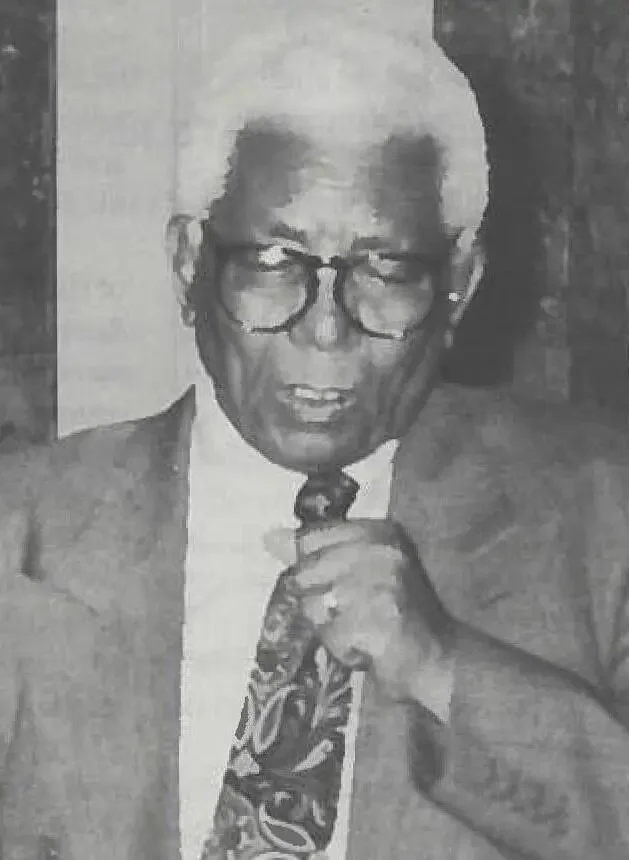
Walter Sisulu belonged to a generation that imagined democracy long before it became a reality. For him and many of his counterparts, freedom was never simply about replacing one government with another. It was about building a country where justice, equality and dignity would become part of everyday life. It was about creating a society where public service mattered more than personal gain, where leadership was measured by integrity and where every South African had the opportunity to live with dignity.
Three decades into democracy, those ideals remain central to South Africa's national story. Yet they are increasingly difficult to reconcile with the realities many people experience today. Corruption has weakened public trust. Youth unemployment remains high. Millions of South Africans continue to battle poverty and inequality despite living in a constitutional democracy that promised a better future. Political freedom has endured but social and economic justice remain out of reach for many.
It was against this backdrop that the second annual Walter Sisulu Memorial Lecture, hosted by the Vaal University of Technology in partnership with the Sisulu Foundation for Social Justice, brought together political leaders, academics, students and civil society. Delivered by former President Kgalema Motlanthe, the lecture was not simply an opportunity to remember one of South Africa's most respected liberation leaders. Instead, it became a moment of reflection on what Walter Sisulu's life still asks of a country that continues to wrestle with the promises of democracy.
The timing of the lecture added another layer to the conversation. South Africa is marking 50 years since the Soweto Uprising, 30 years since the Constitution came into effect and 80 years since the African Mine Workers' Strike. Together, these milestones remind South Africans of the struggles that shaped the country's democracy. But as Motlanthe suggested, anniversaries are not only moments for remembrance. They are opportunities to ask whether the values that inspired those struggles still shape the country's future. “The students of 1976 did not inherit a finished struggle,” Motlanthe said. “They inherited a political tradition, a language of resistance and an unfinished responsibility.”
His message challenged a common assumption that young people should simply follow in the footsteps of previous generations. Instead, he argued that every generation faces its own realities and must find its own way of advancing justice. The responsibility of today's youth is not to recreate the past but to shape the future. “The task of today's youth is not simply to express frustration but to convert frustration into organised, ethical action,” he added.
That idea of an “unfinished responsibility” became one of the defining threads of the evening. Rather than dwelling on the achievements of the liberation struggle, there was a repeated return to the unfinished work of democracy. They spoke about young people entering adulthood in a country where unemployment, poverty and inequality continue to shape everyday life. They spoke about universities that must produce not only graduates but ethical leaders. They spoke about communities where access to quality education and basic services remains uneven decades after apartheid ended. Taken together, their reflections suggested that freedom cannot only be measured by the right to vote. It must also be measured by whether democracy improves the lives of the people it was meant to serve.
Professor Khehla Ndlovu, Vice-Chancellor of the Vaal University of Technology, described the difficult realities facing many young South Africans and argued that higher education has a responsibility to prepare graduates who lead with integrity and use their knowledge to strengthen society.
Mphumzi Mdekazi, Chief Executive Officer of the Sisulu Foundation for Social Justice, took that argument further, questioning whether the country's democratic gains have translated into meaningful social and economic change for those still living on the margins. Speaking about students who go to bed hungry while trying to complete their studies, he argued that South Africa must honestly examine what democracy has achieved since 1994 and where it continues to fall short.
Former Statistician-General Dr Pali Lehohla added another dimension to the discussion, pointing to the structural inequalities that continue to define South African society. His contribution reinforced a recurring message throughout the evening that Walter Sisulu's legacy cannot be honoured through memorial lectures alone. It must be reflected in policies, institutions and leadership that place people at the centre of democracy.
Yet perhaps the evening's most thought-provoking moment came not from a statistic or a political reflection, but from a question that hung in the air long after it was asked. Programme director Carol Bouwer reflected on what she described as a growing crisis of values. Recalling the story of a man who allegedly arranged for his wife's murder shortly after arriving in South Africa, she paused before asking, “Why has it become so easy to buy us? Why does everything seem to have a price tag?”
It was a question that reached beyond one shocking story. It echoed the concerns that had surfaced throughout the evening. While speakers reflected on inequality, education, leadership and the unfinished work of democracy, Bouwer challenged the audience to think more deeply. If Walter Sisulu's life was defined by humility, sacrifice and service, what values are shaping South Africa today? More importantly, what values will shape the next generation of leaders? Turning to the students in the room, she left them with a challenge that captured the spirit of the lecture itself.
Perhaps that is why the memorial lecture resonated beyond the auditorium walls. It was never simply about looking back at Walter Sisulu's life. It was about looking honestly at the country South Africans have built and asking whether democracy has become what generations before imagined it could be. The conversation moved beyond politics and policy to something more fundamental - the kind of society South Africans are choosing to build and the values they uphold.
The lecture did not answer the question of whether South Africa has lived up to Walter Sisulu's vision. Perhaps it was never meant to. Instead, it reminded those in the room that democracy is not measured only by elections, constitutions or commemorative anniversaries. It is measured by whether people live with dignity, whether leaders serve with integrity and whether each generation leaves the country better than it found it. As South Africa reflects on its democratic journey, the question Walter Sisulu's legacy leaves behind is no longer what his generation achieved but what this generation will choose to do with the freedom it inherited.