The long road to curbing motorists' need for speed in Singapore
Despite stiffer penalties and increased enforcement, some road users in Singapore can't give up their need for speed. Can we ever solve our speeding problem, and how?
He knows speeding is illegal. But for one 24-year-old driver, steering past the law comes down to a simple excuse: "It's fun."
The university student, who has been driving a car for three years, reasoned that it is acceptable to flout the speed limit if there are fewer cars and no speeding cameras around him.
"At that point, the law is kind of a suggestion. Also, it is very normalised to speed in Singapore, so that (the two factors) might embolden people to speed," he said.
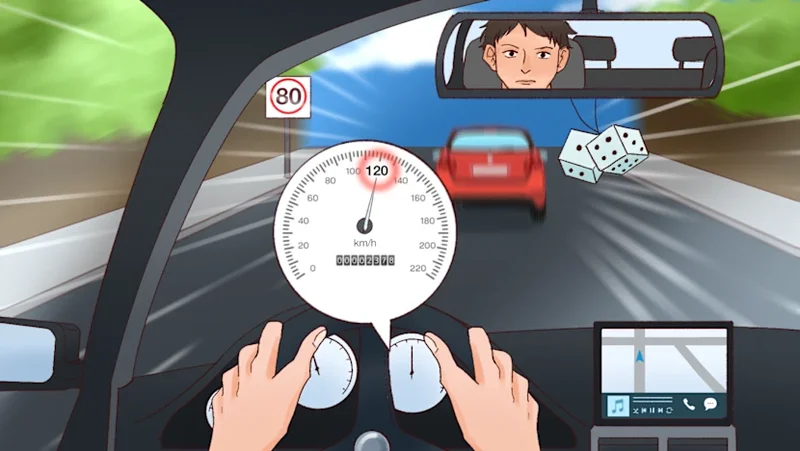
Another habitual speedster, a 31-year-old car driver, told CNA TODAY: "If the speed limit is 90kmh, I will go at least 100kmh; 110kmh is normal for me. Sometimes, I'll hit 130kmh. That is my comfortable speed."
The media professional added: "If I drive slowly, I feel like it's not safe because everyone else is speeding. I don't want to be tailgated. I feel that it is safer to be faster than slower than everyone else."
And for one motorcyclist, near-collisions with speeding cars have not dampened his own appetite for speed, going up to 20kmh above the speed limit.
"I find myself speeding on expressways more, usually to overtake cars that are road hogging on expressways," the 26-year-old data centre engineer said.
These men were among eight road users who admitted to speeding for various reasons during interviews with CNA TODAY. Choosing to remain anonymous for fear of the law, they underscored how speeding is still a deep-rooted problem in Singapore.
In 2024, the police logged 201,358 speeding violations in Singapore, the highest number in a decade. This record was broken again in 2025 with 253,550 speeding violations.
Speeding-related accidents, however, have moderated. Between 2018 and 2020, there were over 700 speeding-related accidents each year. In 2022, there were 1,138 such accidents, a peak that the Singapore Police Force's (SPF) 2022 Road Traffic Situation report attributed to increased activity on the roads following the lifting of COVID-19 restrictions.
But in 2025, speed-related accident numbers dipped to 515, even as traffic accident numbers rose overall. The number of speeding-related fatal accidents also fell 10.9 per cent from 46 cases in 2024 to 41 cases in 2025.
While the surging numbers of speeding violations partly reflect increased enforcement efforts, it's evident that Singapore has yet to stamp out its persistent speeding problem.
The issue was severe enough for the authorities to introduce stiffer penalties, including higher demerit points and fines, which kicked in on Jan 1, 2026.
Come Jan 1, 2027, motorists will also have a lower demerit-point threshold for licence suspension, the SPF said on Friday (Jul 31).
The maximum number of points a motorist can accumulate before having their license suspended will be lowered from 24 to 18. They'll also face longer suspension periods.
Experts, however, said the bigger issue in Singapore is that motorists have a cavalier attitude towards speeding.
        Related:


  Ms Bozy Lu, a lawyer and partner at Han & Lu Law Chambers LLP, said there is no single archetype of people who speed.
"Unfortunately, people who've just driven for two years speed, and so do people who've driven for many decades," said Ms Lu, who specialises in road accident claims and community law.
Weighing in on Singapore's broader culture of speeding, veteran transport engineering consultant Mr AP Gopinath Menon said a mindset shift needs to take place.
"They (drivers) have to realise that the vehicle is akin to a weapon; if not used with care, it can kill or seriously cause injury.
"The extent of any injury in the event of an accident depends on the speed of travel. This should be constantly drummed into the driver," said Mr Menon, who was formerly the chief transportation engineer at the Land Transport Authority (LTA).
THE PSYCHE OF A SPEEDSTER
While drivers in Germany may hurtle down unrestricted sections of the autobahn at 200kmh without flouting any laws, most urban areas around the world have much more conservative speed limits.
The World Bank's Guide for Safe Speeds published in 2024 recommends speed limits of 30kmh for urban roads with high pedestrian activity and 80kmh for motorways.
Several motorists said they feel that Singapore's speed limits are too low. One went as far as to say that some roads have "ridiculously low and unjustified speed limits".
However, Singapore's speed limits largely align with international standards. Most roads have a 50kmh limit while areas with vulnerable pedestrians, such as School Zones and Silver Zones, typically have a 40kmh speed limit. Speed limits on the city-state’s expressways range between 70kmh and 90kmh.
In determining road design and safety measures, each location is assessed based on factors such as pedestrian demand, vehicle speeds, traffic conditions, road geometry, visibility, ground observations and public feedback, an LTA spokesperson told CNA TODAY.
Particular attention is given to locations frequently used by children, seniors and those with mobility needs, the spokesperson added.
Just as there isn't a typical profile of a speedster, motorists' motivations for speeding are similarly hard to pin down. Beyond the innate desire for speed, external factors such as road design and the behavior of surrounding drivers also play a part.
In some cases, motorists speed unwittingly when they exit from expressways with speed limits of 80kmh or 90kmh onto major arterial roads where the speed limit is 50kmh, said Mr Menon, the transport consultant.
Professor Chin Hoong Chor, from the Department of Civil and Environmental Engineering at the National University of Singapore, agreed that this is one area in the nation's road infrastructure that can be improved.
"These transitional corridors are where many speed-related crashes tend to occur," he said. "Designing smoother transitions between higher- and lower-speed road environments may help reduce abrupt speed adjustments and the conflicts they generate."
It also helps when these areas with different speed limits are visually distinct, said Prof Chin.
"Many of these roads – particularly those in areas without a good design in road hierarchy – are somewhat visually similar, making it difficult for motorists to instinctively adapt their speeds to match the localised risk profile."
However, what is harder to fix is the pervasive casual attitude towards speeding among local motorists.
All of the eight road users CNA TODAY spoke to said they believe that they are in control of their vehicles and are still driving or riding safely despite speeding. Most travel at 10kmh to 20kmh over the speed limit; some admit to driving or riding at 130kmh regularly.
As a 21-year-old university student and freelance swim coach put it: "I am more focused (when I speed) as I know I'll be driving slightly quicker. There's more risk involved so I’m less distracted by things like phone notifications."
One common refrain among nearly all those interviewed was the perception that everyone else was speeding as well.
A 32-year-old market analyst, who commutes by motorcycle daily, admitted: "Sometimes it's embarrassing to stick to the speed limit because everyone else on the road is going 10 to 20kmh above the limit. If I stick to the limit, it feels like I'm hogging the road and in danger of being rear-ended."
Another common refrain among the speedsters was that speeding is justified when there are fewer vehicles on the road.
The market analyst expressed the belief that "if the roads are clear and it's safe, there's no reason not to speed".
However, Prof Chin warned: "Even in the absence of surrounding traffic, drivers who frequently accelerate and decelerate throughout a journey are exposed to greater cognitive and operational demands, increasing the risk of making driving errors."
Besides the normalisation of speeding, Singaporean drivers also have a culture of rushing, motorists pointed out.
The freelance swim coach confessed that he is worried about demerit points and losing his licence, but still speeds when he's in a rush.
"Singapore is a fast-paced country. We have to capitalise on time even if it's just a few minutes."
A 26-year-old university student told CNA TODAY that he speeds on his motorcycle whenever he is "super late for class".
"Everyone is impatient and always trying to rush to their destination."
WHEN SPEEDING HAS LIFE-CHANGING CONSEQUENCES
What makes such a casual attitude towards speeding particularly troubling is the irrefutable fact that collisions at higher speeds do more damage than those at lower speeds, experts said.
Consider this scenario: A driver fails to give way at a junction despite not having the right of way. The primary failure here is human error.
At lower speeds, there may be sufficient time and distance for the driver to react and brake, thereby avoiding a collision altogether. Even if a collision occurs, the impact is likely to be minor, resulting in little or no injury.
At higher speeds, however, the same driving error is far more likely to result in a collision with serious consequences.
In one grisly accident on Apr 23, 2023, a drunk driver hit a 64-year-old pedestrian with such force that the victim's body was severed into three parts. The man had been driving at a speed of between 111kmh and 122kmh along a road with a speed limit of 70kmh.
Deadly accidents can also occur at lower speeds. In one such case, a young boy who had been jaywalking was killed by a speeding driver.
Ms Lu, who is currently representing the boy's family in a compensation lawsuit against the driver, said the car was estimated to be driving well above the 50kmh speed limit, but below 100kmh.
The driver did not even realise that he had hit a pedestrian, Ms Lu said.
"Had it not been that fast, I think the boy would not have lost his life. It might have been severe injuries or fractures. I think people forget that the car is like a machine."
She added: "We've seen police reports that say that the driver didn't know what they hit. Sometimes, they think they hit an animal and it was a human. Your cognition is not catching up to your speed."
Ms Lu has also seen cases where pedestrians lose a limb or two, or their mental capacity.
These cases can upend the lives of victims and their families. Not only does it foist unexpected caregiving duties and costs on them, it can sometimes take years for the victims' compensation claims to be resolved**. **
"I think the hardest ones are really the young folks who are bedridden for the rest of their lives, and their parents who have to take care of them. These are the cases where even receiving monetary compensation cannot make up for the loss incurred," said Ms Lu.
THE THORNY ISSUE OF TACKLING SPEEDING
Taking into account income levels in Singapore, demerit points are generally a stronger deterrent than fines, experts such as Associate Professor Walter Theseira from the Singapore University of Social Sciences' School of Business and Mr Bernard Tay, chairman of the Singapore Road Safety Council, told CNA in an earlier report.
Still, increasing demerit points, as the authorities are doing, is no silver bullet. Demerit points are typically more of a deterrent for those who drive for a living, compared to those who drive for convenience, said Ms Lu.
Speeding, of course, is not unique to Singapore – it's a universal concern. Yet, several countries have made remarkable strides towards addressing it.
Finland's claim to fame, besides being the happiest country on earth, is the success of its Vision Zero policy for road safety. Between July 2024 and July 2025, the city of Helsinki saw zero traffic-related fatalities. There was, however, a fatal accident shortly after that in August 2025. Still, the milestone is still widely considered a remarkable feat.
In May, Singapore's Ministry of Home Affairs (MHA) said in response to a parliamentary question that it was studying the Vision Zero push. "The government also approaches road safety on the basis that every fatality is one too many. We will draw reference from the example in Finland, as well as others, in reducing road accidents."
Vision Zero is an extension of traffic calming methodologies established in the 1960s. These frameworks prioritise the reduction of traffic injuries, specifically targeting vehicle-pedestrian conflicts within residential areas, explained Prof Chin.
"The foundational philosophy in many European countries dictates that roads should be shared equitably by all road users rather than being dominated by motor vehicles."
Instead of relying on drivers to have the self-discipline to keep to speed limits, roads are designed to force them to slow down. In Helsinki, for example, roads were narrowed and lined with trees so motorists would instinctively pay more attention.
The city lowered speed limits to 30kmh in most residential neighbourhoods, a move backed by research indicating that reducing impact speeds from 40kmh to 30kmh decreases a pedestrian's likelihood of fatal injury by around 50 per cent. It also expanded its walking and cycling infrastructure, building an extensive network of over 1,500km of cycling paths.
Singapore, in fact, has already implemented road safety measures that are similar to the Vision Zero project, as well as other European interventions, said Prof Chin.
The foundational philosophy in many European countries dictates that roads should be shared equitably by all road users rather than being dominated by motor vehicles.
He said Singapore's newer public housing estates feature a localised adaptation of the Dutch "woonerf" concept, where roadways function exclusively as access routes for car parks and service zones. With lower speeds, this layout effectively mirrors the safety benefits of a 30kmh residential speed limit.
In the last few years, LTA has also ramped up its Friendly Streets and Silver Zones initiatives which feature widened footpaths and traffic calming measures such as road markings, as well as its car-lite push.
When asked about the success of the Friendly Streets programme, which was piloted in five towns – Ang Mo Kio, Bukit Batok West, Tampines, Toa Payoh and West Coast – LTA said it observed average vehicular speeds reducing by up to 25 per cent at the pilot sites.
"Prior to the enhancements, average speeds at these locations were above 40kmh. We have also observed more residents walking and cycling along these Friendly Streets," an LTA spokesperson said.
With the success of the pilots, the programme is expanding to more neighbourhoods. By 2030, every town in Singapore will have at least one Friendly Street.
Besides Finland, MHA and Traffic Police (TP) are also studying measures adopted in Australia and South Korea, a TP spokesperson said, but did not elaborate on what these measures were.
Experts warned, however, that simply copying measures that have worked well overseas offers no guarantee of similar results for Singapore.
Compared to Scandinavia, Singapore manages a much higher volume of motorcyclists, Prof Chin said. Motorcycle accidents typically occur not in residential areas – the primary focus of Finland's Vision Zero policy – but on higher-speed roads.
Prof Chin also cautioned against benchmarking Singapore against Scandinavian countries as they have significantly lower population and vehicular densities. Making comparisons based on indexes such as fatalities per 1,000 people does not conclusively prove that their road infrastructure is inherently safer, he said.
"Nevertheless, these nations do have a more deeply ingrained road safety culture, which we have yet to achieve."
His view was borne out in interviews with motorists, some of whom said the only thing that has ever made them reconsider speeding was getting into a close shave on the road.
A 32-year-old, who works in usability testing, recounted the time he was speeding along a highway when he nearly hit a car that had pulled over and had its lights off.
"I managed to see him from quite far away, but I was going quite fast. My heart was racing," said the driver of seven years. By the next day, however, he was back to zooming above the speed limit on expressways, and continues doing so regularly.
"It made me think twice about speeding that night. But that was about it."