It may be a habitat more fit for alligators, mosquitoes, and a banjo-strumming frog, but Georgia’s Okefenokee National Wildlife Refuge (aka the Okefenokee Swamp) is officially a UNESCO World Heritage Site. It is the 27th World Heritage Site in the United States, the first in the Peach State, and the first new natural World Heritage Site in the U.S. added in over 30 years.
North America’s largest blackwater swamp, the Okefenokee is a biodiverse wonderland. Thirty-nine fish, 37 amphibians, 64 reptiles, 234 birds, and 50 mammal species call it home.
The refuge’s 353,981 acres are also dotted with 620 species of plants. Some of those plants truly fit the definition of bizarre and beautiful. Here are five plants that you may stumble upon when visiting this newest World Heritage Site.
The pitcher plants are hungry
While most planes make their food from sunlight and water, some like pitcher plants are carnivores. Pitcher plants like the park’s famed Okefenokee giant hooded pitcher plant (Sarracenia minor var. okefenokeensis) look like something that would make Seymour and his Little Shop of Horrors proud. Most grow to about five- to 14-inches-tall and eat the swamp’s various insects.
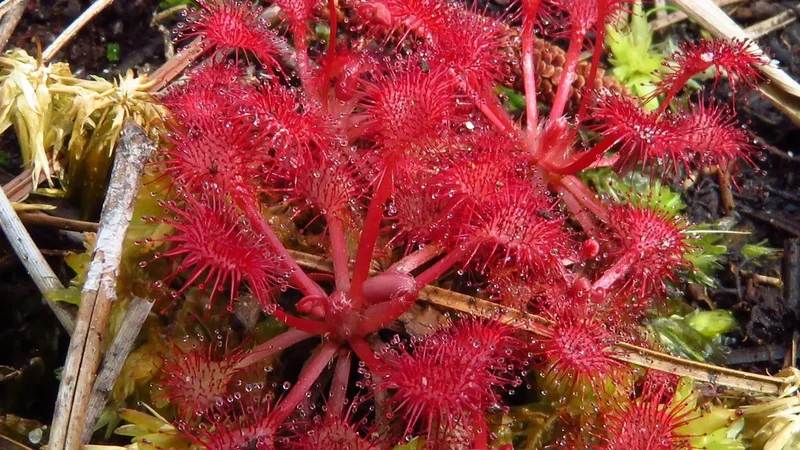
The sundews are sticky
Though smaller than the pitcher plant, sundews are just as deadly—and sticky. To lure bugs, they secrete a sticky goo into a little bowl-like structure that it uses to trap and suffocate flying insects. Once a bug is stuck in his digestive slime, the sundew snaps its leaves shut and kills and eats the insect. The red sundew (Drosera capillaris) is the Okefenokee’s best known sundew species, and they are commonly called “sticky flypaper.”
The Spanish moss is not a moss
Names can be deceiving—jumbo shrimp, Greenland, and a moss that is not technically a moss at all. Spanish moss (Tillandsia usenoides) is a flowering epiphyte, a plant that grows on other plants for support and access to sunlight. This is why it is often seen in swamps and around trees. Instead of using roots, Spanish moss uses scales to collect moisture and nutrients to make food from air, rainwater, and the debris that lands on it.
In a June 1909 issue of Popular Science, Roland M. Harper, elegantly chronicled the swamp’s natural wonders, including Spanish moss. “There the long moss (Tillandsia usneoides) drapes every tree, though it never grows as luxuriantly as in calcareous or alluvial regions in the same latitude,” he wrote.
The water has lilies
The Okefenokee is home to two main species of flowery water lilies—the American white lily (Nymphaea odorata) and yellow bonnet lily (Nuphar advena). They thrive in more shallow bodies of water, so that their stems can grow under the green pad to root in the soil below. They are also the ultimate sun worshippers. Their flower petals open in the morning and close at night to protect their pollen.
The bladderworts are fast—really fast
Don’t let the dainty yellow petals fool you, bladderworts (genus Utricularia) are among Earth’s fastest predators. They can grab and eat insects in mere milliseconds. By one estimate, the Okefenokee’s bladderwords capture and digest at least 400,000,000,000 small aquatic animals every single year.
The name comes from the seed-like bladders it uses to trap invertebrates. When a small aquatic critter plants on it, it triggers trap doors on the bladders. The animal is then sucked inside and digested by the plant’s digestive enzymes.