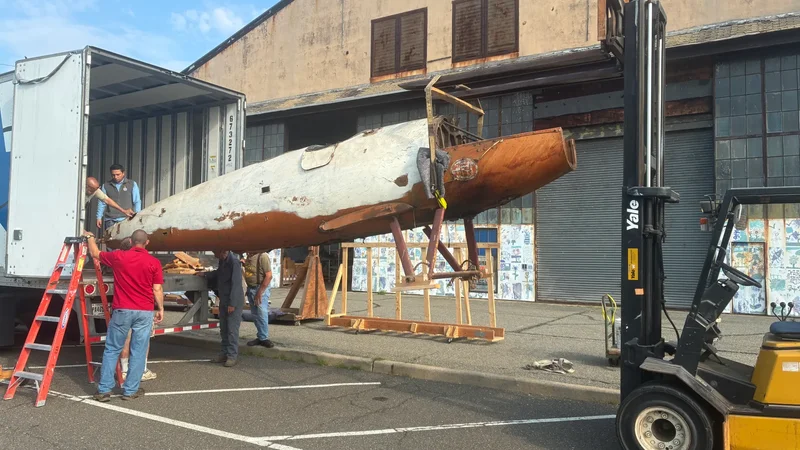
A rare, post-World War I biplane that may have been one of the first aircraft to survey South America has made it back to its hometown after more than a century. This three-seater, Curtiss Oriole is currently in pieces and can’t fly, but restorers at the Cradle of Aviation Museum in Garden City, New York are getting ready to give it some much-needed tender love and care to bring it back to its former glory.
“We’re really excited to have it,” Cradle of Aviation Restoration Manager Peter Truesdell tells Popular Science. “We’ve been looking for one of these things for years and there just aren’t very many to be had.”
A long-forgotten bridge between military and civilian aircraft
The Oriole was the first civilian plane manufactured and sold by historic plane-maker Glenn Curtiss, who is best known for creating the Jenny biplane used in WWI. Born in 1878, Curtiss’ obsession began with speed working on motorcycle engines. In 1907, he designed one of the first air-cooled V-8 engines. He strapped that small beast to a motorcycle and tested it at the Florida Speed Carnival, clocking a track time that would briefly earn him the moniker “the fastest man on Earth.”
Those powerful motorcycle engines would eventually go on to serve as the backbone for early biplanes. The U.S. Army bought up as many of his Jenny planes as they could to support the war effort in Europe. At one point, Curtiss’ company was reportedly manufacturing 100 Jennys per week.
Introduced in 1919, the Oriole was Curtiss’ first effort at pivoting to a more commercial, civilian market.Though interest in flying was sky-high, the Oriole was never really able to get off the ground commercially. It was an improvement over the Jenny in almost every way, but it was also much more expensive. And with so many Jenny planes suddenly no longer being used for war, many planes ended up making their way to Army surplus stores. Aviation hobbyists, researchers, and farmers often picked up one of these former Army planes rather than spend far more on an Oriole.
Even if not the most popular, the Oriole would still go on to influence many of the planes that would follow it. Its three-seat design had the pilot’s cockpit placed behind two passengers sitting side by side in seats slightly staggered to allow a bit more shoulder room. The fuselage, or body, was made of cigar-shaped laminated wood. The whole aircraft was powered first by a Curtiss OX-5 engine, and later by a 160-horsepower C-6. The Oriole was also one of the first aircraft to have an electric starter.. When in the air, the Oriole buzzed through the sky with a maximum speed of 86 miles per hour, though it tended to cruise around 70 mph.
This Oriole migrated South
Over 100 years on from its birth, Curtiss Orioles are incredibly rare. Long Island’s Cradle of Aviation Museum believes there are just three left, one of which they own as of late July 2026. It was a long time coming. Truesdell says that the museum’s curation team had been interested in acquiring one of these for the better part of 20 years.
“We’re really excited to have it,” Truesdell says. “We’ve been looking for one of these things for years and there just aren’t very many to be had.”
This particular Oriole has a globetrotting history. Truesdell says he learned that the plane was sold to someone in Argentina, who may have used it for some of the earliest aerial mapping and photography of South America. The record goes a bit dark after that, but the plane eventually made its way to a new home with a Hollywood stunt pilot. That pilot owned several of the remaining Orioles, but eventually crashed and died while filming a project, according to Truesdell. The stunt pilot’s orphaned Orioles made their way to a collector in Florida, before eventually being sold at auction.
Reviving the Oriole, with an attention to detail
Despite its age, Truesdell says their Oriole remains in shockingly good condition. Good, that is, in the eyes of a restorer. The biplane is currently in pieces, can’t fly, and has holes in the wood fuselage.
Still, Truesdell says the more important thing is that this is a “very complete plane.” Many restoration projects may begin with as little as 20 percent of the original plane. Here, Truesdell estimates they have about 90 percent.
Restoring the Oriole to its former glory will require a painstaking process that’s part art, part mechanics, and part detective work. Truesdell plans to study old photos of the plane, as well as any blueprints he can find to try and get every last part looking right and period appropriate.
The goal here isn’t to make the Oriole fly again. When it’s done, the museum, roughly 30 miles east of New York City, hopes to hang it above their cafe. And while it might be easier, and faster, to simply chuck whole parts of the plane and reimagine it from the ground up, Truesdell says that would miss the point.
“One of the goals is to save and reuse as much of the original material here as possible,” he explains. “We’re not going to replace anything we don’t have to unless it’s rotten or so badly damaged or missing.”
That attention to detail takes time and labor. When all is said and done, Truesdell says anywhere between 15 to 20 different workers may end up laying their hands on this piece of aviation history. As for how long the whole process will take, that’s hard to say, but Truesdell says somewhere around four years seems plausible.
“The Curtiss Oriole is an exceptionally rare aircraft,” Cradle of Aviation Museum Curator Josh Stoff said in a statement e-mailed to Popular Science. “Presenting it before restoration begins gives visitors a unique opportunity to follow its journey through the restoration process.”