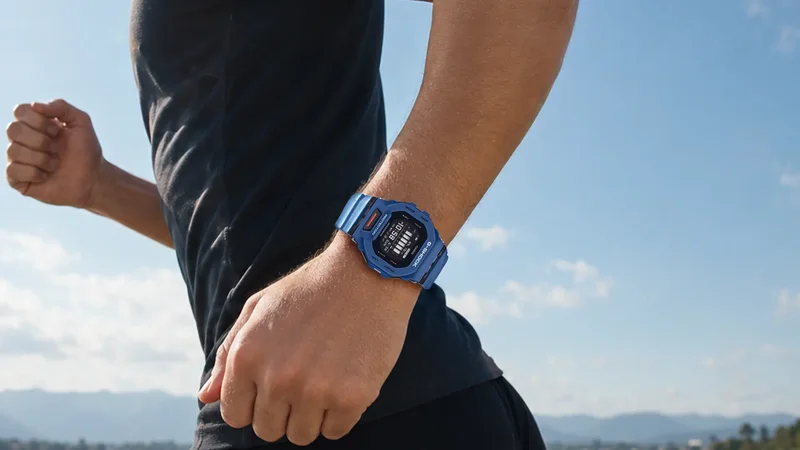
The Casio GBD-200 is the ideal hybrid smartwatch. It has replaced all of my previous wearables for my daily fitness routine.
I was never a big fan of smartwatches that try to get my attention with endless notifications and need to be charged often. That’s when I realized that I never needed a traditional smartwatch.
After some initial research, the Casio GBD-200 was exactly what I needed. It doesn’t bother me when I’m in the middle of a workout, it doesn’t need to be charged frequently like most smartwatches, and it’s a G-Shock.
I bought the GBD-200 when Google’s Fitbit Air wasn’t even a thing, and I refused to purchase a Whoop fitness band because of its subscription model.
The GBD-200 had everything I needed without the extra baggage that comes with some new smartwatches and fitness trackers.
The Casio GBD-200 is far more competent than a standard G-Shock
Tough, sleek, and distraction-free
The Casio GBD-200 is foremost a G-Shock, with the same shock-resistant build as countless other G-Shocks.
My main reason for buying it was to avoid charging the watch every few days or being bombarded with notifications from all sorts of apps, similar to a screenless fitness tracker like the Fitbit Air.
Don’t get me wrong. The GBD-200 can send basic notifications (calls and texts only), but you can turn them off from its dedicated app or from the watch.
The watch isn’t integrated with Wear OS, which makes my life even easier, as no other app can connect with the watch.
What’s cool is that the GBD-200 connects to my smartphone via Bluetooth only when it detects motion, so I only get notifications when I’m using it. But after a while, I turned those off.
It’s a clever way to conserve battery by not having Bluetooth switched on all the time and doesn’t distract me with any unwanted notifications while it is sitting idle.
My absolute favorite spec of the GBD-200 is its super-sharp Memory-in-Pixel (MIP) negative display.
Oftentimes, many smartwatches and fitness trackers have a display that isn’t as sharp or doesn’t have enough contrast, making it downright unusable under direct sunlight.
That’s one problem I’ve never faced with the GBD-200.
Thanks to the MIP display, it’s effortless for me to navigate the different menus and keep track of my workouts, no matter the time of day.
If you’re wondering why this is possible, MIP displays have a layer that reflects ambient light instead of using the internal light, making the screen highly legible in harsh direct sunlight.
And with a dedicated button for G-Shock’s iconic backlight, it’s great for evening workouts.
Is the Casio GBD-200 any good as a fitness tracker?
Short answer: Absolutely yes
Listing every feature the GBD-200 has is moot if it doesn’t excel in one important category: fitness tracking. After all, what sets the GBD-200 apart from the entire G-Shock lineup is its host of fitness features.
The GBD-200 is equipped with a six-axis motion-sensing accelerometer that is highly accurate at tracking steps, movement, calories burned, distance, and pace. Everything I need for my daily runs in the neighborhood.
To sync and track all of my fitness data on my phone, I connected the GBD-200 with Google Health Connect via the Casio Watches app.
You can easily do so by going to My Page, tapping the Hamburger Menu, selecting Link With External App > Health Connect, and tapping Allow all to sync your data.
What’s nifty is that you can see everything on the watch without navigating through menus or using a separate fitness-tracking app on your phone.
Here are some of my other favorite features:
-
**Interval Training Time Tracking**: If you prefer high-intensity interval training (HIIT), you can set up to five timing options, which you can repeat up to 20 cycles. -
**GPS Tracking**: The GBD-2000 does not have on-board GPS tracking to conserve battery life, but it can link to your smartphone’s GPS and give accurate distance and pace stats. It’s not perfect, but it gets more accurate the more you use it. -
**Lap Logging**: Tracks and stores data of up to 100 runs and up to 140 laps per run. You can track laps manually or automatically.
Besides the fitness features, the GBD-200 has water resistance of up to 200 meters, a spec I highly appreciate as I tend to sweat a lot during training, swim occasionally, and dive when I’m on vacation.
The Casio GBD-200 does not have dedicated modes for tracking swim workouts, but you can track laps manually.
Laying out all the features I like on paper makes the GBD-200 sound like the perfect hybrid smartwatch, but a few crucial features are unavailable or missing compared to modern alternatives, especially recent releases like the Fitbit Air and Garmin Cirqa.
The GBD-200 falls short when compared to Fitbit Air and Garmin Cirqa
It still lacks essential features
The most obvious feature many fitness users are looking for is a discreet, screenless tracker. The GBD-200 is neither of those.
But aside from being screenless, the GBD-200 lacks some crucial health features found on the Fitbit Air, the Garmin Cirqa, and other cheaper fitness trackers.
Some of the missing features include continuous heart rate monitoring, SpO2 monitoring, Heart Rate Variability (HRV) tracking, and alerts for Atrial Fibrillation (AFib) or irregular heart rate notifications.
Tracking vital signs is now a necessity for most smartwatches, and the GBD-200 not having it is a big disappointment, especially when it costs $165.
If you like to track your sleep cycle, that won’t be possible with the GBD-200 either.
The Garmin Cirqa has additional features like respiration rate tracking and women’s health tracking, among many others, making it a worthy screenless fitness tracker to get in 2026.
The Fitbit Air and the Garmin Cirqa also have exhaustive apps that offer coaching, daily insights such as Body Battery/Readiness, and advanced sleep tracking, which are quite important to many fitness-focused users like myself.
While the Casio GBD-200 is a great no-fuss hybrid smartwatch and perfect for G-Shock fans, it’s hard to cheer for the device when the Garmin Cirqa or the Fitbit Air has features that blow it out of the water.
I still love my Casio smartwatch, but it might be time for an upgrade
While the Casio GDB-200 is my daily driver at the moment and gets the job done, it’s hard to ignore screenless fitness trackers that can do much more.
That said, for the past three years, I didn’t need a screenless tracker, as the GDB-200 delivered a similar experience while also satisfying my need to have another G-Shock watch in my collection.
As a G-Shock fan, the GBD-200 was a no-brainer purchase as it served its exact purpose.
But as I get older, having essential features like SpO2, heart rate tracking, AI coaching, and many other new features will be essential to take my fitness routine and health tracking to the next level.
The GBD-200 will still be one of my favorite fitness trackers I’ve ever owned, but when the time comes to upgrade, switching to something like the Fitbit Air or the Garmin Cirqa will be more prudent.