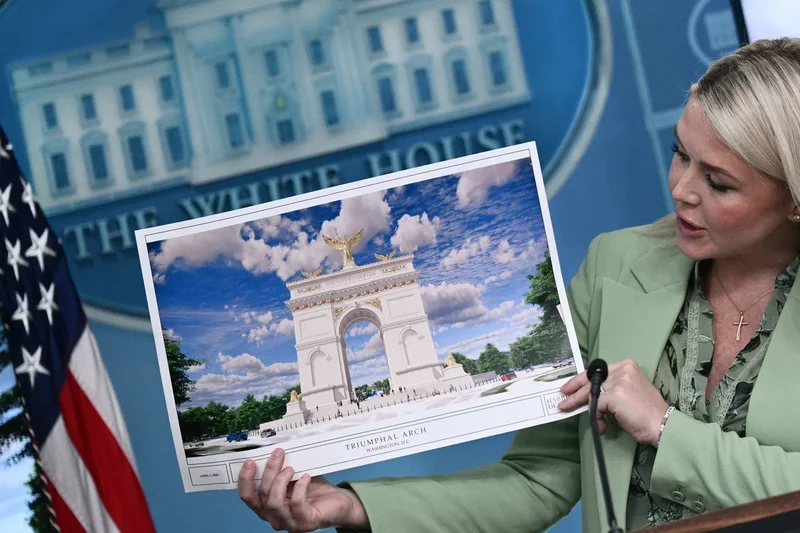
A federal agency packed with allies of President Donald Trump has given preliminary approval to new rules that could pave the way for him to put his stamp on Washington with a slew of construction projects.
The Advisory Council on Historic Preservation voted last week in favor of the rule changes, which face review by the Office of Management and Budget before being published in the Federal Register, a council spokesperson told The Independent in a statement Friday.
Trump appointed more than a third of the council's 23 members this year, including an architect who worked on his private Mar-a-Lago club in Palm Beach, Florida, and members of his administration, according to a Friday report by The New Times.
The leaders of three preservation groups that hold seats on the council told the Times they were shocked by the proposed rules when they received them by email.
“For us, it felt like a bait and switch,” said Ira Matt, an executive director at the National Association of Tribal Historic Preservation Officers.
Brent Leggs, president of the National Historic Trust for Historic Council, also said the new rules would "eviscerate the preservation of our shared civic and cultural heritage in the United States.”
In an email exchange with The Independent, council spokesperson Asley Fry declined to comment on the criticism or detail the vote count, but said the Trump administration had "directed agencies across the federal government to take decisive action toward reviewing their existing regulations."
Fry also said that the existing rules in Section 106 of the National Historic Preservation Act "were last revised in 2004 and now is an opportune time to consider revisions and updates."
A White House spokesperson referred The Independent to the Interior Department, which didn't immediately respond to an inquiry.
The proposed rules would relax Section 106, with an internal council memo saying it currently creates confusion that delays federal projects near historic sites, NPR reported last week.
The changes would narrow the definition of historic places and remove requirements that the council consult with tribal nations and solicit public comments, according to NPR.
"The public will be completely cut out of any conversation around the future of places that matter to them in this country," lawyer Greg Werkheiser of the Cultural Heritage Partners law firm told NPR.
In Washington, the rule changes could ease approval for Trump's plan for a 250-foot "triumphal arch" on Memorial Circle, a traffic roundabout that leads to the Army's Arlington National Cemetery in Virginia.
Three Vietnam War veterans are suing to block that project, with plaintiff Shaun Byrnes, 83, last week calling it a "disgusting vanity project" that would be "very disrespectful" to the soldiers buried nearby.
"The man proposing this was himself a draft dodger," Byrnes told Washington TV station WUSA, in reference to the five deferments from military service, including one for bone spurs in his heels. "That's just a slap in the face."
Trump also wants to build a National Garden of American Heroes in West Potomac Park, with 250 life-size statues of everyone from the Founding Fathers to civil rights icon Rosa Parks, rock 'n' roll icon Elvis Presley and basketball star Kobe Bryant.
It, too, is the subject of a lawsuit to block construction, with preservationists and cultural heritage organizations contending the plan violates a congressional ban on new "commemorative work" in the National Mall and surrounding area.
A third Trump construction plan, to renovate Washington's East Potomac Golf Links, is also being challenged in court.
Trump's controversial demolition of the East Wing of the White House last year isn’t covered by the rules that the Advisory Council on Historic Preservation aims to revise because the building is exempted from the law, according to the Times.
Work on a massive, gilded ballroom and bunker that would replace the East Wing has proceeded at a rapid pace during litigation over a lawsuit filed by the National Trust for Historic Preservation, with an appeals court poised to rule on a judge's finding that it required congressional approval, the Times reported Thursday.