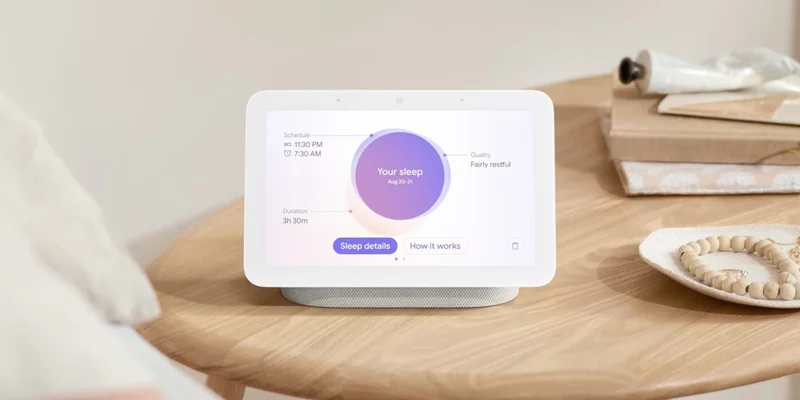
Since launch, Sleep Sensing on the 2nd-gen Nest Hub has only worked with Google Fit. With that app going away, Nest Hub sleep tracking will join Google Health.
About APK Insight: In this “APK Insight” post, we’ve decompiled the latest version of an application that Google uploaded to the Play Store. When we decompile these files (called APKs, in the case of Android apps), we’re able to see various lines of code within that hint at possible future features. Keep in mind that Google may or may not ever ship these features, and our interpretation of what they are may be imperfect. We’ll try to enable those that are closer to being finished, however, to show you how they’ll look in case that they do ship. With that in mind, read on.
As a recap, the Nest Hub uses Soli radar (or Motion Sense) to track your movement (like flailing limbs) and breathing (chest rising and falling). This results in movement graphs that are translated into sleep stages (light, deep, REM, and awake), when you fell asleep, and breathing rate.
The smart display’s microphone is also used to identify coughing and snoring, while other sensors track light fluctuations and temperature changes in your bedroom. (Google frustratingly never made that sensor available in the Home app for general usage.) All data is processed locally and does not leave the Nest Hub.
Strings in Google Home 4.23 for Android today detail “How your Nest Hub works with Google Health.” Basically, Google has updated the strings to replace mentions of Google Fit with Google Health.
- “Google Health lets you connect devices like your Nest Hub to track your sleep. If you turn this feature on, once your Nest Hub determines you’re in bed, it will track your sleep, breathing, the time of day, and the light and temperature in the room.”
- “Other services you’ve connected to Google Health may also have access to this sound events data, depending on your Google Health app settings.”
With the launch of Google Health, the company said it would “consolidate [its] health and fitness offerings.” Specifically, Google Fit users will be able to migrate data to the Health app “later this year.”
When the second-generation Nest Hub launched in 2021, Google said sleep tracking would eventually be a paid feature as part of Fitbit Premium. The company kept pushing back that integration, and it’s highly unlikely it will start charging for it now.