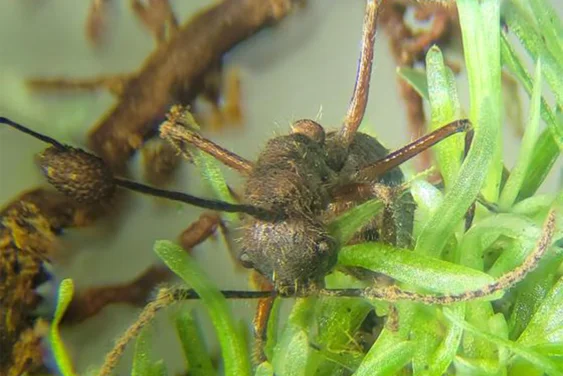
Somewhere in the Amazon right now an ant is beginning to act a little strange. Against all of its instincts, it’s leaving the safety of the colony and striking out alone. Its actions aren’t its own, it’s being puppeted by a fungus that’s invaded its brain. Soon the ant will scale a tree in search of a nice patch of moss, clamp its mandibles to the leaves in a death grip, and its puppet master will emerge from its body—a wiry stalk packed with fungal spores to infect more ants.
It’s a bizarre but common story. Across the planet, there are more than 350 species of “zombie-ant” fungi from the genus Ophiocordyceps (made famous in the video game and HBO series The Last of Us), and they don’t just infect ants. Now a study published in the journal IMA Fungus is adding a new twist to its strange life cycle.
Brazilian biologists working in the Amazon noticed that Ophiocordyceps-infected ants seemed to prefer ending their doomed ascent in patches of moss, so they took a peek inside the plants. Analyzing the DNA of the mosses, they discovered Ophiocordyceps lurking within them, too—even in plants far from any other infected insects.
Read more: “The Last of the Fungus”
In other words, this fungus that evolved to manipulate the behavior of ants was living a secret life in moss as well.
To put it mildly, these findings complicate the Ophiocordyceps story. “The well-known behavioral manipulation caused by Ophiocordyceps may not result solely from the interaction between fungus and ant, but from a complex relationship among the fungus, its host, and the plant where the same fungus lives silently as an endophyte,” study author João Paulo Machado de Araújo of the Natural History Museum of Denmark explained in a statement.
What’s it doing there?
Researchers aren’t entirely sure. Moss may also be a kind of “mating ground” where fungi can exchange genetic material, or it could be a kind of hiding spot, allowing the fungi to hang out when its other hosts are scarce. It’ll take more research to know for sure.
Finally, this isn’t the first time Ophiocordyceps has been found in flora. O. sinensis, a species that infects the larvae of ghost moths in Tibet, was discovered in a variety of plants in the Himalayas by Harvard evolutionary biologist Zhengyang Wang in 2020. You can read the fascinating story about his quest to learn more about the fungus—prized in Chinese medicine as “Himalayan Viagra”—here.
Lead image: Tales Alves-Júnior et al., 2026.