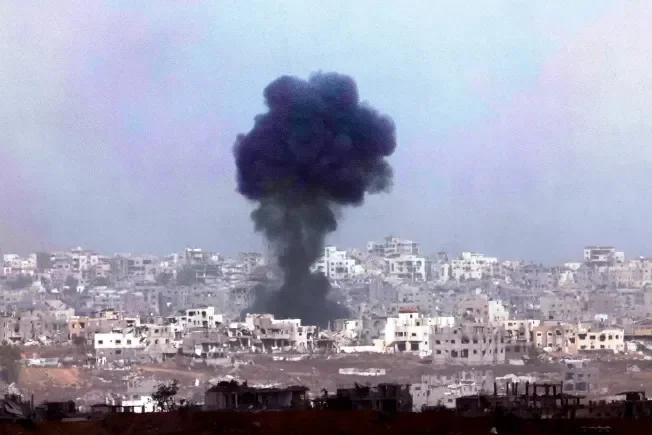
Both Hamas and Israel have given conditions for the implementation of the US-brokered disarmament agreement, which President Donald Trump said will end Israel’s genocidal war on Gaza.
Hamas, the Palestinian nationalist and Islamist movement, insists that implementation of the agreement depends on the withdrawal of Israeli troops from the Gaza Strip, Al Jazeera reports.
A senior Israeli official, on the other hand, told the BBC that its troops will not pull back in Gaza without “genuine” disarmament of Hamas.
But the US president did not specify what is to come first: Hamas disarmament or the withdrawal of Israeli troops.
| | |
|---|
PREMIUM TIMES reports that Mr Trump disclosed on Friday morning a “complete disarmament” agreement between Hamas and other armed factions in Gaza.
He said the agreement will ensure the withdrawal of Israeli troops from the strip and the creation of a “recognised” Palestinian government.
In a post on Truth Social, he described the agreement as “a monumental step” which will be implemented in structured phases that include Hamas disarmament and Israeli forces’ withdrawal from Gaza.
However, when he was asked whether Hamas’s disarmament or Israel’s withdrawal would come first, at a US cabinet meeting at Camp David, Mr Trump did not answer.
Rather, he declared that “Israel is very happy” with plans for Hamas to disarm.
Trump’s disarmament deal
The recent agreement is part of the proposed 20-point plan introduced last October. The proposal led to a temporary ceasefire, which Israel violated with near-daily attacks. Israel violated the October ceasefire at least 3,795 times from October 2025 to July 2026, according to Al Jazeera. More than 1,200 Palestinians have been killed during this period.
The latest agreement signed with Hamas is supposed to be the second phase of the deal.
Mr Trump framed the deal as a success for the Board of Peace, the body he established to oversee Gaza in the supposed aftermath of Israel’s attack, which has left at least 70,000 Palestinians dead.
“Israel will have the security it deserves, with Gaza no longer used as a base for terror attacks,” he said.
Al Jazeera reports that the agreement demanded the creation of a precise disarmament roadmap within 14 days. Possible extensions of the agreed date are subject to the approval of an international verification body and the agreement of all parties.
It also reported that the disarmament process will begin with the entry of a National Committee and the International Stabilisation Force to Gaza.
“The National Committee is expected to oversee the inventory and storage process, with the international verification committee observing, and the Palestinian factions participating,” the report read.
Mr Trump also noted that the “International Stabilisation Force will work with a new Palestinian police force to take responsibility for ensuring that Gaza is safe for its residents and its neighbours.”
**Reactions to the agreement **
World leaders have also celebrated this new agreement. UN Secretary-General António Guterres described the Gaza agreement as “the only good news in recent days”.
“Let me be clear: the fighting must stop on all fronts in the region,” he said.
Pakistani Prime Minister Shehbaz Sharif celebrated the mediating countries, including the United States of America, Egypt, Qatar, and Turkiye, “for their efforts in achieving this progress.”
“Under President Trump’s courageous leadership, this represents a significant achievement for the Board of Peace,” Mr Sharif wrote on X.
According to the Board of Peace’s high representative for Gaza, Nickolay Mladenov, negotiations for the agreement were “very difficult” and took “months.”
“There were several points when I did not believe we would make it,” he wrote on X on Friday.
“Implementation and verification have to be real,” Mladenov said. “Withdrawal must move in lockstep with decommissioning,” he added.
However, concerns remain about the effectiveness of the new deal as Israeli troops have repeatedly violated ceasefire agreements since the war started. Jerusalem has also vehemently resisted attempts by UN member states to recognise Palestinian statehood.