Director Hamaguchi Ryūsuke Explores Boundaries, Connections in “All of a Sudden”
CinemaAll of a Sudden, the latest film by Japanese director Hamaguchi Ryūsuke, recounts encounters between two women. A look at how this Cannes-recognized film, loosely inspired by correspondence between two real-life individuals, fits into Hamaguchi’s oeuvre.
Chance Encounters that Drive Drama
Films frequently depict encounters. Drama is born when individuals unaware of one another’s existence suddenly meet, providing the energy to move a story forward. Director Hamaguchi Ryūsuke is an auteur for whom chance encounters are particularly important.
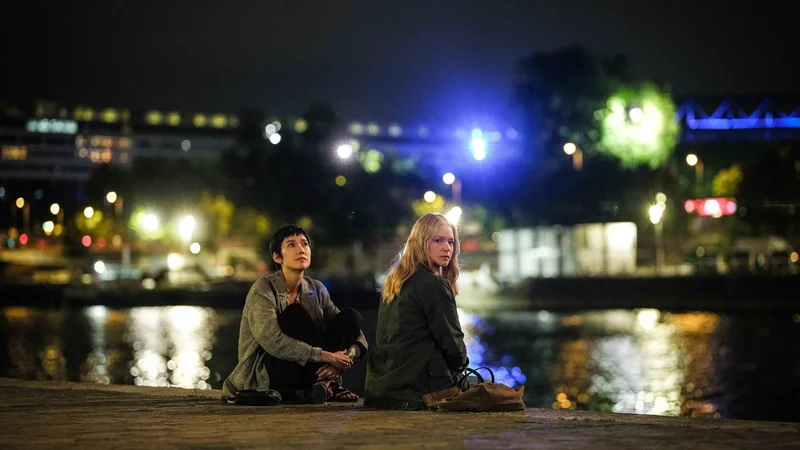
In All of a Sudden, released in French as Soudain, the story of two women who meet and forge a close relationship forms the climax of the film’s first half. An ordinary encounter would not be enough to make the story appealing. This film presents a searing experience: here, this is an encounter with a soulmate. Its two female stars, Virginie Efira and Okamoto Tao, were joint winners of the Best Actress award at the seventy-ninth annual Cannes Film Festival in May 2026.
Hamaguchi was inspired to make the film by the book Kyū ni guai ga waruku naru (A Sudden Turn for the Worse), credited as the original work in the film. Written by philosopher Miyano Makiko and medical anthropologist Isono Maho, it was published in September 2019 as a series of 20 letters exchanged by two women roughly the same age over a period of three months, beginning in April 2019 and ending just three months later. Miyano, who had been undergoing cancer treatment for eight years, passed away on July 22 at the age of 42.
Conversations on Life and the Philosophy of Contingency
In the book, the phrase that gives the film its title appears early on in the letters between the two. When Isono asks Miyano to present a talk at a workshop she has organized, Miyano tells her that “my doctor has told me that I could take a sudden turn for the worse.”
Isono knows that Miyano has stage 4 cancer, but those words upset her. She begins wondering how a risk full of uncertainty, expressed through the doctor’s words, could limit a person’s activities and change her. Nowadays we often hear expressions like “risk management” and “safety and security,” but who are those words for? Based on what she has seen or heard in her fieldwork in medical settings, Isono questions Miyano about issues concerning life and society, illness and death.
Miyano, for her part, interrogates her experience and her feelings through philosophy, her field of specialization, based on Gūzensei no mondai (The Problem of Contingency), a work by the Japanese philosopher Kuki Shūzō (1888–1941). This topic fortunately happened to coincide with Hamaguchi’s exploration of his approach to filmmaking.
The correspondence between the two scholars gradually shifts to soul-searching. Despite the profound nature of their exploration, their exchanges retain a natural feel. The two respect each other and yet are flexible in expressing their feelings and weaknesses to each other, and they derive hints from their plain, unpretentious exchanges.
The pair’s letters interpret each other’s arguments appropriately, revealing their serious side as scholars who think logically and coherently. Hamaguchi could have expressed this verbally, as his films are known for presenting somewhat standoffish conversations that suddenly go to the heart of the matter and erupt into heated discourse. But here, the correspondence steadfastly circles back to happenstance.
An Encounter between France and Japan
Some time after Hamaguchi had begun thinking of creating a film based on the book, he happened to be approached by a French production company. He immediately set about a drastic reworking of the source material, building a story of French and the Japanese protagonists. The film takes place in France and Japan, the characters emerging against a richly detailed background.
Marie-Lou, the character based on Isono, is a Frenchwoman who has studied cultural anthropology at a Japanese university. In France, she operates a seniors’ home based on a progressive concept. Mari, the character representing Miyano, is a Japanese playwright who once studied philosophy in France. The two are presented as being able to communicate in both Japanese and French.
The two happen to meet by chance in a Paris park, where Mari is distributing flyers for a play she is staging. A few days later, Marie-Lou, mulling over difficulties with the staff at her seniors’ home, decides on a whim to go and see the play, and the two meet again at the theater. Instantly on the same wavelength, after the play they talk through the night and forge a deep relationship. As Mari confesses that she could suddenly become unwell, Marie-Lou accepts the reality that Mari is facing.
Just as someone may suddenly fall ill one day, they could just as abruptly encounter their soulmate. Life is filled with innumerable possibilities, and one possibility may lead to another. Although her meeting Mari seems like a random happening, to Marie-Lou it feels like a fate-defining moment. In the same way, Mari sees Marie-Lou as the key to a new path forward. Even though they have just met, the women use each other’s presence to work their way through the problems they had been facing until then.
The Limits of Boundaries
The film, 3 hours and 16 minutes long, incorporates several elements. Although it is loosely based on the book, Hamaguchi pursued his own interest in the topic, adding depth to the work. One recurring theme in Hamaguchi’s body of work is boundaries, and All of a Sudden continues in this vein, with the issue surfacing in several parts of the film.
Communication in Japanese and in French is one aspect of that. At the seniors’ home Marie-Lou runs, there is a wall between those doing the caring and those being cared for. The film is a continual exploration of the struggles with boundaries that exist everywhere—between doctor and patient, nurse and social care worker, the healthy and the ill, the old and the young, the nondisabled and the disabled, the self and the other, life and death . . .
But it is clear that showing these dichotomies is not the point of the film. Boundaries cannot be explained away so simply. For example, the self is also “the other,” as are the ailing body or death. This theme is probed both in the book and the film. The characters, touching on the boundaries between them, try either to reinforce those barriers to protect themselves, or to go beyond them. Mari’s play also questions the boundaries between the actors and the audience.
In the film, Hamaguchi tests the ubiquitous boundaries that occur and then lingers on the scenes where those waver. The film gives audiences time to discover how the characters look at, feel, and touch each other and feel their hearts beat in unison, realizing what a marvel it is to live with others.
Back to the original book: On June 9, 2019, six weeks before passing away, Miyano, acknowledging that she was “irresponsible” for taking on work she might not be able to see through because she might die tomorrow, wrote in one of her letters: “I would be happy if someone were to continue this life of mine that will be ending prematurely.” She would no doubt have been surprised that a film director would take on the task of communicating her desire. Upon reflection, though, it is not so surprising that someone capable of committing such thoughts to paper even as she faced her final days would draw a fellow creator to her side in this miraculous encounter.
“How wonderful this world of ours is, when I see its dear beginnings,” wrote Miyano on July 1, 2019. “I love this world full of the beginnings of life with others, through fate and circumstance. That is the conclusion I have reached.”
Trailer (Japanese)
(Originally published in Japanese. All photos from the film are © 2026 Cinéfrance Studios/Arte France Cinéma/Office Shirous/Bitters End/Heimatfilm/Tarantula/Gapbusters/Same Player/Soudain
JPN Partners.)