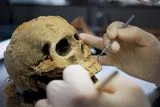
A skull fragment recovered from a hillside in central Spain may have belonged to someone young, a teenager or young adult, based on signs of ongoing bone development. The person lived during the second half of the Middle Pleistocene, in a region that has produced few human fossils from that era.
The partial parietal bone, labeled RVH-1, is the first cranial remain recovered from Ruidera, a site in Ciudad Real where researchers are piecing together the history of early humans in inland Iberia. The findings appear in the Journal of Human Evolution.
Researchers describe the bone as thick, with traits resembling those found in more archaic skulls from Europe and Africa.
"This discovery demonstrates that Ruidera has enormous potential to help us understand who the human populations that inhabited southern Europe hundreds of thousands of years ago were and how they evolved," said lead author Daniel García-Martínez in a translated press release.
Ancient Human Skull Fossil From Spain Preserves Archaic Traits
Two measurements set the bone apart: a thickness of 11.68 millimeters and an angle of 132 degrees at the temporal line. Both sit near the upper end of the range recorded for European hominins from the Middle Pleistocene.
Compared with fossils from Sima de los Huesos, another Spanish site where humans already displayed several Neanderthal-like features, RVH-1 is thicker and has a larger parietal angle. Its proportions are closer to more angular skulls from Africa and a handful of European sites, including Ceprano in Italy.
Researchers aren't ready to pin the fragment to a particular species. The measurements overlap among several ancient human groups, meaning one piece of bone cannot establish ancestry by itself. The team classified it cautiously as Homo sapiens, while noting similarities to fossils often grouped under Homo heidelbergensis.
"This discovery reinforces the idea that human evolution in Europe was not a linear process, but a complex scenario in which different populations with distinct evolutionary histories coexisted," said researcher Carlos Palancar.
Read More: Ghost DNA in Living Humans Reveals Two Unknown Ancient Human Lineages
Why the Fossil's Age Remains Uncertain
Researchers dated quartz grains taken from sediment attached to the inside of the skull fragment. Optically stimulated luminescence, a method that measures when minerals were last exposed to light, placed the sediment's burial between approximately 160,000 and 224,000 years ago.
A separate test performed on the bone itself returned a much younger number, about 18,000 years, which researchers say reflects when uranium entered the bone rather than the fossil's true age.
The luminescence range is also more than 100,000 years younger than an earlier estimate based on animal teeth from the same layer, which produced dates closer to 300,000 to 400,000 years ago.
Researchers still aren't sure why the two methods disagree. Uncertainty surrounding the fossil's burial environment may have affected the newer estimate, and the skull and animal remains may not have entered the deposit at the same time.
Ruidera May Hold More Human Fossils
Local residents first collected bone fragments from the Ruidera hillside in 2009. A team later assessed the location, but systematic excavation did not start until 2023.
The dig has since produced more than 1,000 fossils, including animal bones, stone tools, and RVH-1. The skull fragment was found attached to reddish breccia in material displaced during road construction, and researchers believe the original fossil deposit may remain a few meters farther uphill.
Additional bones could help determine whether RVH-1's ancestral-looking traits belonged to a distinct population or simply reflected normal differences between individuals.
“This fossil is just the tip of the iceberg. Ruidera still has much to reveal about human evolution in Europe, and we are convinced that it will continue to yield findings of great scientific importance," concluded researcher Sara Díaz Pérez.
Read More: A 90,000-Year-Old Skeleton May Be One of the Earliest Known Victims of a Sharp-Object Attack
Article Sources
Our writers at Discovermagazine.com use peer-reviewed studies and high-quality sources for our articles, and our editors review for scientific accuracy and editorial standards. Review the sources used below for this article:
- This article references information from a study published in the Journal ofHuman Evolution:The first human fossil from the Ruidera site (Castilla-La Mancha, Spain): A partial parietal and its implications for Middle Pleistocene hominin variability in Southern Europe